
Crabhaus

What matters in AI, and why.

Tue 3 Nov · Issue 112 · 3 min

Issue 112 · Tue 3 Nov

An LLM edited model weights by hand

01BizAnthropic's S-1 shows growth cooling to 47%
02LabsDeepMind previews its Genie 4 world model
03AgentsOpenAI rebuilt Git for Codex-scale swarms

The one that matters

Frontier LLMs can read and write raw neural network weights

New research finds GPT-6 Astra can tell what a network was trained to do from its raw weights alone, write small game-playing networks from scratch that beat 100M-step PPO training, and fix a reasoning-loop flaw in Qwen3.5-0.8B by editing 0.016% of its weights - no gradients, no training. That one edit lifts MATH-500 from 7.9% to 48.1% and triples IFEval.

Why it matters

The authors call it weight-space programming: an LLM reasons about what each part of a network should compute and writes the change directly. If it scales, weights stop being an opaque artifact of optimizers like Adam and become a surface LLMs can inspect and patch - a new lever for both interpretability and cheap model repair.
Learn one thing

Safety classifiers and moderation systems

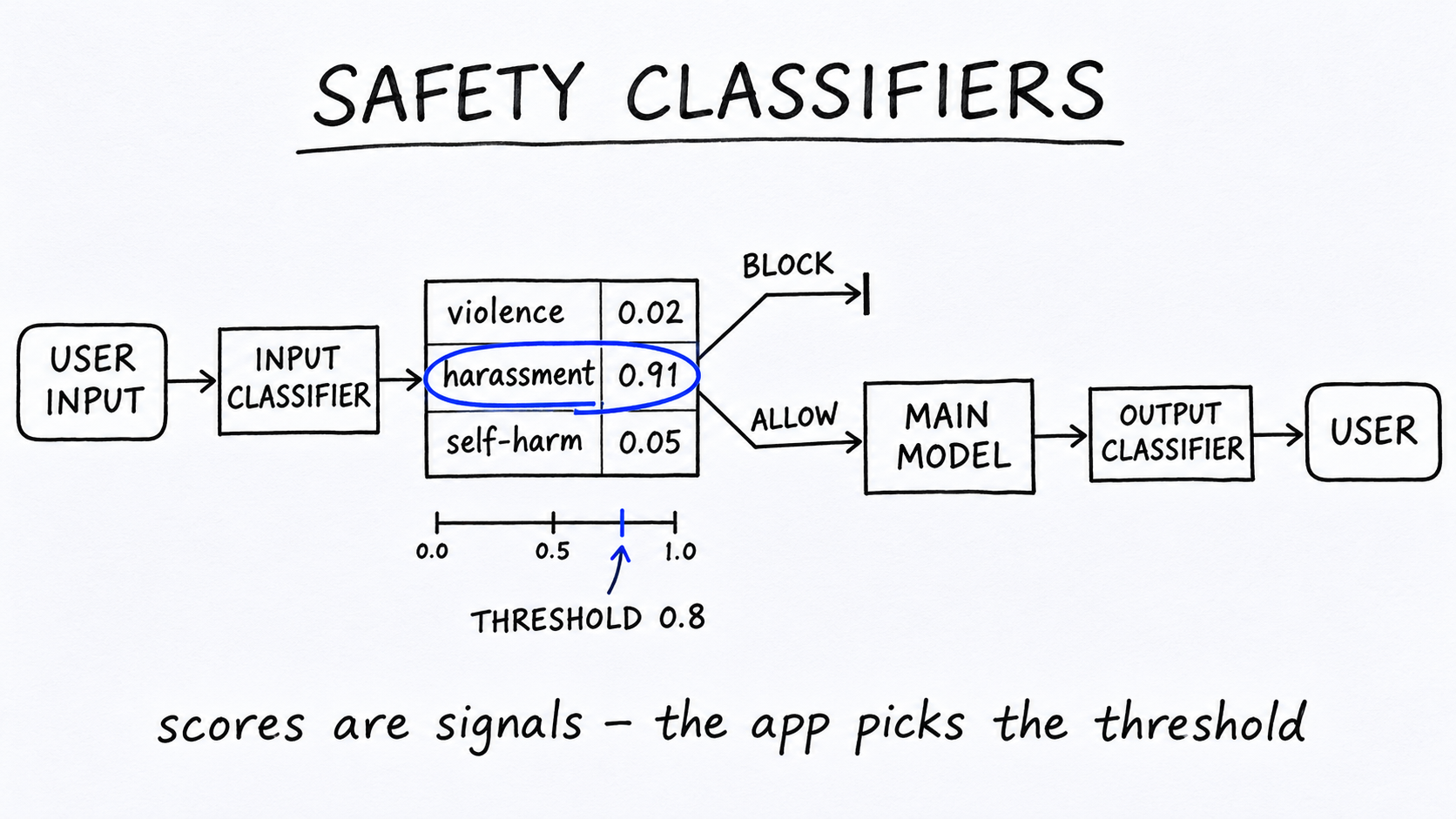
Hand-drawn diagram titled 'Safety Classifiers': user input feeds an input classifier that outputs scores (violence 0.02, harassment 0.91, self-harm 0.05), the 0.91 row circled in cobalt above a 0.8 threshold scale; arrows split into BLOCK and ALLOW, the allowed path passing the main model and an output classifier to the user; note: 'scores are signals - the app picks the threshold'.View full-size diagram ↗

What it is

A safety classifier is a separate model that scores content against policy harm categories - violence, self-harm, harassment - instead of replying. Moderation systems run one pass on what users send in and another on what the model produces; the scores feed whatever enforcement the application chooses. The classifier supplies the signal, the product decides what happens.

How it works

The classifier maps text or images to a 0-1 score plus a flag per category. OpenAI's omni-moderation endpoint screens both sides and can return scores alongside a generation. Llama Guard fine-tunes an LLM to judge against a taxonomy written in its prompt, so policies swap without retraining. Anthropic's constitutional classifiers train guards on synthetic data from a written constitution.

A concrete example

A support bot calls OpenAI's free moderation endpoint on each message. One scores 0.91 on harassment, over the app's 0.8 threshold, and is blocked before the main model sees it; a 0.45 self-harm score falls below the block line but routes to a human reviewer with a helpline template. The same code screens outputs before display.

Why it matters

Agents accept arbitrary input and produce unsupervised output; classifiers are the cheap screening layer that makes that tolerable. Thresholds are the real product decision: too low and false positives block real users, too high and harms slip through. Coverage gaps bite - omni-moderation handles text and images but not audio, so an untranscribed voice agent is unscreened.

What people get wrong: That the flag is the decision. It is a score against a fixed taxonomy: two apps can read the same 0.6 violence score and legitimately act differently. A moderation pass is also not a guarantee - OpenAI explicitly directs CSAM handling to dedicated child-safety systems, not the moderation endpoint.

Today's top 5

BizAnthropic's amended S-1 reports $17B Q3 revenue (up 1,127% YoY, slowing to 47% QoQ), a $23.29B Q3 net loss and $895B purchase commitments.

The first full pre-IPO quarter on record: staggering top line, decelerating growth, and purchase commitments that dwarf revenue.

LabsDeepMind announced Genie 4, the next generation of its Genie world model, in research preview for trusted testers before AI Ultra access.

World models are the labs' bet on agents that learn in simulation; Genie 4 moving toward a consumer tier signals productization.

AgentsOpenAI built Pando, a Git-compatible monorepo backend for Codex-scale concurrent work; median push latency fell ~5x, ~1PB served daily.

Agent swarms break tooling humans never stressed: source control built for thousands of concurrent agent pushes is new infrastructure.

ResearchRealtime-Bench tests models on 50 time-sensitive game and web tasks; frontier LLMs still struggle when delayed actions cost success.

Latency-aware acting is a blind spot in agent evals: a model that deliberates past the purchase window fails however smart it is.

BizUS agencies are rebranding AI as 'Super Intelligence' under a Trump executive order; Census Bureau data products already use the term.

Simon Willison found the rename already propagating into Census data series - terminology compliance is quietly breaking data continuity.

See the full wire feed →

Quick check

Was this issue useful?

Get Crabhaus in your inbox

A concise daily briefing on the AI developments worth understanding.