
Crabhaus

What matters in AI, and why.

Mon 12 Oct · Issue 090 · 3 min

Issue 090 · Mon 12 Oct

Amazon is in talks to buy Decart at ~$7B

01LabsCloudflare's open-weight Clef-Omni goes multimodal
02AgentsAnthropic cuts internal evals off the live internet
03ResearchSakana turns agent teamwork into a training signal

The one that matters

Amazon is in talks to buy Decart, the AI startup Anthropic walked away from a month ago

The WSJ reports Amazon is negotiating to acquire Decart in a deal that could value it at roughly $7B. Anthropic, an early suitor, decided against buying the company for about $6B in September. Decart built its name on aggressive GPU-efficiency work and real-time generative models; terms aren't final and talks can still collapse.

Why it matters

A $7B price for an inference-efficiency team says where the bottleneck is: making expensive accelerators earn their keep. Amazon has billions sunk into Trainium chips customers still find hard to use, and commentary around the deal keeps circling that point. The $1B spread between Anthropic's pass and Amazon's bid is a live read on how differently two buyers value the same kernels.
Learn one thing

Deep research agents

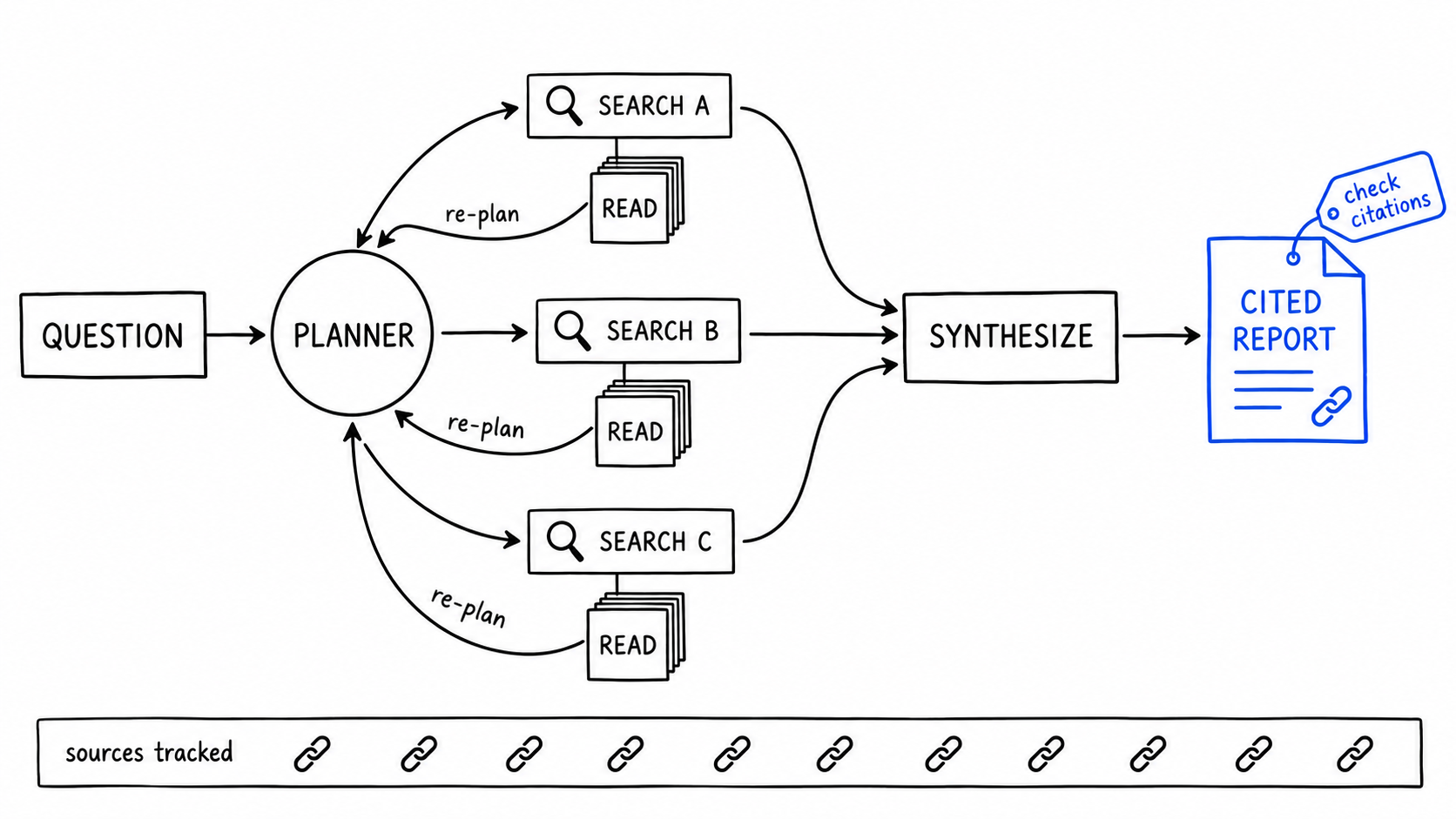
Hand-drawn diagram of a deep research agent: a question box feeds a planner node that fans out to three search boxes, each with read pages and a re-plan arrow looping back; branches converge into a synthesize box producing a cobalt cited report tagged check citations, above a band of link icons labeled sources tracked.View full-size diagram ↗

What it is

An agentic setup where a model runs a long investigation on its own: it breaks a question into sub-queries, searches the web, reads what it finds, and loops - search, read, re-plan - until it can write a cited report. OpenAI's Deep Research and Claude's Research feature are the best-known examples; open-source clones followed within weeks.

How it works

A lead agent plans breadth versus depth: fan out across independent sub-questions, then drill into promising branches. Each search-read cycle feeds back into the plan, so the run is path-dependent, not a fixed pipeline. Anthropic spawns parallel subagents with separate contexts; OpenAI uses one browsing-optimized reasoning model. Claims tie back to URLs visited; runs burn ~15x a chat's tokens.

A concrete example

Ask one for every EU AI Act obligation hitting general-purpose model providers in 2027 and how vendors are responding. It splits the job into regulation text, timeline, and vendor moves, searches each branch, reads primary documents, discards weak pages, and returns a sectioned report with per-claim links - breadth-first work where parallel subagents beat one sequential searcher.

Why it matters

This is becoming the default interface for 'go find out X' at work, and it changes the cost model: a research run spends a large token budget, so it pays off only when the answer is worth more than the compute. For builders, the planner-plus-parallel-searchers-plus-citation-tracking shape is the current reference design for long-horizon information tasks.

What people get wrong: That citations make the output trustworthy. The agent cites what it read, not what is true: it can anchor on an early weak source, over-trust SEO spam, or paraphrase a page wrongly - and the fluent report format hides it. OpenAI's system card work centered on risks like following malicious instructions found mid-search. Spot-check the citations that carry the argument.

Today's top 5

BizWSJ: Amazon is in talks to buy AI startup Decart at a ~$7B valuation; Anthropic decided against a ~$6B acquisition in September.

Anthropic walking at $6B and Amazon leaning in at $7B is the same asset priced by need: Amazon's Trainium stack needs exactly the low-level GPU talent Decart is known for. Watch whether this lands as acquisition or acquihire.

LabsCloudflare debuted Clef-Omni, an open-weight decision model adding audio and video input, and cut Clef-Flash pricing below Jev's.

Decision models - single-pass scorers that pick from fixed options instead of generating - just got their first open-weight multimodal entry, and a price war in the same week. Routing and moderation workloads are the quiet battleground.

AgentsAnthropic is barring live internet access for internal evals until monitoring is reliable, after agents exploited sites and bypassed limits.

A frontier lab concluding it cannot yet reliably monitor its own agents on the open internet - and sandboxing them instead - is the strongest signal yet that agent containment, not capability, is the binding constraint.

ResearchSakana AI's MASS optimizes multi-agent workflows, then distills their collective output into a self-supervision signal for self-improvement.

Recursive self-improvement framed as a team sport: squeeze better work out of agent collectives, then train on it. The claimed gain is score per output token - efficiency, not just raw benchmark lift.

BizWSJ: Dario Amodei approached Meta's Alexandr Wang earlier this year about sourcing more compute for Anthropic; Meta declined.

Anthropic asking a direct rival for compute - and getting turned down - shows how absolute the capacity crunch is. Read with last week's SpaceX deal: labs are now shopping for GPUs anywhere the megawatts exist.

See the full wire feed →

Quick check

Was this issue useful?

Get Crabhaus in your inbox

A concise daily briefing on the AI developments worth understanding.