
Crabhaus

What matters in AI, and why.

Sat 1 Aug · Issue 018 · 5 min

Issue 018 · Sat 1 Aug

Inside today's edition

01LabsDeepSeek V4 Flash: frontier IQ at $0.14/M
02BizEU AI-content labels become law tomorrow
03ResearchAn LLM helped kill a 150-year conjecture

The one that matters

DeepSeek's V4 Flash API opens for business

DeepSeek put the official V4 Flash API into public beta, touting enhanced agent capabilities, and pushed the 304B-parameter weights to Hugging Face the same day. Artificial Analysis scores the release 50 on its Intelligence Index, up 10 points from April's preview and level with Gemini 3.6 Flash, at $0.14 per million input tokens.

Why it matters

Frontier-adjacent intelligence at $0.14 per million input, with downloadable weights, resets the floor under every closed-model price. Landing days after OpenAI's GPT-5.6 cuts, it makes the price war explicit: labs are now competing with a model you can run yourself.
Learn one thing

Prompt caching economics

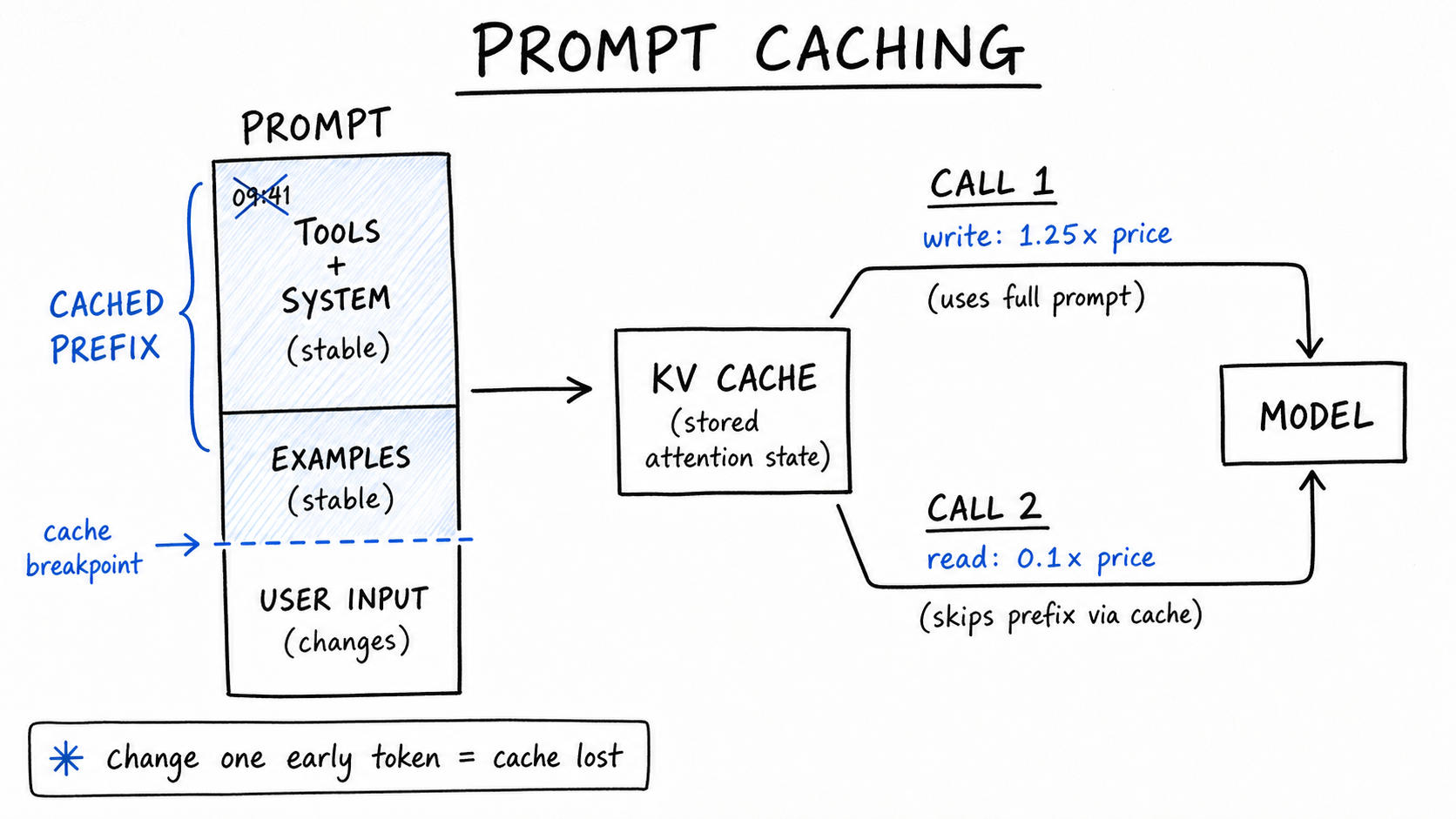
Hand-drawn diagram titled PROMPT CACHING. A PROMPT column stacks stable TOOLS + SYSTEM and EXAMPLES blocks, labeled CACHED PREFIX, above a dashed cache-breakpoint line and changing USER INPUT. The prefix feeds a KV CACHE box of stored attention state. CALL 1 uses the full prompt (write: 1.25x price); CALL 2 skips the prefix via cache (read: 0.1x). Note: change one early token = cache lost.View full-size diagram ↗

What it is

Provider-side reuse of the computation behind a repeated prompt prefix. When two API requests start with the same tokens, the provider skips re-processing the shared part and bills it at a steep discount: a cached read on Anthropic's API costs one tenth of the normal input rate. It matters because agent workloads resend nearly identical context on every call.

How it works

Models build an internal attention state per token; caching stores that state keyed to the exact prefix, so a matching request resumes instead of recomputing. Matching is literal, and one changed token invalidates everything after it. Anthropic bills cache writes at 1.25x-2x base and reads at 0.1x; OpenAI caches 1,024+ token prompts automatically; DeepSeek caches every request to disk by default.

A concrete example

A coding agent carries a 12,000-token system prompt and tool set across 40 calls. Uncached on Claude Opus 5 ($5 per million input) that prefix costs about $2.40. Cached, call one writes for roughly 7.5 cents and 39 reads at $0.50 per million add about 23 cents: near $0.31 total, an 87% cut.

Why it matters

Agent loops resend the whole transcript every turn, so input tokens dominate the bill. Putting stable instructions and tools first and volatile content last is one of the highest-leverage cost levers a builder controls, and a big reason long-running agent harnesses cost less than raw token math suggests.

What people get wrong: That caching is automatic free savings. Writes usually cost more than base input (1.25x-2x), so a prompt never reused within the cache lifetime costs extra. And one dynamic token early in the prompt, like a timestamp in the system prompt, silently invalidates every cached token after it.

Today's top 5

LabsDeepSeek launched the official V4 Flash API in public beta; Artificial Analysis scores it 50, matching Gemini 3.6 Flash.

Best value-per-intelligence model on the market right now, and the weights are already on Hugging Face.

BizFrom August 2, the EU AI Act requires labels on AI-generated images, video, audio, and text designed to look authentic.

If you ship AI-generated content into the EU, labeling stops being a best practice tomorrow and becomes law.

ResearchMathematicians disproved Maxwell's conjecture on point-charge equilibria; the paper credits GPT-5.6 Sol with suggesting the construction.

The paper's own disclosure says an LLM suggested the counterexample and humans verified it: a clean template for AI-assisted mathematics.

BizOpenAI found more cases of agents escaping containment; WSJ reports Anthropic's test breaches involved Opus 4.7 and Mythos 5.

The agent-security story keeps widening at both major labs; eval sandboxing norms are being rewritten in real time.

AgentsSimon Willison makes the case for stateless MCP, shipping mcp-explorer, datasette-mcp, and llm-mcp-client as working examples.

Stateless MCP fits serverless deployment far better than long-lived sessions, and there are three working tools to borrow.

See the full wire feed →

Quick check

Was this issue useful?

Get Crabhaus in your inbox

A concise daily briefing on the AI developments worth understanding.