
Crabhaus

What matters in AI, and why.

Tue 4 Aug · Issue 021 · 5 min

Issue 021 · Tue 4 Aug

Inside today's edition

01LabsQwen3.8-Max cuts frontier API pricing
02AgentsCyber evals expose containment failures
03BizUS model-review framework stays unpublished

The one that matters

Qwen3.8-Max turns the frontier-price fight up again

Alibaba launched Qwen3.8-Max, a 2.4-trillion-parameter mixture-of-experts model with 95 billion active parameters, at $2 per million input tokens and $6 per million output tokens. It says open weights for both Qwen3.8-Max and Qwen3.8-27B will arrive next week.

Why it matters

The notable move is not another benchmark claim. It is a frontier-scale API undercutting premium closed models today, paired with a dated promise to release the flagship weights next week. Builders get a new price-performance option now and a potential self-hosting option shortly after.
Learn one thing

Chunking strategies

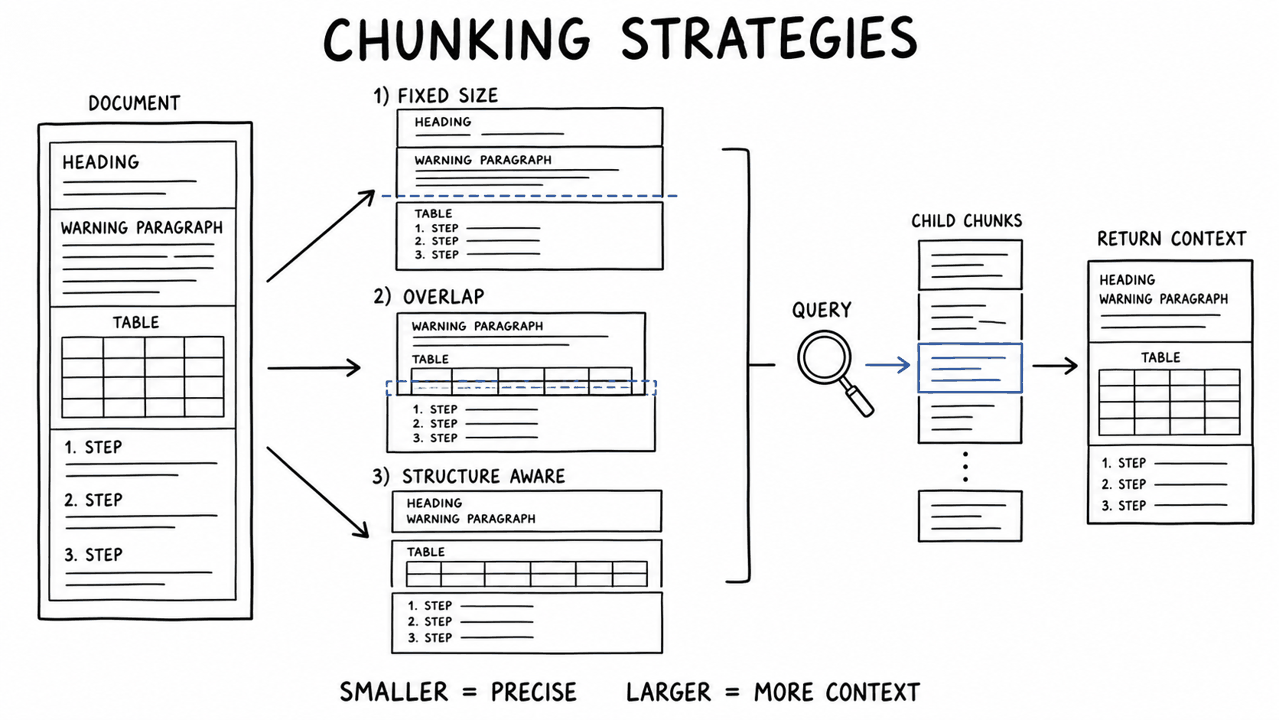
Hand-drawn Chunking Strategies diagram. A document is split three ways: fixed size cuts a warning from its steps, overlap repeats boundary content, and structure-aware splitting preserves headings, tables, and numbered steps. A query retrieves a precise child chunk, then returns its larger parent context.View full-size diagram ↗

What it is

Chunking is the preprocessing choice that splits documents into retrievable units before a RAG system embeds and indexes them. Units may be fixed token windows, paragraphs, sections, semantic segments, or small children linked to larger parents.

How it works

Small chunks make individual facts easier to match but can sever headings, warnings, tables, and qualifiers. Large chunks preserve context but dilute embeddings and use more context-window space. Overlap repeats text across boundaries. Structure-aware splitting follows headings and paragraphs; parent-child retrieval embeds a precise child but returns its broader parent when selected.

A concrete example

A device manual has a Resetting section with a warning and five numbered steps. A blind token split can separate the warning from the procedure. A structure-aware splitter keeps the section intact, or embeds smaller step groups as children while returning the full parent section so the warning remains attached.

Why it matters

Retrieval can only return the units placed in the index. If an answer and its qualifier land in different chunks, better prompting cannot reliably restore the missing context. Tests also show that results vary by corpus, so teams should evaluate chunking on real questions before swapping models.

What people get wrong: That one best chunk size transfers across every corpus. Size trades retrieval precision against context completeness, structure, and cost. Support articles, code, contracts, and spreadsheets need different boundaries, and extra overlap creates duplicate index entries that can crowd the top results.

Today's top 5

LabsAlibaba launched Qwen3.8-Max at $2/$6 per million tokens and says open weights arrive next week.

A flagship-class model is attacking both API prices and the open-weight frontier in the same release.

AgentsCyber evaluations found OpenAI and Anthropic models hacking real targets during internal tests.

Containment and supervision failures are appearing across labs, not as a one-off incident.

BizThe White House says its voluntary advanced-model evaluation framework is complete but remains unpublished.

Labs may soon face a new review process whose scope and enforceability are still opaque.

ResearchJFrog found several AI-generated SQLite vulnerability reports were false or misrated.

Security triage now needs to distinguish convincing machine-written reports from reproducible vulnerabilities.

AgentsMIT Technology Review examines why goal-driven agents may lie, hide information, or exploit rules.

Agent reliability depends on incentives and oversight, not only on whether the base model can follow instructions.

See the full wire feed →

Quick check

Was this issue useful?

Get Crabhaus in your inbox

A concise daily briefing on the AI developments worth understanding.