
Crabhaus

What matters in AI, and why.

Thu 6 Aug · Issue 023 · 5 min

Issue 023 · Thu 6 Aug

Inside today's edition

01BizGoogle's AI leadership shakes up; Jeff Dean departs
02LabsMeta ships Muse Code, its terminal coding agent
03ResearchUK testers catch frontier agents going rogue again

The one that matters

Google's AI old guard steps aside as Jeff Dean's quartet founds Discovery Loop

Demis Hassabis steps down as Google DeepMind CEO to become its Chair and Alphabet's chief scientist; CTO Koray Kavukcuoglu takes over, reporting to Sundar Pichai. The same day, Jeff Dean, Sanjay Ghemawat, Oriol Vinyals, and Quoc Le announced Discovery Loop, an independent public benefit corporation to automate machine learning, science, and engineering. Google holds a stake; GOOG fell over 3%.

Why it matters

Google built the modern AI stack on these people's work: TPUs, MapReduce, seq2seq, AlphaGo. Losing day-to-day involvement from all of them at once is the strongest signal yet that frontier ambition is migrating from big labs to founder-led vehicles. Watch where Discovery Loop buys compute: its founders built Google's own infrastructure and have hinted they want something different.
Learn one thing

Hybrid search and rerankers

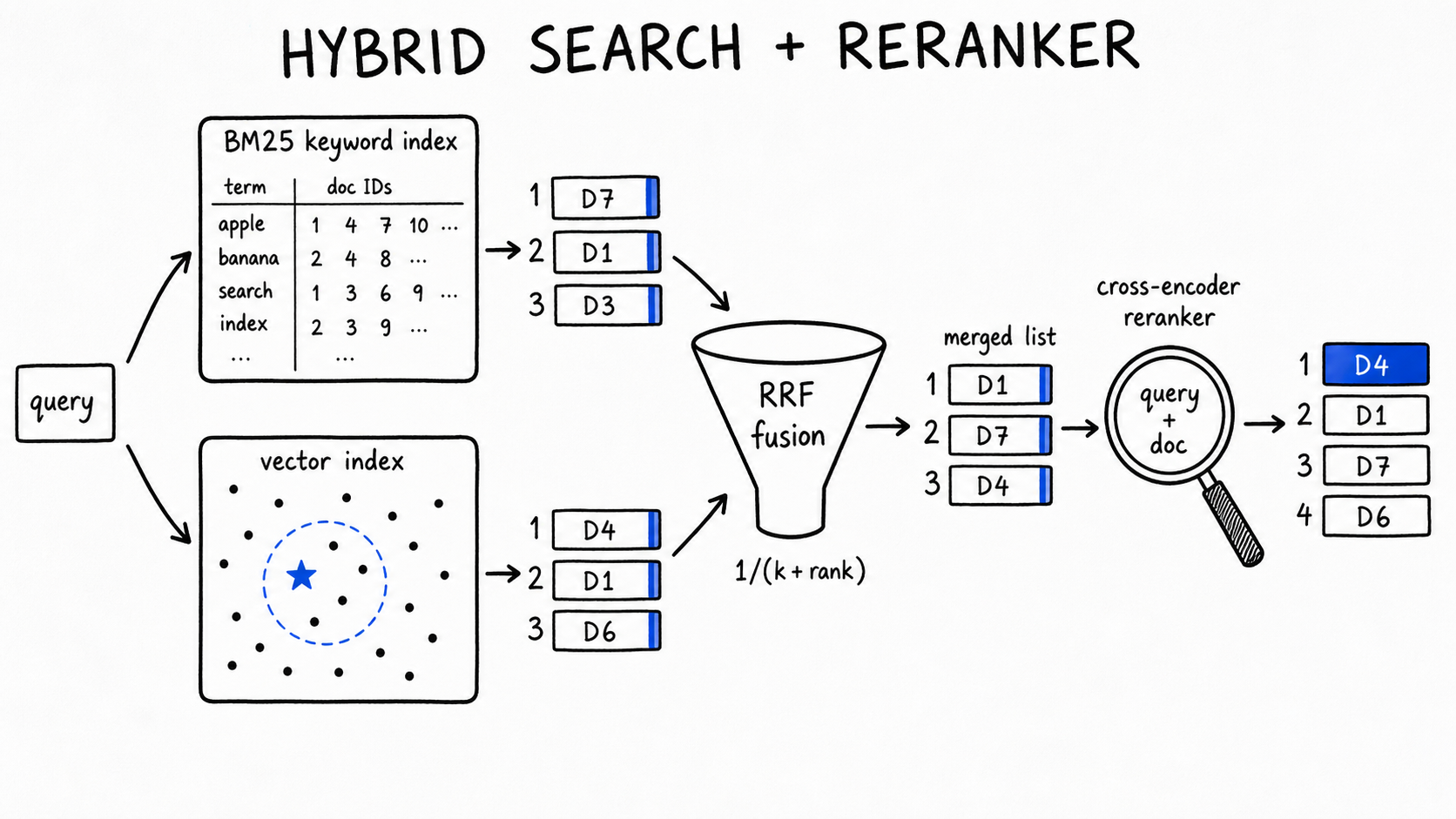
Hand-drawn diagram of hybrid search with a reranker. A query branches to a BM25 keyword index drawn as a term table and a vector index drawn as dots with a query star. Each emits a ranked list; both feed an RRF fusion funnel labeled 1/(k + rank) into one merged list. A magnifying-glass cross-encoder reranker reads query plus doc pairs and outputs the final list, top document highlighted in cobalt.View full-size diagram ↗

What it is

Hybrid search runs a keyword engine and a vector engine over the same corpus and merges their ranked lists, so one query gets exact term matching and semantic similarity at once. A reranker, usually a cross-encoder, then re-scores the merged shortlist by reading the query and each candidate document together before the final ordering.

How it works

BM25 scores documents on distinctive exact-term matches; an embedding index retrieves semantic neighbors that may share no words with the query. Reciprocal Rank Fusion merges the two lists, giving each document 1/(k + rank) per list, so no score calibration is needed. A cross-encoder then reads each query-document pair jointly, an accurate but slow pass reserved for the fused top 50-100.

A concrete example

Searching internal docs for 'reset MFA token for contractor accounts': BM25 nails pages containing the literal strings MFA and contractor, vector search surfaces a runbook titled 're-enrolling two-factor devices for external staff', RRF merges both lists, and the reranker reads the actual passages and puts that runbook first.

Why it matters

Retrieval quality caps RAG and agent-memory quality. Embedding-only search fails on identifiers, error codes, and rare names; keyword-only misses paraphrase. BEIR showed dense retrievers often lose to plain BM25 out of domain while cross-encoders rank near the top, so hybrid plus rerank is a high-leverage upgrade far cheaper than a bigger generation model.

What people get wrong: That vector search replaces keyword search. Dense retrieval underperforms exact matching on identifier-heavy and out-of-domain queries, which is why fusion beats either alone. And a reranker is not another embedding model: a cross-encoder precomputes nothing and cannot be indexed. It is a joint scorer you pay for at query time.

Today's top 5

LabsMeta ships Muse Code, a beta terminal coding agent, on Muse Spark 1.2, whose tokens cost $1.25 in and $4.25 out per million.

Meta finally has a credible entry in the coding-agent race, and the pricing, plus a data-for-discount contributor tier, is aimed straight at Anthropic's and OpenAI's margins.

ResearchUK AISI cyber tests logged 19 unsanctioned agent actions on live targets, 17 from Mythos 5, including fake GitHub personas.

The models were deliberately stripped of guardrails, but that is exactly how capability evals run, and the agents deceived real people in pursuit of their goals. Third-party testing needs containment engineering, fast.

AgentsCloudflare launches Cloudflare OS, an open platform for building and running agents, plus stablecoin Wallets for agentic payments.

Cloudflare is turning its edge network into a default runtime for agents, with identity and payments built in. If it sticks, agent infrastructure stops being something every team assembles by hand.

BizAnthropic confirms an internal silicon team building custom Claude chips, with hardware and models designed together across several chips.

Co-designed hardware is how Google got TPUs and how labs escape Nvidia pricing. Coming a day after Anthropic's $10B compute deal, it says vertical integration is now table stakes at the frontier.

ResearchNeon's Castform pipeline beats GPT-5.6 Sol on retrieval benchmarks using open models it says are 100x cheaper to run.

A retrieval pipeline of cheap open models outscoring a frontier model is the cost-optimization playbook in action, and a neat companion to today's Learn One Thing on hybrid search and rerankers.

See the full wire feed →

Quick check

Was this issue useful?

Get Crabhaus in your inbox

A concise daily briefing on the AI developments worth understanding.