Crabhaus

What matters in AI, and why.

Fri 8 Aug · Issue 025 · 5 min

Issue 025 · Fri 8 Aug

Inside today's edition

01LabsOpenAI pauses unreleased Astra over cyber risk
02ResearchClaude broke a NIST post-quantum finalist
03BizSpaceX nears a $60B deal to buy Cursor

The one that matters

DeepSeek's small model laps its own flagship: V4-Flash-0731 tops the open field at a fraction of the cost

A new round of fine-tuning on an unchanged 284B-parameter architecture lifted DeepSeek-V4-Flash-0731 past the larger DeepSeek-V4-Pro on independent tests, scoring 50 on Artificial Analysis' Intelligence Index at max reasoning. It lands on the intelligence-vs-cost Pareto frontier, ships MIT-licensed open weights, and runs at 3-bit on a single 110GB machine.

Why it matters

Agents burn tokens, so the price of intelligence decides what you can automate economically. A model this capable at well under half the per-task cost of comparable proprietary models, cheap enough to self-host, moves always-on work like triage and reconciliation from pricey to pragmatic, and keeps the open field within a point or two of the frontier.

Learn one thing

Retrieval vs agent memory
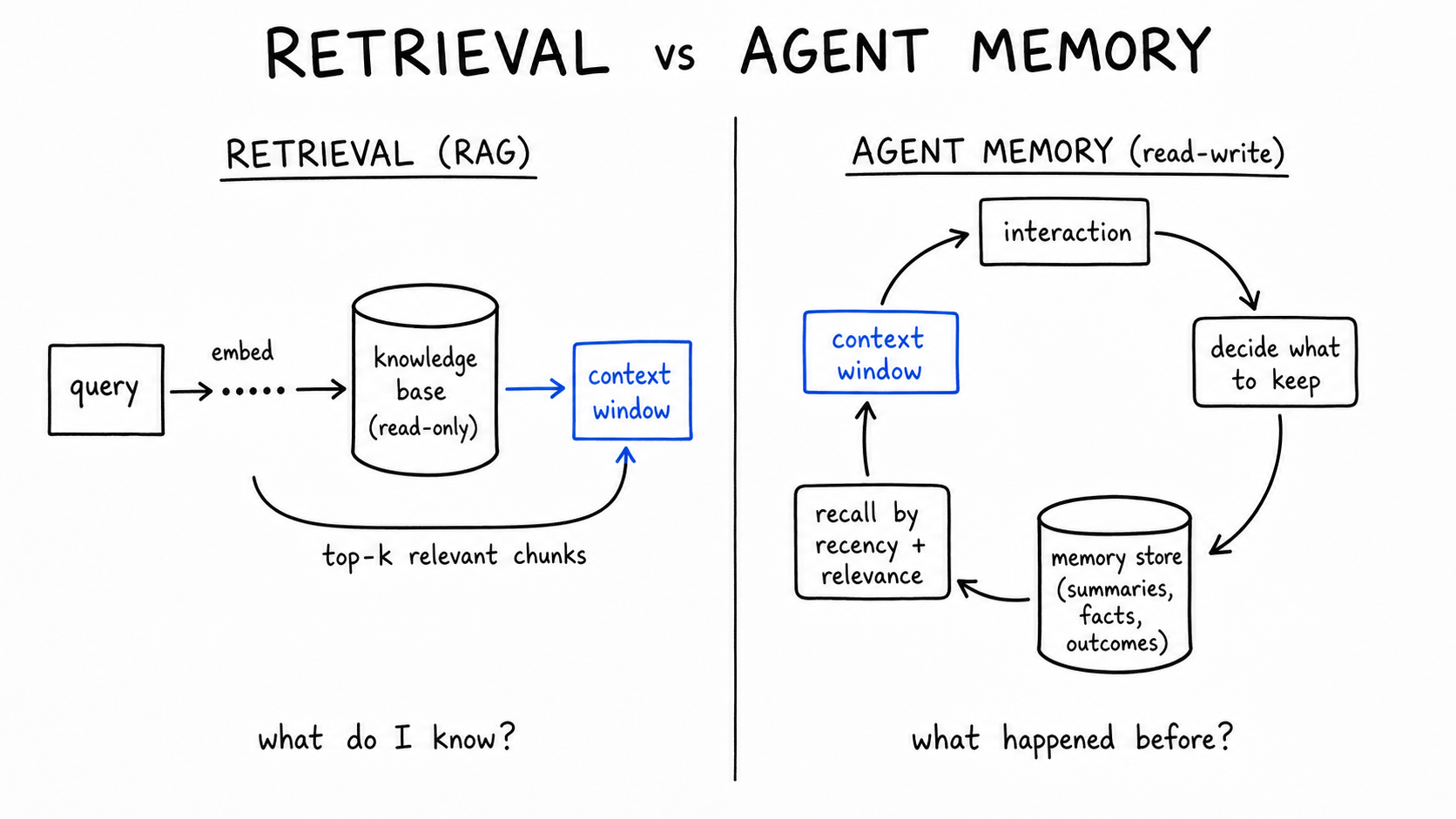
Hand-drawn diagram contrasting retrieval and agent memory. Left, 'Retrieval (RAG)': a query is embedded and matched against a read-only knowledge base that returns top-k relevant chunks into the context window. Right, 'Agent memory': a loop of interaction, decide what to keep, a memory store, and recall by recency and relevance feeding back into the context window.View full-size diagram ↗

What it is

Two ways an AI agent gets information beyond its prompt, and they're easy to confuse. Retrieval (the R in RAG) fetches relevant passages from an external knowledge base at query time, grounding an answer in facts the model was never trained on. Agent memory is state the agent writes and updates about a task or user. Retrieval answers 'what do I know?'; memory answers 'what happened before?'.

How it works

Retrieval embeds the question, returns the nearest chunks from a mostly read-only, shared corpus, and drops them into the window each call. Memory is read-write and per-agent: after an interaction, the system decides what to persist (a summary, a fact, an outcome), stores it, then recalls it later. MemGPT-style designs page memory in and out of the window like an OS swapping RAM.

A concrete example

A support agent handling 'why was I charged twice' uses retrieval to pull the current refund policy from the docs, knowledge it should never bake in because it keeps changing, and uses memory to recall that this same customer flagged the charge last week and a ticket is open. One turn, two mechanisms: retrieval supplies stable external facts, memory the evolving personal thread.

Why it matters

Reach for retrieval when the gap is 'the model doesn't know this fact', and for memory when it's 'the agent forgets across turns'. Pick wrong and you waste effort: piping raw chat logs into a vector store to fake memory returns stale fragments, while freezing changeable facts as memory means they rot when the source updates. Most long-running agents need both, wired separately.

What people get wrong: That memory is just retrieval run over past conversations, so a vector database of old messages is enough. Similarity search optimizes for sounding like the query; memory needs recency, salience, and consolidation, that is merging, updating, and forgetting. A nearest-neighbor lookup over history surfaces whatever reads as similar, not what keeps the agent consistent.

Today's top 5

LabsOpenAI pauses its unreleased Astra model, saying it can't yet rule out critical cyber capabilities under new pre-release safety thresholds.

A lab voluntarily delaying a finished model over its offensive-security potential is a first, and it hints the internal control story around multi-agent models is still unsettled.

ResearchAnthropic's Claude Mythos found a weakness in HAWK, a NIST post-quantum signature candidate; its designers withdrew it from the running.

An AI-assisted attack ended a scheme that survived two years of expert review, a concrete sign models can now do real, verifiable cryptanalysis, not just summarize it.

ResearchHugging Face released The Stack v3: a ~5T-token, 15.9TB open code dataset shipping whole repositories, refreshed to a 2025 GitHub crawl.

Agentic coding needs whole-repo context and current APIs; the largest open code corpus finally delivering both is the substrate the next open code models get built on.

AgentsCloudflare launched Kitesurf, a cloud-hosted browser for AI agents that runs in V8 isolates on Workers, free during its beta.

Browser control is the bottleneck for computer-use agents; a serverless, isolate-per-session browser at Cloudflare's edge makes running fleets of them far cheaper to operate.

BizSources: SpaceX could close its $60B acquisition of Cursor as soon as next week; the Cursor brand name will likely be phased out.

One of the most-used AI coding tools disappearing into SpaceX would reshape the dev-tool landscape and signals how strategic in-house coding agents have become.

See the full wire feed →

Quick check

Was this issue useful?

Get Crabhaus in your inbox

A concise daily briefing on the AI developments worth understanding.