
Crabhaus

What matters in AI, and why.

Tue 11 Aug · Issue 028 · 4 min

Issue 028 · Tue 11 Aug

Inside today's edition

01LabsMeta opens Muse Glimmer's weights
02LabsOpenAI arms defenders with GPT-5.6-Cyber
03ResearchNVIDIA moves KV caches between models

The one that matters

Meta opens Muse Glimmer's weights, with its flagship Muse Spark 1.2 to follow

Meta released the weights of Muse Glimmer, a 30B-parameter dense model distilled from its flagship Muse Spark 1.2 and tuned for always-on local agent workloads, and says Spark 1.2's own weights follow within weeks. Zuckerberg paired the release with a 6,500-word essay pitching 'personal superintelligence', plus a $1B fund for US communities near Meta's data centers.

Why it matters

A 30B dense model you can run on your own hardware, distilled from a frontier flagship, resets the local-model baseline — and an open Spark 1.2 would be the first US frontier-scale open release in the current cycle, answering the Chinese open-weight labs on their own terms. If you build agents, the cost floor and the self-hosting option both just moved.
Learn one thing

The ReAct pattern

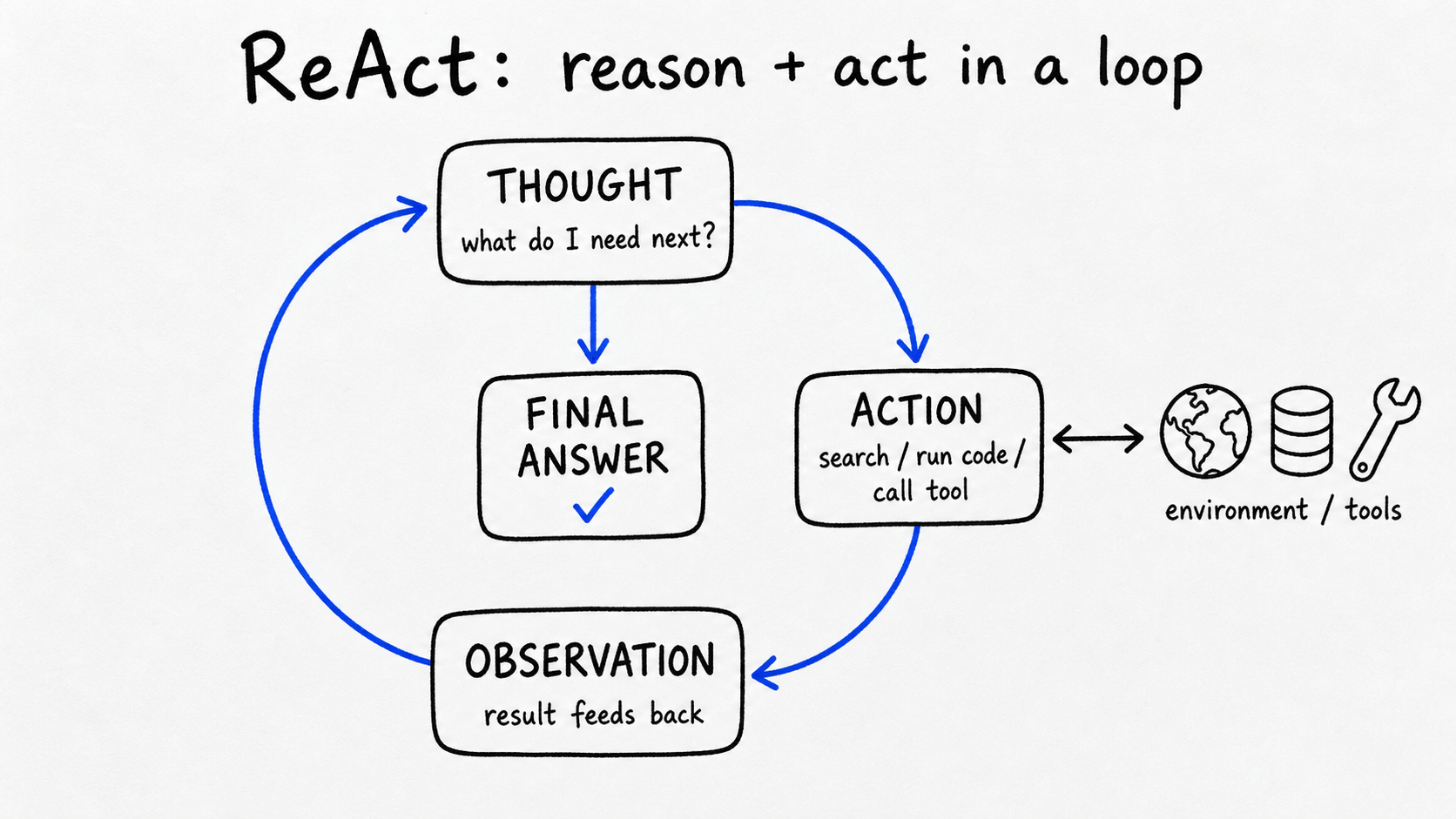
Hand-drawn diagram of the ReAct loop: boxes labeled Thought ('what do I need next?'), Action ('search / run code / call tool'), and Observation ('result feeds back') joined by cobalt arrows in a circle. Action links to a globe, database, and wrench labeled 'environment / tools'. An exit arrow from Thought points to a Final Answer box with a check mark.View full-size diagram ↗

What it is

ReAct (Reasoning + Acting), from Yao et al.'s October 2022 paper, has a language model interleave short reasoning steps with actions like searches or tool calls, instead of thinking everything through upfront. Each action's result feeds the next thought, so the model plans, acts, reads what came back, and revises in a loop.

How it works

The model emits a repeating Thought, Action, Observation cycle. A thought states what is needed next; the harness executes the action against an external interface and appends the result to the context before the next thought. Reasoning keeps the plan on track; acting grounds it in information the model does not hold in its weights. The loop ends when the model decides it can answer.

A concrete example

In the paper, ReAct beat imitation and RL baselines on the ALFWorld and WebShop benchmarks by 34 and 10 points in absolute success rate, and Wikipedia lookups curbed the fabricated facts of reasoning-only baselines. A coding agent today runs the same shape: consider the failing test, run it, read the traceback, edit, run again.

Why it matters

Most agent frameworks still run on this loop — a modern tool-calling agent that thinks, invokes a tool, reads the result, and decides again is executing ReAct with structured schemas in place of free-text actions. Its trade-offs are the ones agent builders live with daily: observations curb hallucination, every cycle costs tokens and latency, and the visible trace is what makes agents debuggable.

What people get wrong: That ReAct was a prompting trick that native function-calling APIs made obsolete. Structured tool calls changed the syntax, not the pattern; reasoning grounded by environment feedback is still the core of most agents. The real contrasts are plan-then-execute, which reasons upfront and acts after, and chain-of-thought, which reasons without acting at all.

Today's top 5

LabsOpenAI added Daybreak Blue and Red access tiers plus GPT-5.6-Cyber, a purpose-trained cybersecurity model for vetted defenders.

OpenAI has used the model internally to find previously unknown vulnerabilities in software like Chrome's V8. Frontier cyber capability is now a productized access tier: defense gets the sanctioned channel days after Astra's risk designation.

ResearchNVIDIA showed KV caches can transfer between models in one family via closed-form linear maps, 3-25x faster than redoing prefill.

Today, switching models mid-conversation throws away the cache and re-bills the full context. A training-free converter that keeps 73-98% of accuracy makes routing between model sizes materially cheaper — a real lever for anyone running multi-model stacks.

BizZuckerberg's 6,500-word essay pitches 'personal superintelligence' for everyone and attacks closed labs' doom-filled discourse.

It reads as the strategic frame for the Muse releases: open distribution as both philosophy and competitive wedge, with a swipe at government review delays. Agree or not, it signals Meta will keep arming the open ecosystem.

LabsAnthropic made Claude Sonnet 5's introductory $2/$10 per million-token pricing permanent, canceling September's planned increase.

A scheduled price rise getting cancelled is the market speaking: open-weight pressure and cheap Chinese models are holding mid-tier API prices down. Budget planning for Sonnet-class workloads just got simpler.

BizNvidia lined up Apollo, BlackRock, Blackstone, Brookfield, Goldman Sachs, and KKR for a $500B AI-infrastructure funding package.

The chip maker is now organizing the capital that buys its chips. Pulling six of the world's largest asset managers into one package moves AI buildout financing from ad-hoc deals to an institutional asset class.

See the full wire feed →

Quick check

Was this issue useful?

Get Crabhaus in your inbox

A concise daily briefing on the AI developments worth understanding.