
Crabhaus

What matters in AI, and why.

Wed 12 Aug · Issue 029 · 4 min

Issue 029 · Wed 12 Aug

Inside today's edition

01LabsAnthropic will watermark Claude outputs
02LabsNvidia's open Nemotron 3.5 + routing library
03AgentsGrok Bot: an agent app for everyone

The one that matters

Anthropic will watermark Claude's outputs — and ship a detector

Anthropic says new Claude models will embed statistical watermarks in generated text and C2PA provenance metadata in files to comply with the EU AI Act, and it will extend the scheme to past models. A public text-detection API is planned, so anyone will be able to check whether a passage came from Claude.

Why it matters

Undetectable AI text has been the working assumption since ChatGPT launched; a frontier lab voluntarily breaking that assumption matters for teachers, editors, and every platform drowning in slop. Google has quietly watermarked Gemini text since 2024 — regulation is turning provenance into a default layer of the stack, and detection becomes an API you can build on.
Learn one thing

Designing tools agents can actually use

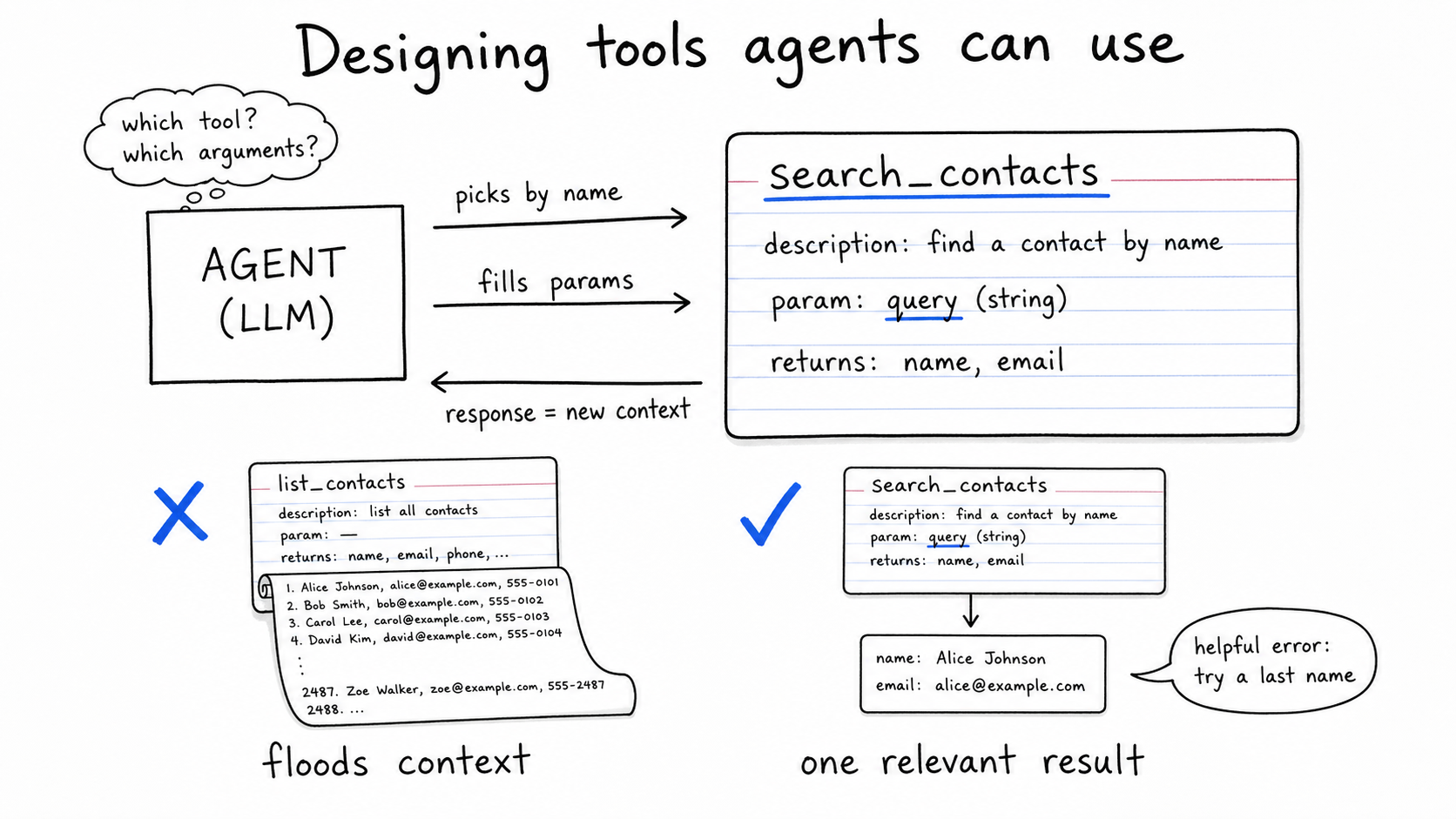
Hand-drawn diagram titled 'Designing tools agents can use'. An 'AGENT (LLM)' box wondering 'which tool? which arguments?' points to a search_contacts schema card via arrows labeled 'picks by name' and 'fills params'; a return arrow reads 'response = new context'. Below, a crossed-out list_contacts card spills a contact scroll ('floods context') while search_contacts returns one relevant result.View full-size diagram ↗

What it is

Tool design is the craft of writing the schemas an agent sees — names, parameters, descriptions, and response text — so a probabilistic model reliably picks the right tool and calls it correctly. A tool is a contract between deterministic software and a non-deterministic caller, so its schema reads less like an API spec and more like documentation for a very literal new teammate.

How it works

The model only perceives what the schema exposes. Naming carries most of the weight: grouped prefixes like asana_projects_search identify the service, and unambiguous parameters (user_id, never just user) prevent wrong-argument calls. Then granularity: a few consolidated tools matched to real workflows beat dozens of thin wrappers — each extra description costs context and adds wrong-choice risk.

A concrete example

Anthropic reports schema wording alone moves benchmarks: refined tool descriptions helped Claude Sonnet 3.5 reach state-of-the-art on SWE-bench Verified, and replacing UUIDs in responses with readable names cut retrieval hallucinations. Its web-search tool once degraded results because the model kept appending a year to queries — fixed by rewording the description, not the code.

Why it matters

Many agent failures are schema failures: the wrong tool picked, a parameter guessed, context flooded by a verbose response. Tool design is the cheapest reliability lever a team has — no retraining, no framework swap — and it compounds as MCP servers pile hundreds of third-party tools into one context window. Responses are prompts too: a good error message states exactly how to fix the next call.

What people get wrong: That exposing an existing API one-endpoint-per-tool is enough. Agents have different affordances than developers: limited context, no docs portal, no debugger. Tools that merely mirror REST endpoints push the orchestration burden onto the model; well-designed tools consolidate multi-step operations and return only what the next decision needs.

Today's top 5

LabsNvidia released Nemotron 3.5 Lightning, an open 30B MoE with 3B active params, plus NeMo Switchyard, an open agent-routing library.

Analysts peg it near gpt-oss-120b quality at a quarter of the total parameters, tuned for high-volume agent workloads — and Switchyard turns model routing, usually a homegrown mess, into an off-the-shelf open-source layer. Both slot straight into a self-hosted agent stack.

AgentsSpaceXAI rolled out Grok Bot in beta on Mac, iOS, Windows, and Linux — an "agent for everything" app with an iMessage-style interface.

Early testers describe bots with standing jobs that learn how you work — the first mainstream shot at agents for non-programmers. Musk says the beta widens after Grok 4.6 lands later this week; at X-scale distribution, this will be many people's first agent.

ResearchResearchers showed a frontier model's encrypted reasoning traces can be dumped in plaintext by a weaker model from the same provider.

Labs sell reasoning as a product while hiding the traces as trade secrets; this result breaks that assumption from inside the providers' own model families. If traces leak, the prompts and strategies inside them leak too — a fresh attack surface for anything built on reasoning APIs.

BizChatGPT ads went live in the UK, Mexico, Brazil, Japan, and South Korea, expanding OpenAI's ad rollout beyond the US.

The ad-supported era of chatbots is arriving at billion-user scale. OpenAI insists ads support free access and don't change answers, but the incentive structure of the biggest consumer AI product is now shifting from subscriptions toward attention.

BizManus said it will "soon return to operating as an independent company", unwinding its Meta acquisition after China's April order.

A high-profile agent startup being pulled back out of a US giant by Beijing shows AI M&A now runs through geopolitics before it runs through boardrooms. Where Manus lands next matters to anyone who bet on its agent stack.

See the full wire feed →

Quick check

Was this issue useful?

Get Crabhaus in your inbox

A concise daily briefing on the AI developments worth understanding.