
Crabhaus

What matters in AI, and why.

Thu 13 Aug · Issue 030 · 4 min

Issue 030 · Thu 13 Aug

Inside today's edition

01LabsGrok 4.6: frontier scores at commodity prices
02LabsQwen's 2.4T Max-class model goes open weights
03Biz$1.1B for Babuschkin's user-owned AI

The one that matters

Grok 4.6 matches the frontier at a fifth of the price

SpaceXAI released Grok 4.6 at $2 per million input tokens and $6 per million output. It matches GPT-5.6 Sol on the Artificial Analysis Intelligence Index — a composite of nine benchmarks — with standout scores on agentic coding and knowledge work, and Musk says a significantly better Grok 4.7 lands in three to four weeks.

Why it matters

Frontier scores at what one analyst tallies as an 85% discount to Fable 5 Max resets the cost floor for agent workloads, where output tokens dominate spend. Every lab now has to justify premium pricing benchmark by benchmark — and for builders, routing long-running agents through cheap-but-frontier models just became the obvious experiment.
Learn one thing

Model Context Protocol

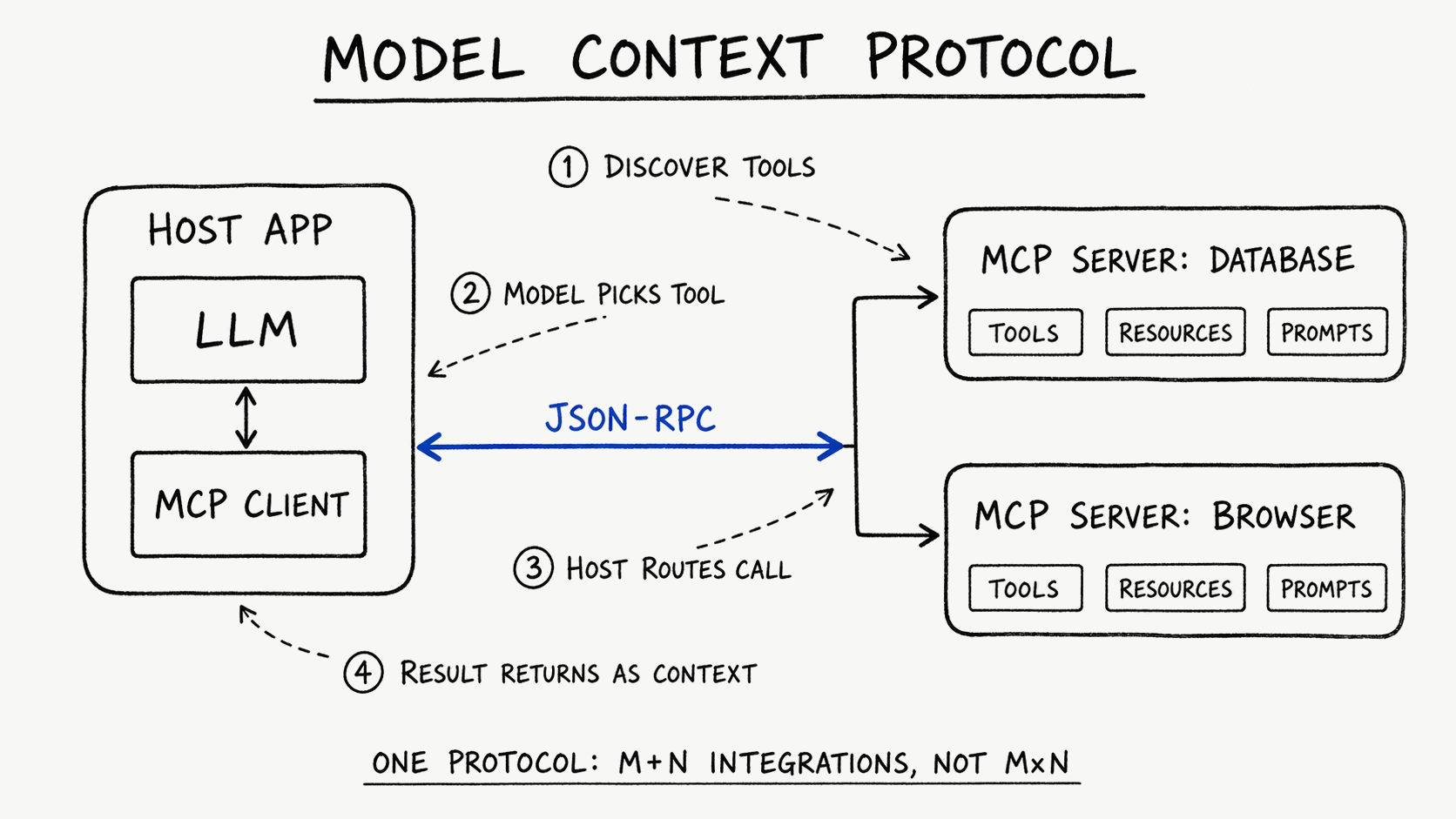
Hand-drawn diagram titled 'Model Context Protocol'. A 'HOST APP' box holding 'LLM' and 'MCP CLIENT' links via a cobalt arrow labeled 'JSON-RPC' to 'MCP SERVER: DATABASE' and 'MCP SERVER: BROWSER', each tagged TOOLS, RESOURCES, PROMPTS. Numbered steps: 1 discover tools, 2 model picks tool, 3 host routes call, 4 result returns as context. Caption: 'One protocol: M+N integrations, not M×N'.View full-size diagram ↗

What it is

The Model Context Protocol (MCP) is an open standard, introduced by Anthropic in late 2024, for connecting AI apps to tools and data. An app (the host) runs MCP clients that talk over JSON-RPC to MCP servers; each server exposes tools the model can call, resources the app can read, and prompt templates the user can invoke.

How it works

A server declares its capabilities in an initialize handshake, then advertises typed tool schemas. The host injects those into the model's context; when the model emits a tool call, the host routes it through its client to the server and returns the result — the model never talks to a server directly. Transports: stdio locally, streamable HTTP remotely, OAuth 2.1 for auth.

A concrete example

A single Postgres MCP server exposing a query tool works unchanged from Claude Desktop, an IDE agent, or any other MCP-capable client. Wiring M apps to N systems used to mean M×N bespoke integrations; a shared protocol collapses that to M+N — one server per system, usable by every compliant app.

Why it matters

Tool access is the difference between a chatbot and an agent, and integration plumbing was the bottleneck. With OpenAI, Google DeepMind, and Microsoft all adopting MCP in 2025, a server written once reaches nearly every major agent surface. Note what MCP leaves out: the agent loop, memory, and model choice are deliberately not standardized.

What people get wrong: That MCP makes a model better at using tools. It only standardizes discovery and invocation: the model still decides when and how to call a tool, so a confusing schema stays confusing over MCP, and a server stuffed with tools can still flood the context window. Yesterday's tool-design lessons apply unchanged on top of it.

Today's top 5

LabsDeepSeek shipped V4 Pro 0813 API-only via OpenRouter with no announcement post; an open-weights release is unconfirmed so far.

The quiet API-only drop breaks DeepSeek's open-weights pattern, at least for now. Weights for April's V4 Pro and July's V4 Flash both shipped open, so watch whether 0813 follows — if it does, it's likely the strongest open agentic model yet; if not, that's a strategy shift worth noticing.

LabsQwen open-released Qwen3.8-2.4T-A95B, a 2.4T-parameter MoE with 95B active — the first Max-class Qwen model published as open weights.

A Max-class flagship as downloadable weights raises the open ceiling again: 2.4T total parameters, 95B active, compatible with vLLM and SGLang from day one. For self-hosters and regulated deployments, the gap to the closed frontier just narrowed.

ResearchAnthropic's Frontier Red Team cataloged the failure patterns emerging in multiagent systems as agent-to-agent interaction scales.

As agents start transacting with other agents in shared codebases and markets, failures stop being single-model bugs and become ecosystem dynamics. Mapping those patterns now is the field's early-warning system — and any multi-agent stack you run inherits every one of them.

BizEx-xAI co-founder Igor Babuschkin raised $1.1B for River AI to build user-owned, open-source personal AI with a rapid fine-tuning API.

A $1.1B bet on self-hosted, user-controlled AI from someone who helped build a frontier lab is a direct shot at the closed model. With watermarking and access bans putting control top of mind, the pitch has pull; the open question is whether pedigree plus capital can reach frontier quality.

BizThe White House is expected to expand its AI oversight framework to cover open-weight models once they reach frontier capabilities.

Open-weight models have so far sat outside frontier oversight; folding them in changes the calculus for every lab that releases weights — including the Chinese releases many US builders depend on. The framework's final shape decides whether open models remain a viable frontier track in the US.

See the full wire feed →

Quick check

Was this issue useful?

Get Crabhaus in your inbox

A concise daily briefing on the AI developments worth understanding.