
Crabhaus

What matters in AI, and why.

Fri 14 Aug · Issue 031 · 4 min

Issue 031 · Fri 14 Aug

Inside today's edition

01LabsGemini 3.7 Flash resets workhorse pricing
02LabsOpenAI Ultrafast: GPT-5.6 Sol at 14x speed
03BizAnthropic investors eye a $2T October IPO

The one that matters

Gemini 3.7 Flash lands three weeks after 3.6 — and resets the workhorse price war

Google released Gemini 3.7 Flash, calling it its most intelligent workhorse model for coding and agents, at launch pricing of $0.75 per million input tokens and $3.75 output — half of 3.6 Flash's launch price, but scheduled to double on December 31. It tops Code Arena's WebDev leaderboard at 1588 points and arrives just three weeks after 3.6 Flash shipped.

Why it matters

The Flash tier is where agent workloads actually run, and Google now ships workhorse models faster than most teams finish evaluating the previous one. Simon Willison flags the wrinkle: intro pricing that doubles in five months, on a line iterating every three weeks, turns 'which model' into a scheduling question. Price, not capability, is becoming the frontier's main competitive lever.
Learn one thing

Agent skills

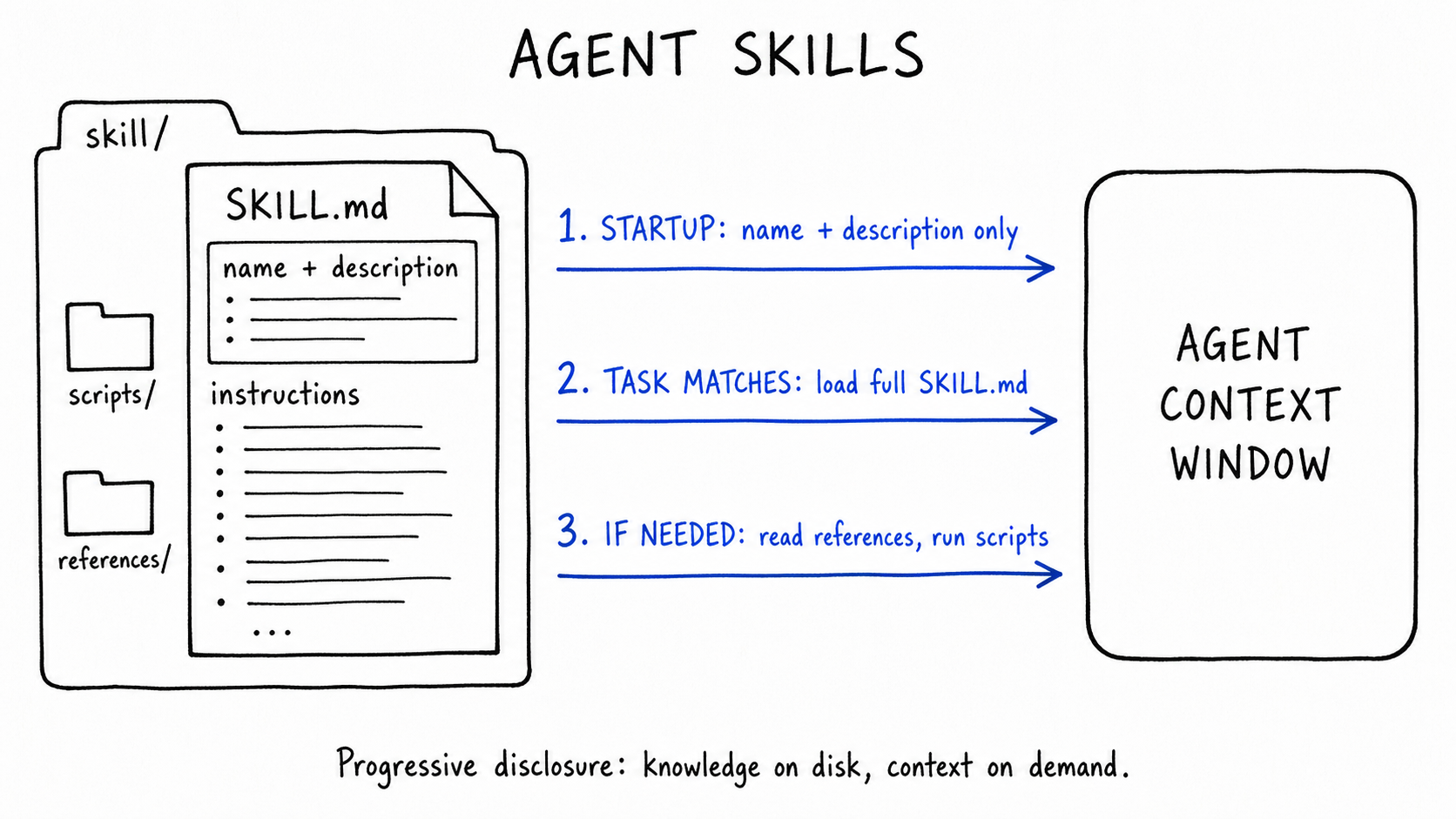
Hand-drawn diagram titled 'Agent Skills'. A skill/ folder holds SKILL.md — a 'name + description' header and 'instructions' body — beside scripts/ and references/. Three cobalt arrows to an 'Agent context window' box: 1 startup loads name + description only; 2 on task match, full SKILL.md; 3 if needed, references and scripts. Caption: 'Progressive disclosure: knowledge on disk, context on demand.'View full-size diagram ↗

What it is

A skill is a folder of procedural know-how an agent loads on demand. Its SKILL.md opens with YAML frontmatter — a name and a one-line description — followed by markdown instructions, with scripts, templates, and reference docs alongside. Instead of cramming every procedure into a system prompt, expertise ships as files the agent reads only when a task calls for them.

How it works

Progressive disclosure, in three stages. At startup the agent preloads only each skill's name and description — tens of tokens apiece. When a task matches a description, it reads the full SKILL.md into context. Bundled references are read, and scripts run, only if that run actually needs them, so a skill can hold megabytes while idling at near-zero context cost.

A concrete example

Anthropic's official skills cover procedures like building .xlsx spreadsheets or filling PDF forms: the frontmatter costs a sentence, and the full checklist plus helper scripts load only when a matching task appears. DeepSeek's Harness, previewed this week, treats skills as one of its swappable plugin types alongside models and tools.

Why it matters

Context is scarce, and procedural knowledge is most of what teams want agents to retain. Skills turn it into portable, versionable files instead of prompt sprawl. The new vendor-neutral Agent Plugins 1.0.0 spec standardizes the packaging — one directory with plugin.json, skills/, and mcp.json — with maintainers from Amazon, Cursor, Microsoft, OpenAI, and Vercel.

What people get wrong: That skills are another flavor of tools or MCP. MCP standardizes connections — live runtime access to external systems. A skill packages knowledge: instructions telling the agent how to do the work with capabilities it already has. That's why Agent Plugins carries skills/ and mcp.json side by side rather than merging them — they describe different things.

Today's top 5

LabsOpenAI previewed Ultrafast, a Cerebras-powered API tier running GPT-5.6 Sol up to 14x faster at up to 750 output tokens per second.

Speed becomes the product: until now, real-time meant dropping to a smaller model. Frontier intelligence at 750 tokens per second changes what agent loops and incident-response workflows can do — and putting Cerebras wafer-scale hardware in OpenAI's serving path diversifies the inference supply chain beyond GPUs.

LabsDeepSeek made V4-Pro official at $0.435/$0.87 per 1M, with agent upgrades, adjustable reasoning effort, and Responses API support.

Yesterday's quiet OpenRouter drop is now a full launch. Native OpenAI Responses API support, optimized for Codex with one-click setup, makes V4-Pro a drop-in for OpenAI-shaped stacks at a fraction of frontier prices. Still no weights, though — the open-release question from yesterday's issue stays open.

BizDeepSeek added peak/off-peak dynamic pricing ahead of a possible IPO; V4-Flash output jumps from $0.28 to $1.32 per 1M at peak.

Electricity-style pricing arrives in LLM APIs. A 4.7x peak multiplier rewards batch jobs, overnight agents, and off-peak scheduling — and it signals real capacity constraints plus pre-IPO margin discipline at the lab that started the price war. API budget forecasting just got genuinely harder.

ResearchA SIAM News essay reports a neurosurgery resident used GPT-5.6 in ChatGPT to settle Crouzeix's conjecture, open since 2004.

A day after Tim Gowers' measured take on what maths LLMs are good at, a two-decade-old open problem in numerical linear algebra reportedly falls to a domain outsider steering a frontier model. The pattern to watch: not autonomous AI mathematicians, but determined humans using models as proof collaborators.

AgentsDeepSeek open-sourced Harness (MIT), a developer-preview agent framework where models, tools, skills, and sandboxes are plugins.

The agent-harness layer is commoditizing. An MIT-licensed, everything-is-a-plugin chassis from a frontier lab lets builders swap models and capabilities without rewriting the loop — and its skills-as-plugins design is exactly the packaging story in today's Learn One Thing.

See the full wire feed →

Quick check

Was this issue useful?

Get Crabhaus in your inbox

A concise daily briefing on the AI developments worth understanding.