
Crabhaus

What matters in AI, and why.

Sat 15 Aug · Issue 032 · 4 min

Issue 032 · Sat 15 Aug

Inside today's edition

01LabsQwen3.8-27B: open weights, one GPU
02BizNvidia halves OpenAI's $250B backstop
03BizAnthropic: $11.5B quarter, Model 2 held

The one that matters

Qwen3.8 goes open: Apache-2.0 weights put near-frontier coding on one GPU

Alibaba released open weights for its Qwen3.8 line under Apache 2.0, including Qwen3.8-27B — a model testers report jumping from 53.5 to 61.7 on SWE-bench Pro and 49.3 to 79.0 on software-engineering benchmarks over its 3.6 predecessor. The 17GB quantized build runs on a single consumer GPU, and it topped Hacker News within hours of the drop.

Why it matters

A day after the 2.4T-parameter flagship, the release that matters for builders is the small one: serious coding ability, a permissive license, and hardware you may already own. Every capability that moves from API-only to a $700 used GPU changes who gets to build with it — and puts fresh price pressure on the closed workhorse tier the labs fought over all week.
Learn one thing

Agent memory architectures

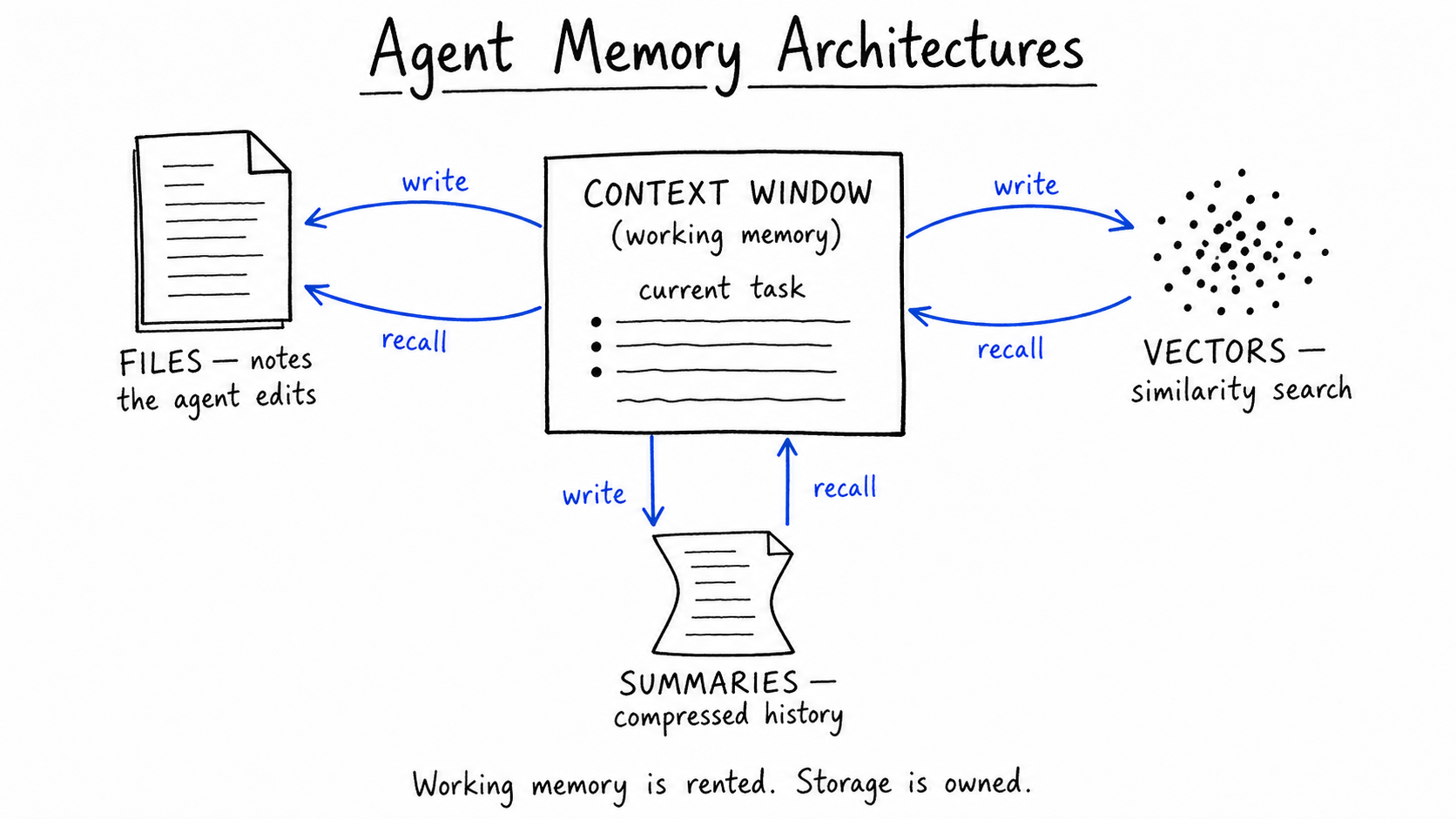
Hand-drawn diagram titled 'Agent Memory Architectures'. A central box, 'CONTEXT WINDOW (working memory)', holds the current task. Cobalt write and recall arrows connect it to three stores: FILES (notes the agent edits), VECTORS (similarity search), and SUMMARIES (compressed history). Caption: 'Working memory is rented. Storage is owned.'View full-size diagram ↗

What it is

How an agent remembers across sessions. Short-term memory is the context window — whatever fits in the current prompt. Long-term memory is everything stored outside it: facts, preferences, and past work that survive after the conversation ends.

How it works

The window empties when a session ends, so persistence lives in external substrates the agent reads and writes. Files hold documents it edits directly; vector stores embed past text for similarity retrieval; summaries compress old history. MemGPT's OS analogy: context is RAM, storage is disk, and the agent pages data in and out with tool calls.

A concrete example

Claude Code reads a CLAUDE.md file at session start — durable project instructions written earlier — and Anthropic's memory tool lets Claude edit files that persist between chats. A support bot instead embeds past tickets in a vector database and pulls the closest matches when a customer writes in.

Why it matters

Memory choice sets cost, reliability, and failure modes. Files are auditable but need curation; vectors scale yet retrieve approximately — the right memory can fail to surface; summaries lose detail forever. Agents without memory burn tokens re-deriving everything; agents with sloppy memory confidently recall stale facts.

What people get wrong: That bigger context windows make memory architecture obsolete. A window is capacity, not persistence: it resets between sessions, cost scales with every loaded token, and models attend less reliably mid-window. Selection — what to store, what to bring back — stays the hard problem at any size.

Today's top 5

BizWSJ: Nvidia reworked its OpenAI Ohio data-center financing to initially guarantee only half of the planned $250B backstop.

The AI buildout runs on circular vendor financing, and its biggest guarantor just trimmed its exposure. Whether that's prudence or cooling conviction, the terms behind the trillion-dollar data-center pipeline are being renegotiated in real time — worth watching for anyone whose roadmap assumes compute keeps getting cheaper.

BizInvestor docs: Anthropic generated $11.5B+ revenue with positive adjusted operating income in Q2, up from $787M a year earlier.

A 14-fold annual jump with positive adjusted operating income undercuts the 'AI has no business model' thesis right as the IPO forms up. Paired with the same day's Axios report that Anthropic is withholding a stronger internal 'Model 2' on risk grounds, you get the week's strangest split-screen: record commercial results, deliberate capability restraint.

BizReuters: Apple trained a China-specific LLM with Alibaba's support — the first foreign company to offer a proprietary model in China.

Regulatory registration, a local partner, and a bespoke model just to ship a feature: Apple's China playbook shows what operating AI across the two blocs actually costs. One company now maintains separate models for separate jurisdictions — a preview of compliance-driven model fragmentation others will face.

ResearchGoogle engineers detail making homomorphic encryption practical for private AI — inference on queries the server never sees in plaintext.

HE has been 'promising but 1,000x too slow' for a decade. Google claiming practical latency for real AI workloads matters for every regulated-industry agent use case where the blocker isn't capability but where the data is allowed to go. If it holds, 'the model never sees your query' becomes an engineering option, not a research dream.

AgentsMixedbread launched Toast 1, a specialized search agent it says matches Opus 5 and GPT-5.6 Sol on retrieval at up to 10x lower cost.

The specialized-agent thesis in miniature: a narrow model tuned for one job — search — claiming frontier-quality results at a tenth of the price. Retrieval is a piece nearly every agent stack pays frontier rates for today; if task-specific agents keep beating generalists on cost, agent architectures splinter into routed specialists.

See the full wire feed →

Quick check

Was this issue useful?

Get Crabhaus in your inbox

A concise daily briefing on the AI developments worth understanding.