
Crabhaus

What matters in AI, and why.

Sun 16 Aug · Issue 033 · 4 min

Issue 033 · Sun 16 Aug

Inside today's edition

01AgentsCodex auto-research: a 232x GPU-kernel speedup
02ResearchIs AI out-remembering mathematicians?
03ResearchDerek Lowe on AI drug discovery's real state

The one that matters

An auto-research loop with Codex hit a 232x GPU-kernel speedup — and placed 12th of 183

In GPU Mode's auto-research contest with Core Automation, developer Sankalp ran Codex in a research loop against batched QR factorization and finished 12th of 183 with a 232x speedup over the baseline kernel. The write-up details the loop engineering: learning enough math to ask better questions, and injecting idea diversity to escape local maxima.

Why it matters

Contest leaderboards are becoming a testbed for a real workflow shift: you supervise an agent's research loop instead of hand-writing CUDA. The levers that mattered — problem selection, domain context, forcing diverse attempts when progress stalls — are the same ones any builder pulls when pointing agents at hard optimization work. The ceiling wasn't the model; it was how well the loop was run.
Learn one thing

Context compaction and summarization

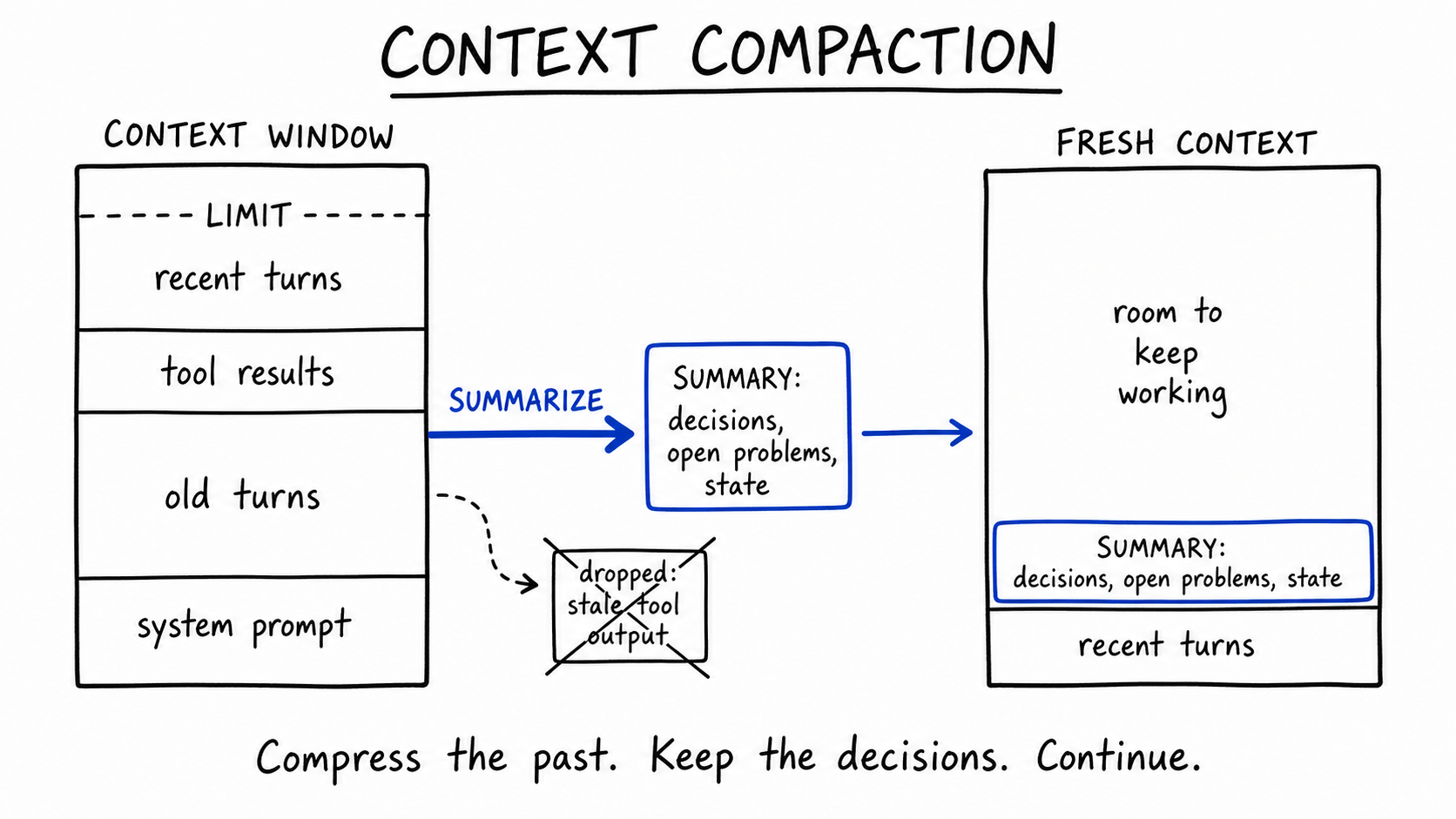
Hand-drawn diagram titled 'Context Compaction'. A full CONTEXT WINDOW box — system prompt, old turns, tool results, recent turns, dashed LIMIT — feeds a cobalt SUMMARIZE arrow into 'SUMMARY: decisions, open problems, state'; a crossed-out scrap says 'dropped: stale tool output'. The summary lands in a roomier FRESH CONTEXT box. Caption: 'Compress the past. Keep the decisions. Continue.'View full-size diagram ↗

What it is

How a long-running agent keeps working after its transcript outgrows the model's context window: older history is compressed — summarized, with stale tool output dropped — and the task continues in a fresh, smaller context seeded with that summary instead of the full record.

How it works

Near the limit, the history goes to a model with a summarization prompt that keeps decisions, constraints, and open problems while dropping bulk like raw tool results; the summary replaces the old transcript. Lighter variants edit in place, clearing old tool outputs or old reasoning blocks. MemGPT frames this as OS-style paging between context and storage.

A concrete example

Claude Code compacts by summarizing the message history — preserving architectural decisions, unresolved bugs, and implementation details while discarding redundant tool output — then continues from the compressed context plus recently accessed files, so a coding session can run past the window limit.

Why it matters

Every long-horizon agent hits the context ceiling, and compaction is usually the first lever: effectively unbounded task length, paid for with lossy memory. Knowing what your framework silently throws away explains a whole class of 'the agent forgot what I said an hour ago' bugs — and tuning what the summary keeps is real engineering work.

What people get wrong: That big context windows make compaction obsolete. A filling window degrades focus and raises cost and latency long before the hard limit, so curation stays necessary at any size — and compaction is lossy: aggressive summaries drop subtle details whose importance only shows up later.

Today's top 5

AgentsA GPU Mode contestant ran Codex in an auto-research loop to a 232x speedup on batched QR factorization kernels, placing 12th of 183.

A concrete, replicable account of agent-driven kernel optimization — what worked, what stalled, and how idea diversity broke the plateaus.

ResearchDavide Piffer argues AI's math performance owes less to superior reasoning than to a vastly larger symbolic working memory.

A mechanism-level reframe of why models ace hard math: humans juggle a handful of symbols; a context window holds the whole proof. If right, it changes what benchmark wins actually measure.

ResearchDerek Lowe (In the Pipeline) assesses what AI is genuinely contributing to drug discovery so far — and the path forward.

One of medicinal chemistry's most credible skeptics takes stock of the field AI keeps promising to transform — a grounded antidote to both hype and dismissal.

AgentsSimon Willison builds CORS Chat, a browser UI for any OpenAI-compatible endpoint, to test Qwen 3.8 27B in LM Studio and on a DGX Spark.

A small, useful pattern: a zero-install browser client for local models — and a live look at exercising open weights on consumer and workstation hardware.

AgentsAllen Bargi's viral note: working with AI is less like issuing commands to a compiler, more like leading through shared context.

The weekend's big HN discussion on AI-assisted work: context, clarity, and feedback beat exact instructions. Experiential, not empirical — but it matched many builders' experience.

See the full wire feed →

Quick check

Was this issue useful?

Get Crabhaus in your inbox

A concise daily briefing on the AI developments worth understanding.