
Crabhaus

What matters in AI, and why.

Mon 17 Aug · Issue 034 · 4 min

Issue 034 · Mon 17 Aug

Inside today's edition

01BizStripe buys OpenRouter: routing is a $7B asset
02AgentsWhen model routing doubles your bill
03ResearchQwen: 3B downloads, 151K derivatives

The one that matters

Stripe is reportedly buying OpenRouter for $7B+ — model routing just became payments infrastructure

Bloomberg reports Stripe has finalized a deal to acquire OpenRouter, the marketplace that fronts hundreds of models behind one API, for more than $7B — over five times the $1.3B valuation OpenRouter raised at in May. Stripe gets the metering layer for AI usage; OpenRouter gets distribution inside the machinery that already bills much of the internet.

Why it matters

OpenRouter sits in the request path of a huge share of indie and startup AI traffic, seeing which models win real workloads. Attaching that to Stripe pairs usage data with billing rails right as per-token spend becomes a line item every company tracks. If the deal closes, the neutral traffic-switch layer of the model economy belongs to a payments company — worth watching what stays neutral.
Learn one thing

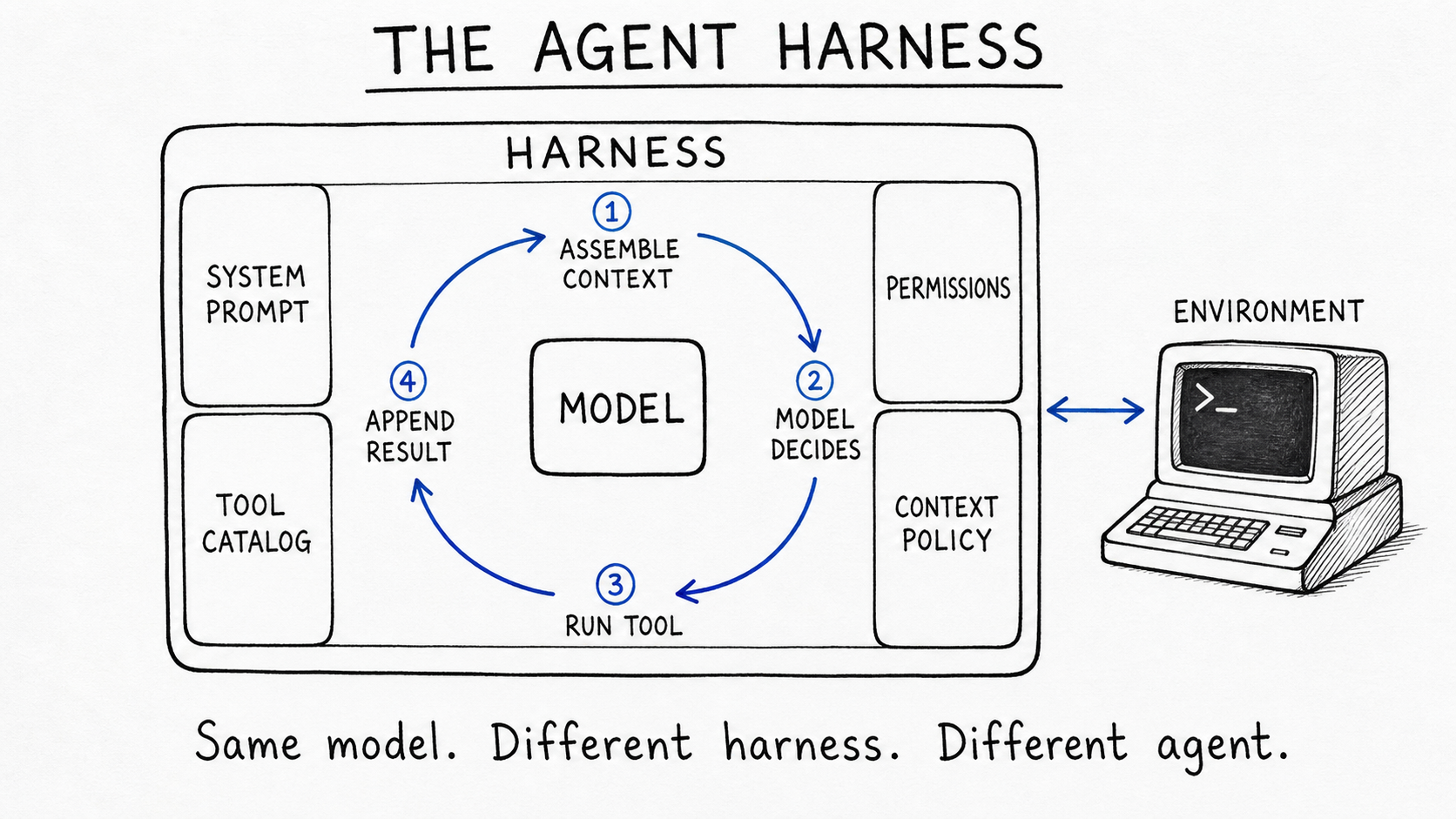
The agent harness: the scaffolding around the model

Hand-drawn diagram titled 'The Agent Harness'. A rounded HARNESS box holds a central MODEL ringed by a numbered cobalt loop - Assemble context, Model decides, Run tool, Append result - with compartments for System prompt, Tool catalog, Permissions, and Context policy. A double arrow links to a terminal labeled ENVIRONMENT. Caption: 'Same model. Different harness. Different agent.'View full-size diagram ↗

What it is

All the software wrapped around a language model to make it act: the system prompt, the tool catalog, the loop that executes tool calls and feeds results back, permission gates, and the rules for what stays in context. Anthropic's SWE-bench write-up defines an agent as exactly this pairing — a model plus its scaffolding.

How it works

Each cycle, the harness assembles everything the model sees: instructions, tool definitions, history, and the latest results. The model replies with an action; the harness parses it, runs the real tool, appends the observation, and calls the model again until a stop condition. Since history is re-sent every turn, harness design is dominated by managing that growing context.

A concrete example

Coding benchmarks score model+harness pairs, not bare models. Terminal-Bench submissions must name both an agent and a model, and Anthropic reported SWE-bench results "can vary significantly" from scaffolding changes alone — same weights, very different rank under two different harnesses.

Why it matters

Choosing between agent products means choosing between harnesses at least as much as models. A benchmark gap between two tools on the same model is scaffolding, not weights — and in your own stack, harness work is often a bigger lever than a model upgrade.

What people get wrong: That the harness is one-off glue code. It's the most-iterated layer: Manus rebuilt its agent framework four times hunting better context layouts, and labs treat scaffolding as a tuned, evolving system rather than plumbing.

Today's top 5

BizStripe has reportedly finalized a deal to acquire model marketplace OpenRouter for over $7B - up from a $1.3B valuation in May.

A payments giant taking over the largest neutral model-routing layer says per-token spend is now core financial infrastructure.

AgentsAnalysis: per-turn model routing can double long-session costs, since switching models discards the warm prompt cache.

Timely counterweight to the OpenRouter news: in long agent sessions, cache economics can flip the savings routers promise.

ResearchHugging Face's summer open-models report: Alibaba's Qwen passed 3B downloads in six months, with 151K+ derivative models built on it.

The clearest snapshot yet of where the open-weights ecosystem's center of gravity actually is — with caveats about what download counts measure.

ResearchFields medalist Timothy Gowers: famous math problems solved by LLMs so far have almost all fallen to counterexamples, not proofs.

A top mathematician maps precisely which kinds of mathematical work models are winning at — and which they aren't.

AgentsAnthropic's published system prompts for the Claude apps draw fresh attention as a rare documented look inside a production harness.

Reading a production system prompt is the fastest way to see how much behavior lives in the harness, not the weights.

See the full wire feed →

Quick check

Was this issue useful?

Get Crabhaus in your inbox

A concise daily briefing on the AI developments worth understanding.