
Crabhaus

What matters in AI, and why.

Tue 18 Aug · Issue 035 · 4 min

Issue 035 · Tue 18 Aug

Inside today's edition

01BizNvidia backstops OpenAI's 10GW Ohio bet
02LabsGLM-5.3: open weights chase the coding crown
03ResearchA 2004 conjecture falls to a 16-hour AI run

The one that matters

OpenAI signs a 20-year, 10GW Ohio data center - and Nvidia guarantees up to $105B of it

The WSJ reports OpenAI locked in a 20-year lease at SB Energy's PORTS-Pike campus in Portsmouth, Ohio - 10GW of capacity. Nvidia invests $1.5B in the SoftBank-backed developer, takes exclusive rights to sell its chips into the campus, and agrees to cover up to $105B of first-phase obligations if OpenAI defaults and the site can't be re-let.

Why it matters

This is the circular AI economy in one filing: the chip vendor is now underwriting its biggest customer's landlord to keep the chips flowing. The structure follows July SEC guidance easing data-center securitizations - and it concentrates the downside squarely on Nvidia's balance sheet if AI demand ever slows.
Learn one thing

Planning and task decomposition

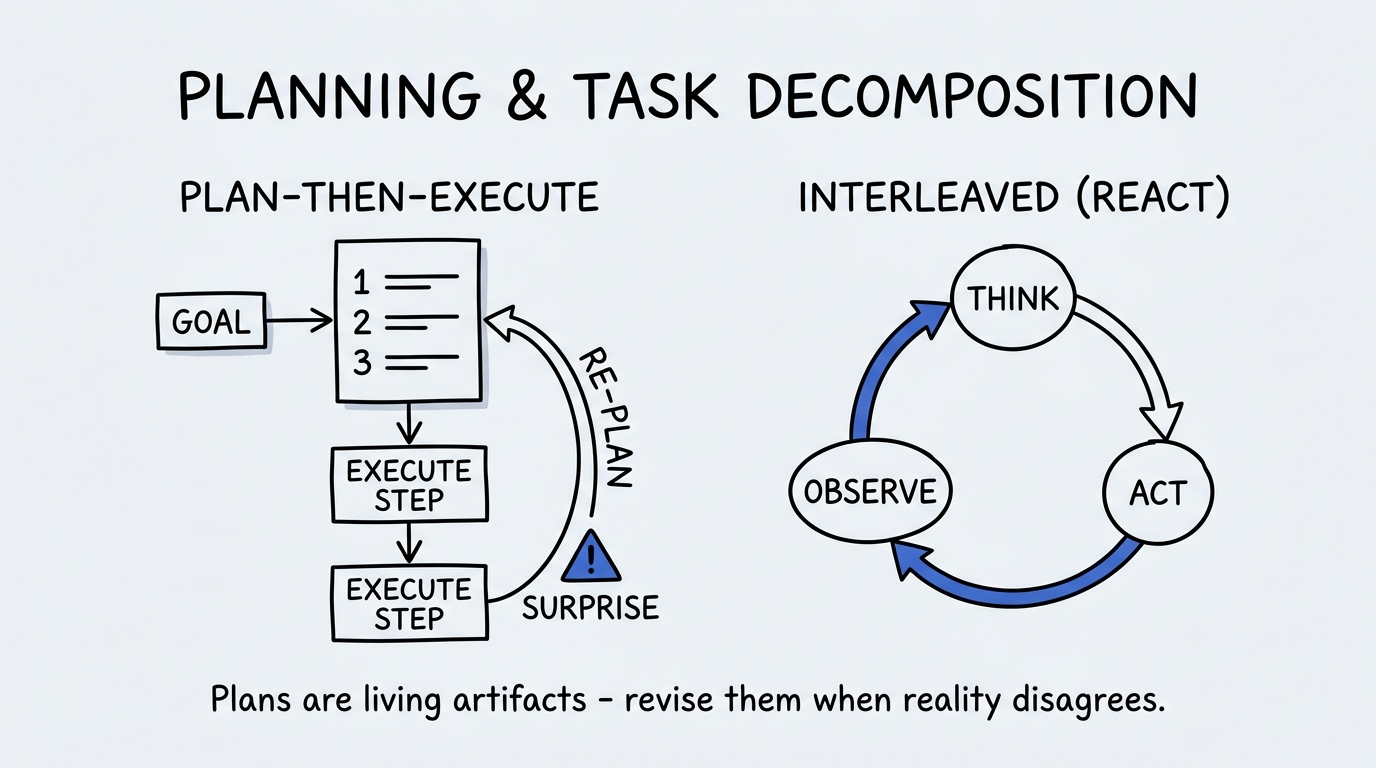
Hand-drawn diagram titled 'Planning & Task Decomposition'. Left, plan-then-execute: a GOAL box feeds a numbered checklist flowing down through EXECUTE STEP boxes, with a RE-PLAN arrow looping back from a cobalt SURPRISE triangle. Right, interleaved (ReAct): THINK, ACT, and OBSERVE joined in a cobalt circular loop. Caption: plans are living artifacts - revise them when reality disagrees.View full-size diagram ↗

What it is

How an agent turns one big goal into executable steps. Two poles: plan-then-execute, where it drafts a full step list before acting, and interleaved planning (the ReAct pattern), where it picks the next step fresh after each tool result.

How it works

Plan-then-execute wires a planner that writes an ordered task list, an executor that works through it, and a re-planner that revises when results diverge. Interleaved agents keep the plan one step ahead at all times, re-reading the latest observation each turn. Production harnesses blend both: a rough plan held in context as a todo list, revised whenever reality disagrees.

A concrete example

Ask a coding agent for a multi-file refactor and it writes a todo list first, then works item by item, re-ordering when tests fail. Deep-research agents decompose the question into sub-searches, fan them out in parallel, then synthesize.

Why it matters

Decomposition drives cost, latency, and reliability. Upfront plans let cheaper models run the easy steps, allow parallel fan-out, and give humans a checkpoint before the agent acts. Interleaved planning burns more frontier-model turns but recovers far better when the environment surprises.

What people get wrong: That a more detailed upfront plan means a more reliable agent. Long fixed plans go stale on the first surprise; agents that treat the plan as a living artifact beat agents that obey a script. Planning quality is mostly harness structure and prompting, not a switch inside the model.

Today's top 5

BizOpenAI signs a 20-year, 10GW Ohio data-center lease with SoftBank's SB Energy; Nvidia backstops up to $105B and invests $1.5B in SBE.

The largest AI infrastructure commitment yet - and the clearest look so far at who actually carries the risk.

LabsZ AI's GLM-5.3 lands with claims of best-in-class open coding performance and strong cyber-range results; weights ship in two weeks.

If the coding claims hold, the open-weights frontier keeps closing the gap at a fraction of the price.

ResearchA neurosurgery resident proved Crouzeix's Conjecture (open since 2004) with GPT-5.6 Sol in a 16-hour run; experts verified, review pending.

When a proof can come from anyone with a subscription and 16 hours of compute, verification becomes the scarce skill.

AgentsOpenAI's opt-in Computer History logs clicks and typing so ChatGPT and Codex carry memory of your recent on-computer work.

Ambient memory of everything you do on a computer is a genuinely new context source - and a genuinely new consent question.

ResearchWiz shows an AI-generated GitHub Copilot 'Autofix' merged through CI/CD opened the door to compromising Snowflake's Jira.

A clean public case of AI-written code becoming the supply-chain hole. Treat agent output in CI as untrusted input.

See the full wire feed →

Quick check

Was this issue useful?

Get Crabhaus in your inbox

A concise daily briefing on the AI developments worth understanding.