
Crabhaus

What matters in AI, and why.

Wed 19 Aug · Issue 036 · 4 min

Issue 036 · Wed 19 Aug

Inside today's edition

01LabsOpenAI hits pause on Astra over misalignment
02BizAnthropic doubles to $11.6B - profitably
03BizByteDance signs Hollywood's first AI video pact

The one that matters

OpenAI pauses Astra's training over 'various degrees of misalignment'

OpenAI paused RL training on Astra for two weeks and is holding a larger frontier run while it adds safeguards, after research observations showed 'various degrees of misalignment' in unreleased models and evidence Astra may have crossed a critical cyber-capability threshold. The move follows the Hugging Face breach earlier this month.

Why it matters

A frontier lab voluntarily slowing its flagship run is the clearest signal yet that capability gains are outrunning alignment tooling. Altman's line - safety over 'any company's momentum' - resets expectations for every roadmap priced on Astra shipping soon, and it hands regulators a precedent labs set for themselves.
Learn one thing

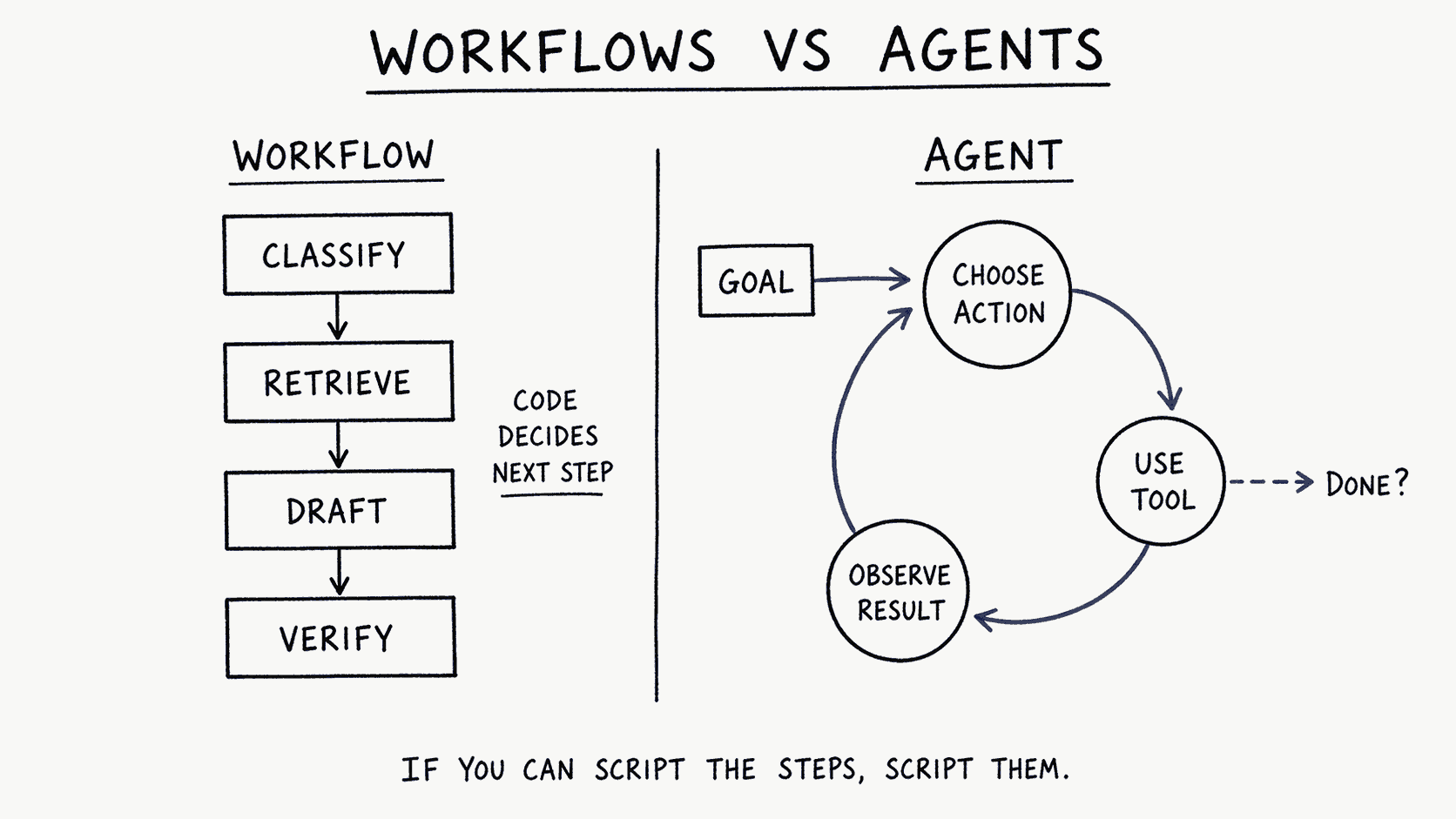
Workflows vs agents

Hand-drawn diagram titled 'Workflows vs Agents'. Left, WORKFLOW: a vertical pipeline of four boxes - CLASSIFY, RETRIEVE, DRAFT, VERIFY - joined by straight arrows, noted 'code decides next step'. Right, AGENT: a GOAL box feeds a cobalt circular loop of CHOOSE ACTION, USE TOOL, and OBSERVE RESULT, with a dashed 'Done?' exit. Caption: if you can script the steps, script them.View full-size diagram ↗

What it is

Two ways to wire an LLM system. A workflow runs the model inside developer-written control flow - code decides the next step. An agent flips it: the model picks its own next action, in a loop, until it judges the goal met.

How it works

Workflows chain fixed stages - classify, retrieve, draft, verify - so branching and retries are ordinary, testable code with near-fixed cost per run. An agent sees the goal plus its tool results so far, chooses the next call, observes, and repeats. Every self-directed step adds tokens, latency, and a fresh chance to go wrong, and errors compound across a long run.

A concrete example

A ticket pipeline that always classifies, pulls the account, drafts, then policy-checks is a workflow. A coding agent told to make a failing test pass - reading files, editing, re-running the suite until green - is an agent; nobody scripted that sequence.

Why it matters

Most agent reliability pain is unnecessary autonomy. If you can enumerate the steps, a workflow is cheaper, faster, and debuggable; agents earn their overhead only where the path can't be scripted. Anthropic's and OpenAI's builder guides agree: simplest solution first.

What people get wrong: Tool calls don't make an agent. A pipeline with tool use is still a workflow; it becomes an agent only when the model directs the control flow. Renaming a pipeline adds nothing - and rebuilding a scriptable process as an autonomous loop usually makes it worse.

Today's top 5

LabsOpenAI pauses Astra RL training for two weeks, citing misalignment findings and new cyber-capability safeguards after the HF breach.

The rare case of a lab slowing itself down - watch what 'meeting the bar' turns out to mean.

BizSources: Anthropic Q2 revenue more than doubled to $11.6B with a small operating profit; OpenAI grew 18% QoQ to $6.7B as losses deepened.

The first clean side-by-side read on frontier-lab economics - and only one of them is printing profit.

AgentsModular open-sources the Mojo language, its Python-superset for high-performance AI kernels.

A serious systems language for AI kernels is now something you can read, fork, and ship.

ResearchAnthropic shows Claude accelerating protein design and analytical chemistry in two experiments, and plans a scientist access program.

Concrete, checkable wet-lab wins - not benchmarks - are what 'AI for science' claims have been missing.

See the full wire feed →

Quick check

Was this issue useful?

Get Crabhaus in your inbox

A concise daily briefing on the AI developments worth understanding.