
Crabhaus

What matters in AI, and why.

Thu 20 Aug · Issue 037 · 4 min

Issue 037 · Thu 20 Aug

Inside today's edition

01BizStripe buys OpenRouter for $7.5B
02BizOpenAI's zero-data-retention frontier push
03Agentssmolvm: open-source sandboxes for agents

The one that matters

Stripe pays $7.5B for OpenRouter, and the token marketplace becomes payments infrastructure

Stripe confirmed it is acquiring OpenRouter for $7.5B - $1.5B to the startup's founders and $6B to its investors. OpenRouter says it keeps its name, product, and roadmap. Patrick Collison framed the deal around businesses soon managing 'both revenue flows and token flows', calling OpenRouter 'the world's leading token marketplace'.

Why it matters

Model routing just became payments infrastructure. If tokens are a metered spend sitting next to revenue, the neutral router that allocates them is worth owning - and the model-picker many AI builders rely on now belongs to the company that also moves their money. Watch whether provider neutrality survives ownership.
Learn one thing

Multi-agent orchestration patterns

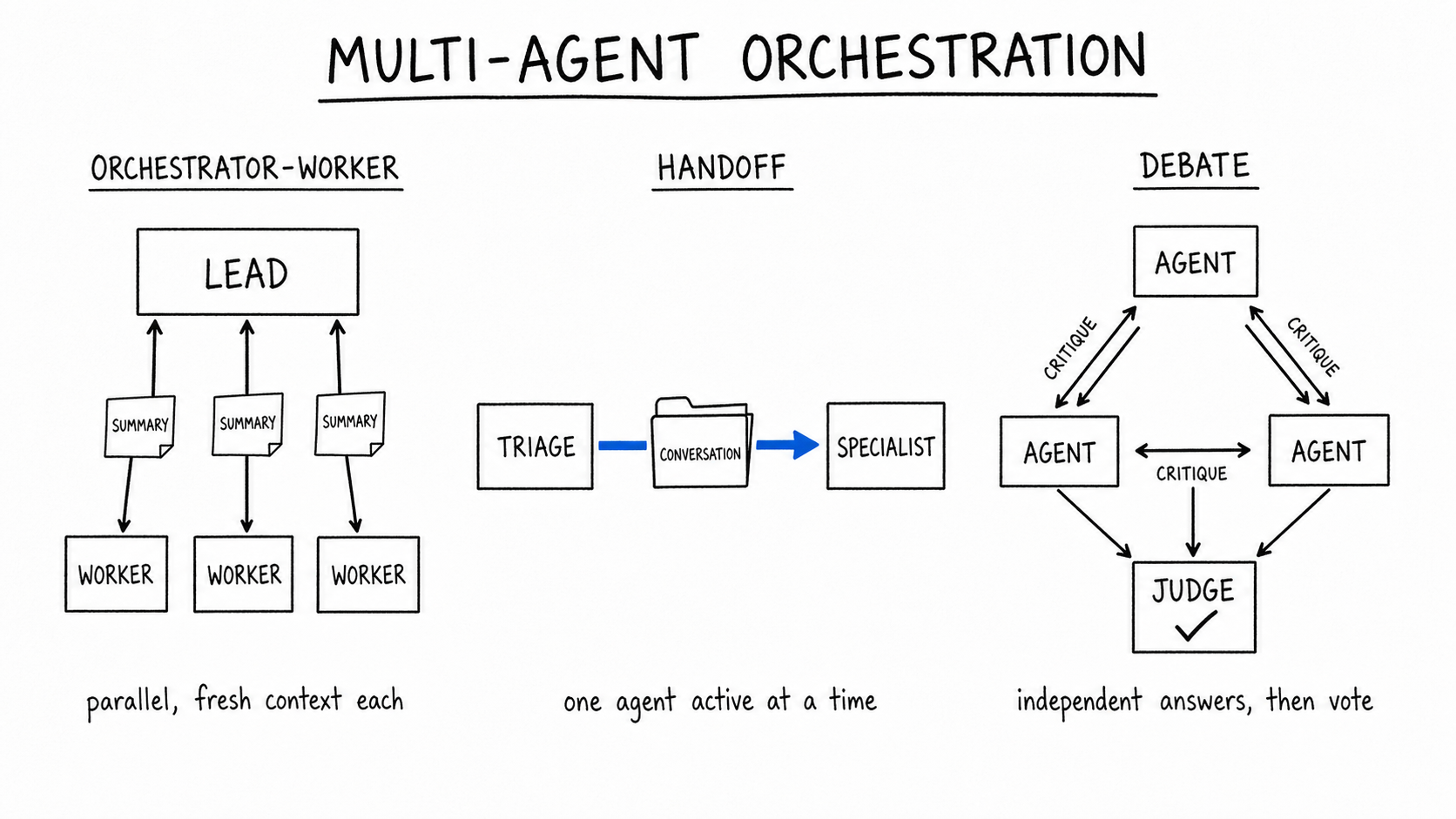
Hand-drawn three-panel diagram 'Multi-Agent Orchestration'. ORCHESTRATOR-WORKER: LEAD delegates to three WORKERs, each returning a SUMMARY slip ('parallel, fresh context each'). HANDOFF: a cobalt arrow passes a CONVERSATION folder from TRIAGE to SPECIALIST ('one agent active at a time'). DEBATE: three AGENTs trade CRITIQUE arrows into a JUDGE with a checkmark ('independent answers, then vote').View full-size diagram ↗

What it is

The recurring shapes for coordinating multiple LLM agents: orchestrator-worker (a lead agent splits the task across parallel sub-agents), handoffs (one agent passes the whole conversation to a specialist), and debate (independent agents answer, then critique or vote).

How it works

An orchestrator plans, spawns workers with fresh context windows, and synthesizes their short summaries. Handoffs transfer control, not work - one agent active at a time, each with a small, focused prompt. Debate buys error-checking by running one question through independent contexts and reconciling disagreements with a judge or a vote.

A concrete example

Anthropic's research feature: a lead agent plans, parallel search sub-agents explore, and the lead synthesizes. Anthropic reports 90.2% better results than a single-agent Claude Opus 4 baseline on its internal research eval - at roughly 15x the tokens of a normal chat.

Why it matters

Coordination buys context isolation, wall-clock parallelism, and independent perspectives; it costs tokens, latency, and new failure modes like duplicated work. Orchestration pays on tasks that decompose cleanly - research, review, migration sweeps - and mostly multiplies the bill on tightly coupled work.

What people get wrong: More agents isn't smarter. Cognition's team argues most agent-to-agent chat systems underperform one well-managed context, because splitting coupled work loses shared state. Default to a single agent; add orchestration when the task genuinely parallelizes.

Today's top 5

BizStripe confirms its OpenRouter acquisition at $7.5B - $1.5B to founders, $6B to investors; OpenRouter keeps its name, product, and roadmap.

The neutral model router is now owned by a payments giant - neutrality is the thing to watch.

BizOpenAI offers zero data retention on frontier models via private safety processing; monitoring adds ~20% compute overhead OpenAI absorbs.

Privacy and safety monitoring stop being a trade-off - and OpenAI is eating the compute bill to prove it.

Agentssmolvm, an Apache-2.0 microVM runtime, gives agent sandboxes kernel isolation, GPU passthrough, and live forking with sub-200ms boots.

The sandbox gap that forced Kimi's team to build custom infrastructure now has an off-the-shelf answer.

LabsOrnith-1.5 open-source models (397B/35B MoE, 9B dense) train via a self-improvement loop; 397B matches Claude Opus 4.8 on Terminal-Bench.

A self-improvement training loop reaching Opus-class agentic scores is the open-weights story of the week.

ResearchTerence Tao's ICM 2026 essay 'Mathematics in the age of AI' maps how the field should adapt once AI handles research-level mathematics.

The field's leading mathematician is planning for research-level AI as a given - the question is workflow, not whether.

See the full wire feed →

Quick check

Was this issue useful?

Get Crabhaus in your inbox

A concise daily briefing on the AI developments worth understanding.