
Crabhaus

What matters in AI, and why.

Fri 21 Aug · Issue 038 · 4 min

Issue 038 · Fri 21 Aug

Inside today's edition

01ResearchClaude runs protein design - and it works
02AgentsSlack Code puts AI agents in your channels
03BizAnthropic preps a SpaceX-sized IPO

The one that matters

Claude ran the protein-design loop itself - and the molecules worked

Anthropic let Claude run protein-design campaigns nearly autonomously - one expert-written prompt, internet access, and tools. Partner labs Twist Bioscience and Adaptyv Bio synthesized and tested the designs: working binders on 14 of 15 targets, with 22-35% hit rates against a typical 10-15%. Opus 5 also read raw instrument files, measuring purity in 19 minutes versus the lab's four days.

Why it matters

The point isn't that AI touched biology - specialist models have for years. It's that a general-purpose agent ran the campaign end to end and beat industry-standard hit rates under wet-lab validation. Days after Dario Amodei predicted 'early glimmers' months out, the earliest step of drug discovery looks automatable with off-the-shelf agents.
Learn one thing

Sub-agents and context isolation

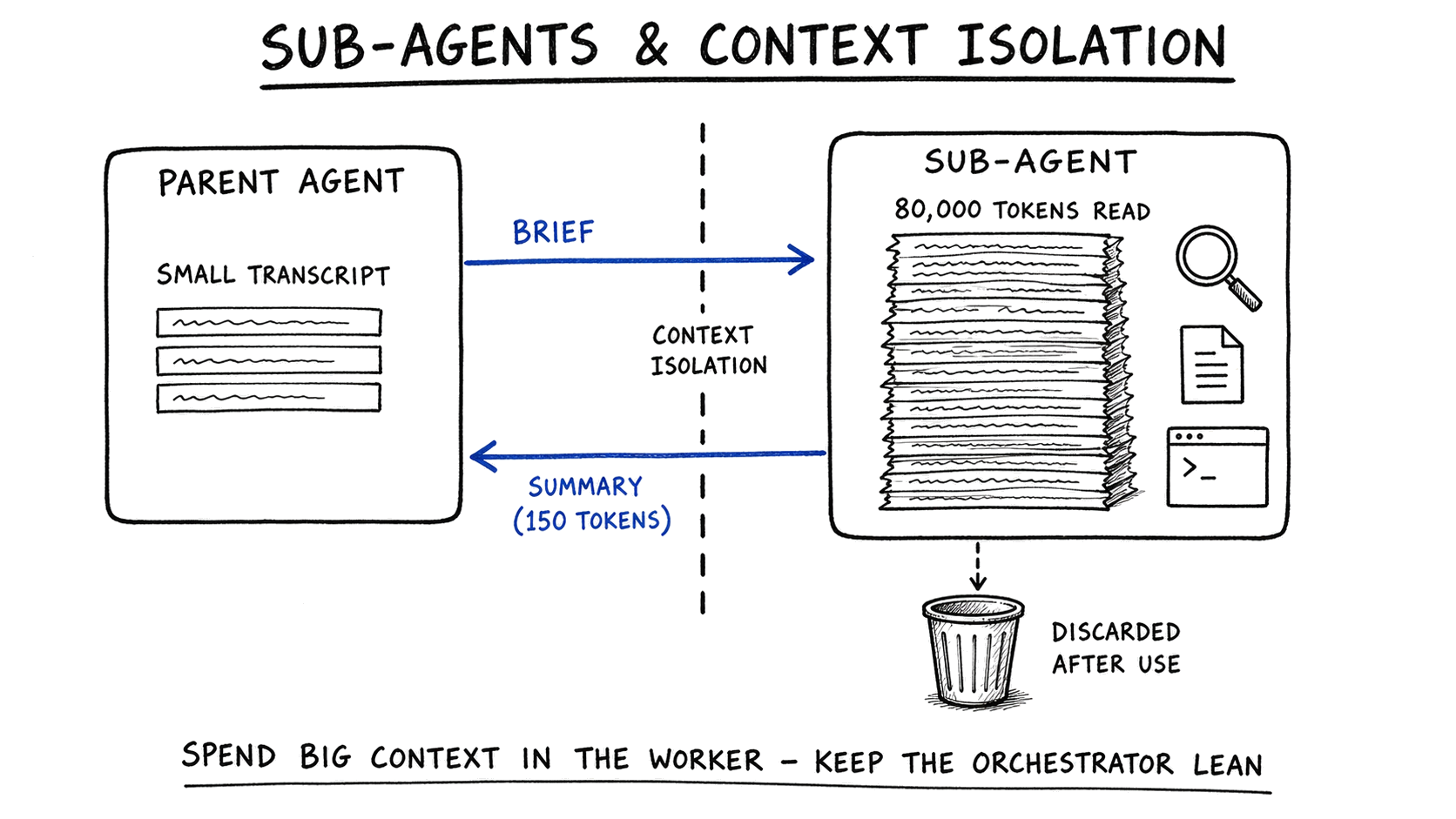
Hand-drawn diagram 'Sub-Agents & Context Isolation'. A PARENT AGENT box holds a small three-line transcript. A cobalt BRIEF arrow crosses a dashed wall marked CONTEXT ISOLATION into a SUB-AGENT box with a tall messy stack labeled '80,000 tokens read'. A cobalt SUMMARY (150 tokens) arrow returns; the stack drops into a bin marked 'discarded after use'. Caption: spend big context in the worker.View full-size diagram ↗

What it is

A sub-agent is a separate model instance an AI agent spawns to handle one delimited task in its own fresh context window. Isolation means the worker sees only the brief it is handed - not the parent's transcript - and the parent gets back only the result, not the worker's working.

How it works

The parent writes a short brief per sub-task. Each worker starts clean with that brief plus tools, does the heavy reading and searching on its own token budget, and returns a compressed summary; everything else it read is discarded. The parent's transcript grows by brief plus summary - small, cheap to re-send, clear - and isolated workers can safely run in parallel.

A concrete example

Asked why a test fails in a big repo, an agent spawns a search worker. The worker reads 60 files - roughly 80,000 tokens - and returns a 150-token answer naming the three relevant functions. Every later turn is priced and reasoned against those 150 tokens, not the dump.

Why it matters

Long transcripts hurt twice: models attend less reliably to facts buried mid-context ('context rot'), and every prior token is re-processed on every call, taxing each turn's cost and latency. Isolation is token hygiene - spend big context once in a disposable worker, keep the orchestrator lean.

What people get wrong: More sub-agents isn't automatically smarter. A worker knows nothing you left out of its brief, so siloed constraints produce confidently wrong work. Sub-agents shine on read-heavy, parallelizable research; for tightly coupled edits, one well-managed context beats a committee.

Today's top 5

ResearchAnthropic: Claude models ran protein-design campaigns near-autonomously; binders worked on 14 of 15 targets at 22-35% lab hit rates.

General agents running wet-lab-validated campaigns moves AI-for-biology from specialist models to off-the-shelf tooling.

AgentsSlack launches Slack Code: project channels where teams code with AI agents from Anthropic, GitHub, Cognition, and Vercel, on all plans.

The place work already happens just became an IDE - agents as teammates is now a default-on enterprise product.

BizBloomberg: Anthropic expects an IPO matching or topping SpaceX's record listing, and may file publicly as soon as the end of August.

A SpaceX-scale listing would be the largest AI capital event yet - and the filing may land within days.

BizNvidia strikes a non-exclusive $6B licensing deal with Poolside and invests $1B at a $12B pre-money valuation; 109 staff get offers.

Buying the model factory without an acquisition is a new template for consolidating AI talent and IP.

AgentsReplit's new Free Mode runs routine tasks on OpenAI's GPT-5.6 Luna without spending plan credits, leaning on Luna's 80% price cut.

When cheap models stop meaning dumb models, the economics of every AI product change.

See the full wire feed →

Quick check

Was this issue useful?

Get Crabhaus in your inbox

A concise daily briefing on the AI developments worth understanding.