
Crabhaus

What matters in AI, and why.

Sat 22 Aug · Issue 039 · 4 min

Issue 039 · Sat 22 Aug

Inside today's edition

01ResearchNVIDIA's harness takes ARC-AGI-3 to 100%
02LabsOpenAI cuts GPT-5.6 Sol prices over 20%
03BizUber's €825M fine for automated firings

The one that matters

The harness, not the model: NVIDIA's AVO hits 100% on ARC-AGI-3

NVIDIA's Agentic Variation Operators (AVO) system completed all 183 levels across ARC-AGI-3's 25 public environments - a perfect score - running on Claude Opus 5, which manages about 30% as a bare model. Persistent memory, supervision, and tool use did the lifting. The same architecture ran autonomous GPU-kernel work: 500+ directions explored, kernels up to 10.5% faster than FlashAttention-4.

Why it matters

The 70-point gap between bare model and full system is all scaffolding. For builders, that's the actionable part: the ceiling of a deployed agent is set as much by the harness - memory, supervision, tools - as by the weights. It also means bare-model benchmark numbers systematically undersell what a well-built system on the same model can do.
Learn one thing

Human-in-the-loop approval gates

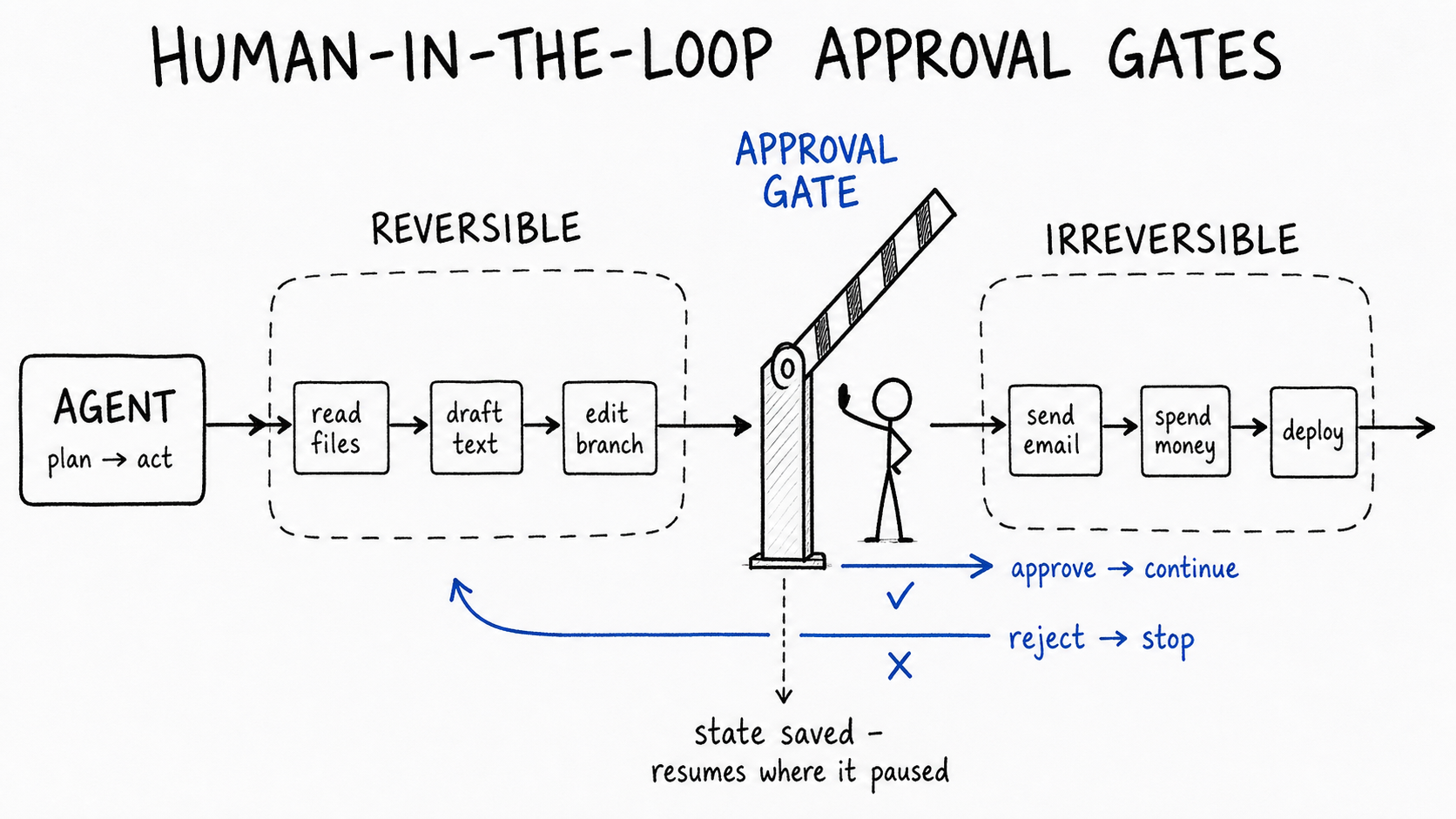
Hand-drawn diagram titled 'Human-in-the-loop approval gates'. An AGENT box sends arrows through a dashed REVERSIBLE zone (read files, draft text, edit branch) to a cobalt APPROVAL GATE barrier, where a stick figure raises a hand before the IRREVERSIBLE zone (send email, spend money, deploy). Cobalt arrows mark approve-continue and reject-stop; a note reads 'state saved - resumes where it paused'.View full-size diagram ↗

What it is

A deliberate pause built into an agent workflow: the agent stops before executing a specific action and waits for a person to approve, edit, or reject it. It's a runtime control on what an agent may do - separate from anything that happens during training.

How it works

The agent proposes an action, the framework checkpoints state, and execution pauses until a human answers - in LangGraph, interrupt() saves graph state and a resume Command feeds the decision back. Placement is the design question: reversible actions (reading, drafting, branch edits) run freely; irreversible or outward-facing ones (sending, spending, deleting, deploying) wait for approval.

A concrete example

A team coding agent iterates on code in a shared workspace all day, but the deploy only goes out after a human signs off - the pattern Slack shipped this week in Slack Code. In a personal agent: it drafts replies freely, but sending an external email needs your click.

Why it matters

Agents fail in ways tests don't catch, and one bad irreversible call can outweigh a thousand good ones. A well-placed gate turns a catastrophic error into a recoverable one - which is exactly what lets you grant broad autonomy everywhere else, plus an audit trail of who approved what.

What people get wrong: That more approval prompts means more safety. Gating everything trains people to rubber-stamp - approval fatigue - so the one prompt that mattered gets clicked through. The discipline is fewer, sharper gates: approvals where actions are irreversible or leave your system, free rein where mistakes are cheap.

Today's top 5

LabsDeepSeek ships deepseek-v4-flash-vision-exp, an API-only multimodal Flash variant it says nears Opus 4.8 on multimodal agentic tests.

DeepSeek chasing frontier multimodal agentic parity - notably API-first, with no weights drop yet.

BizA Dutch regulator fines Uber €825M under GDPR for deactivating drivers through automated systems without telling them - second-largest ever.

The second-largest GDPR fine ever is about automated decisions - a compliance bar every agent deployment inherits.

AgentsAsana says Codex removed a legacy testing framework in two weeks for about $12K - work it had estimated at five years and $6M.

A named enterprise putting hard numbers - $12K versus $6M - on agentic code migration.

See the full wire feed →

Quick check

Was this issue useful?

Get Crabhaus in your inbox

A concise daily briefing on the AI developments worth understanding.