
Crabhaus

What matters in AI, and why.

Mon 24 Aug · Issue 041 · 3 min

Issue 041 · Mon 24 Aug

Inside today's edition

01BizNvidia warns of 15%+ AI system price hikes
02BizFable 5 plateaus as firms trade down models
03LabsMystery 'Ox Alpha' model floods OpenRouter

The one that matters

Nvidia to its biggest customers: prices rise 15%+ in 2027

Bloomberg reports Nvidia has told some of its largest customers that prices on its AI systems - including the upcoming Vera Rubin platform and current Grace Blackwell - will jump more than 15% starting in early 2027, according to people familiar with the notifications.

Why it matters

AI compute is already the biggest line item in any serious deployment, and the industry's default supplier just signaled the squeeze tightens from here. Expect the maths to shift further toward efficiency: cheaper models, routing, quantization - and the open-weight alternatives several stories in today's feed are chasing.
Learn one thing

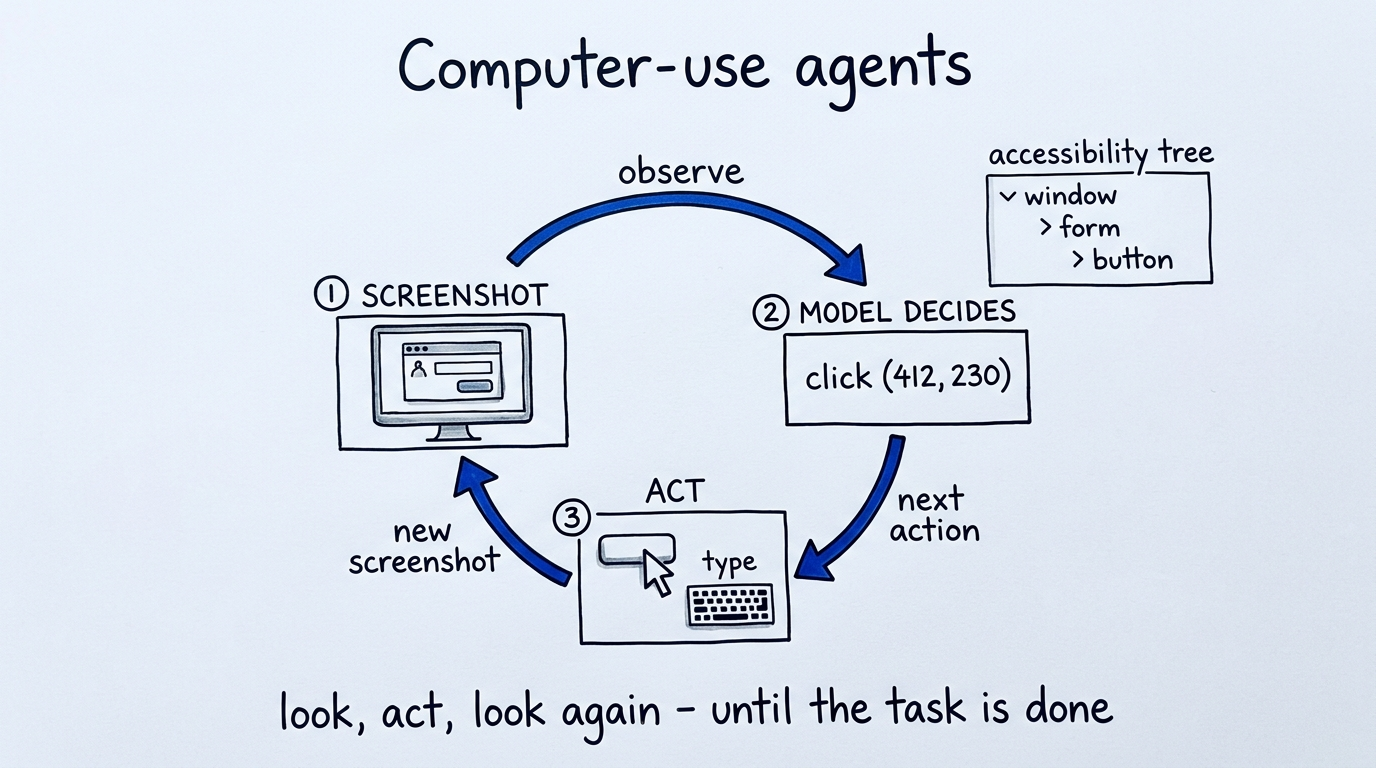
Computer-use agents

Hand-drawn diagram titled 'Computer-use agents'. Three boxes in a loop joined by cobalt arrows: SCREENSHOT (a monitor with an app window), MODEL DECIDES ('click (412, 230)'), and ACT (a cursor and keyboard labeled 'type'); arrows read 'observe', 'next action', 'new screenshot'. A side panel shows an accessibility tree: window > form > button. Caption: 'look, act, look again'.View full-size diagram ↗

What it is

An AI agent that operates software the way a person does: it looks at the screen, moves the cursor, clicks, and types instead of calling an API. The model gets control of a real desktop or browser and works through the same interface you do - including apps that were never built for automation.

How it works

A screenshot-act loop. Each turn the harness captures the screen - often with the accessibility tree, the structured element list the OS exposes for screen readers - and the model replies with one action: click these coordinates, type this text, scroll. Execute it, take a fresh screenshot, repeat until done. The hard part is grounding: turning 'the blue Submit button' into exact pixels.

A concrete example

Ask Claude's computer-use tool to file an expense report: it screenshots the browser, clicks into the expenses app, types amounts into form fields, scrolls to the submit button, and reads the confirmation screen - dozens of model calls for a task a human finishes in a minute.

Why it matters

Most software has no API: internal dashboards, legacy desktop apps, government portals. Computer use is the only general route to automating that long tail. It is also far harder than API tool use - an API has a typed contract; a GUI offers ambiguous pixels and shifting layouts. On OSWorld's real desktop tasks, humans hit about 72% while the best early agents scored under 15%.

What people get wrong: That it's RPA with a model bolted on. RPA replays brittle recorded selectors and breaks when layouts shift; a computer-use agent re-perceives the screen every step and picks its next action, so it recovers from surprises - at the cost of speed and a model call per step. It trades fragility for latency, not a strict upgrade.

Today's top 5

BizNvidia tells top customers that system prices, including Vera Rubin and Grace Blackwell, will jump 15%+ starting early 2027.

The default AI compute supplier raising prices reprices every deployment plan built on today's numbers.

BizRamp data via FT: Fable 5 plateaus at ~11% of Anthropic tool spend as firms shift to cheaper models; Opus 5 has overtaken it.

Real spend data saying 'good enough and cheaper wins' - the strongest signal yet that price beats peak capability.

LabsOx Alpha, a stealth model with 1M-token multimodal context and 100T free tokens/day, goes viral on OpenRouter; clues point to Zhipu.

Whoever it is, someone is giving away frontier-class inference at a scale only a handful of labs could serve.

ResearchSemiAnalysis: across LLM eras - scaling, reasoning, agentic - open models have halved the time to catch the first closed model.

If the catch-up clock keeps halving, closed-model moats become months, and pricing power follows.

AgentsInherent, founded by DeepMind alumni with $50M seed, says its Faraday agent beats GPT-5.5 at reproducing research-paper findings.

Reproducing papers is a real benchmark for science agents - and a startup claims the frontier labs just lost it.

See the full wire feed →

Quick check

Was this issue useful?

Get Crabhaus in your inbox

A concise daily briefing on the AI developments worth understanding.