
Crabhaus

What matters in AI, and why.

Tue 25 Aug · Issue 042 · 3 min

Issue 042 · Tue 25 Aug

Inside today's edition

01BizNvidia's Groq 3 LPX inference chip hits production
02AgentsMeta's OpenClaw-style Hatch platform lands in weeks
03LabsOx Alpha's tokenizer twist points to Microsoft

The one that matters

Nvidia's dedicated inference chip is now in full production

Nvidia says Groq 3 LPX, its inference-only accelerator, has entered full production, posting 3,431 tokens/sec on Gemma 4 31B with a 100,000-token input - which it claims is 4x the next public endpoint. Nebius signed as first customer, and SpaceX will fly a space-optimised Vera Rubin NVL72 to orbit next year.

Why it matters

Agent workloads are dominated by inference, not training - long contexts, many calls, tight latency. Silicon built only for that, shipping at volume, reprices every serious agent deployment. The Register's read of the same benchmark is a useful corrective: one spectacular number on one model is not a price list.
Learn one thing

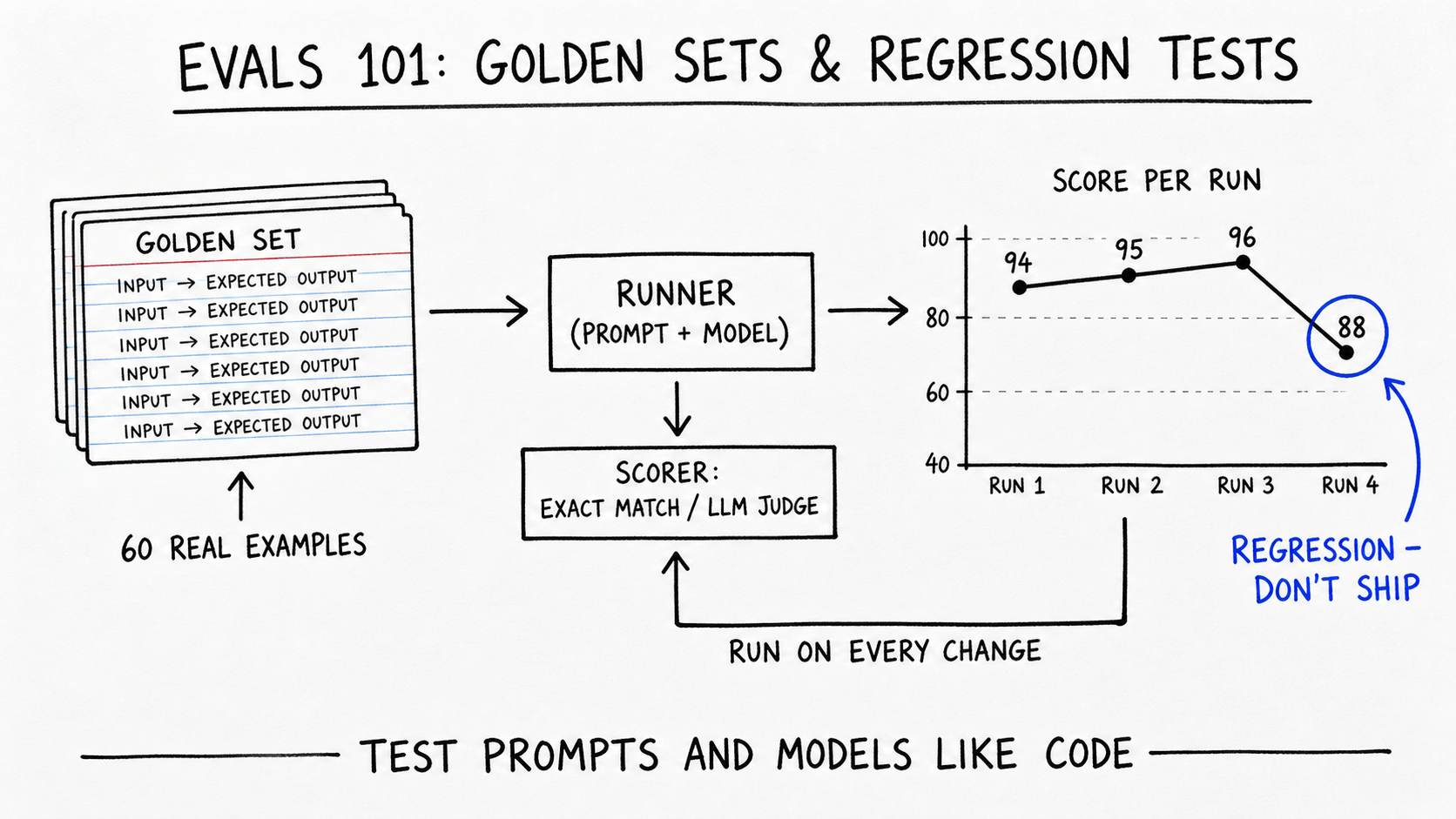
Evals 101: golden sets and regression tests

Hand-drawn diagram titled 'Evals 101: Golden sets & regression tests'. Index cards labeled 'Golden set' ('input -> expected output', '60 real examples') feed a 'Runner (prompt + model)' box with a 'Scorer: exact match / LLM judge' box below. A 'Score per run' chart shows 94, 95, 96 then 88, circled in cobalt: 'Regression - don't ship'; a loop arrow reads 'run on every change'.View full-size diagram ↗

What it is

A repeatable test suite for an AI feature: a fixed set of real inputs with known-good expected outputs - the golden set - plus a scorer that grades the model's answers. You run it every time you change a prompt, swap a model, or touch the pipeline, exactly like unit tests for ordinary code.

How it works

Collect 30-100 real examples of your task, label each with the expected answer or a pass/fail rubric. A runner replays every input through the current prompt and model, then scores outputs: exact-match or assertions for structured tasks, an LLM judge with a written rubric for free text. A change ships only if the score holds or improves; the judge itself is spot-checked against human labels.

A concrete example

A support-bot team keeps 60 real tickets labeled with the correct category and refund decision. When a cheaper model launches, they rerun the suite: it matches 58 of 60 - but flips two refund-eligible tickets to deny. The models felt identical in casual use; the golden set surfaced a costly regression in minutes.

Why it matters

LLM behaviour shifts in non-obvious ways with every prompt edit or model update. Without a fixed test set, teams judge changes by re-trying favourite prompts and quietly break edge cases. A golden set turns 'feels better' into a measured delta, makes model swaps a ten-minute decision, and is cheap: a few dozen well-chosen examples catch most regressions.

What people get wrong: That you need thousands of labels or a benchmark like MMLU. Leaderboards measure general skill, not your task - a model can climb them while getting worse at your workload. Dozens of task-specific examples beat generic benchmarks for shipping decisions, and an unaudited LLM judge is its own trap: judges drift and share blind spots with the models they grade.

Today's top 5

BizNvidia's inference chip Groq 3 LPX enters full production claiming 3,431 tok/s on Gemma 4 31B at 100K context; Nebius is first customer.

Inference-only silicon at production volume changes the cost curve every agent product is built on.

AgentsDocs: Meta plans to launch Hatch, its OpenClaw-style agent platform, in coming weeks; new model Watermelon lands in October.

A three-billion-user company entering personal agents resets distribution for the whole category.

LabsZ.ai's GLM-5.3 reuses GLM-5.2's 743B base, gaining via scaled post-training alone; DeepSWE jumps 46.2 to 66.9. Weights due in ~2 weeks.

Big capability jumps without touching the base model - post-training is where the race moved.

LabsOx Alpha update: full DeepSWE runs put it at 63%, near Fable 5 at fewer tokens; its OpenAI cl100k tokenizer shifts guesses to Microsoft.

If a Flash-class anonymous model really trades blows with the frontier, the whodunit matters less than the trendline.

See the full wire feed →

Quick check

Was this issue useful?

Get Crabhaus in your inbox

A concise daily briefing on the AI developments worth understanding.