
Crabhaus

What matters in AI, and why.

Wed 26 Aug · Issue 043 · 3 min

Issue 043 · Wed 26 Aug

Inside today's edition

01BizOpenAI's Jalapeño chip takes aim at Nvidia
02BizApple's M5 Ultra: 512GB for local models
03LabsThomson Reuters built a legal LLM for $40M

The one that matters

OpenAI's first chip posts numbers Nvidia has to answer

OpenAI says Jalapeño, the inference ASIC it co-designed with Broadcom in 16 months, delivered 1.5-1.9x more AI work per watt and 1.7-3.6x lower latency than Nvidia hardware across GPT-OSS, DeepSeek R1, and Kimi K2.5 1T. SemiAnalysis' independent breakdown broadly backs the efficiency story.

Why it matters

Custom inference silicon from the biggest model shop reprices the agent economy - though 30-year chip veterans are openly sceptical a v1 part holds these numbers at production scale. Either way, Nvidia's per-watt moat now has a named challenger with published benchmarks.
Learn one thing

LLM-as-judge and its pitfalls

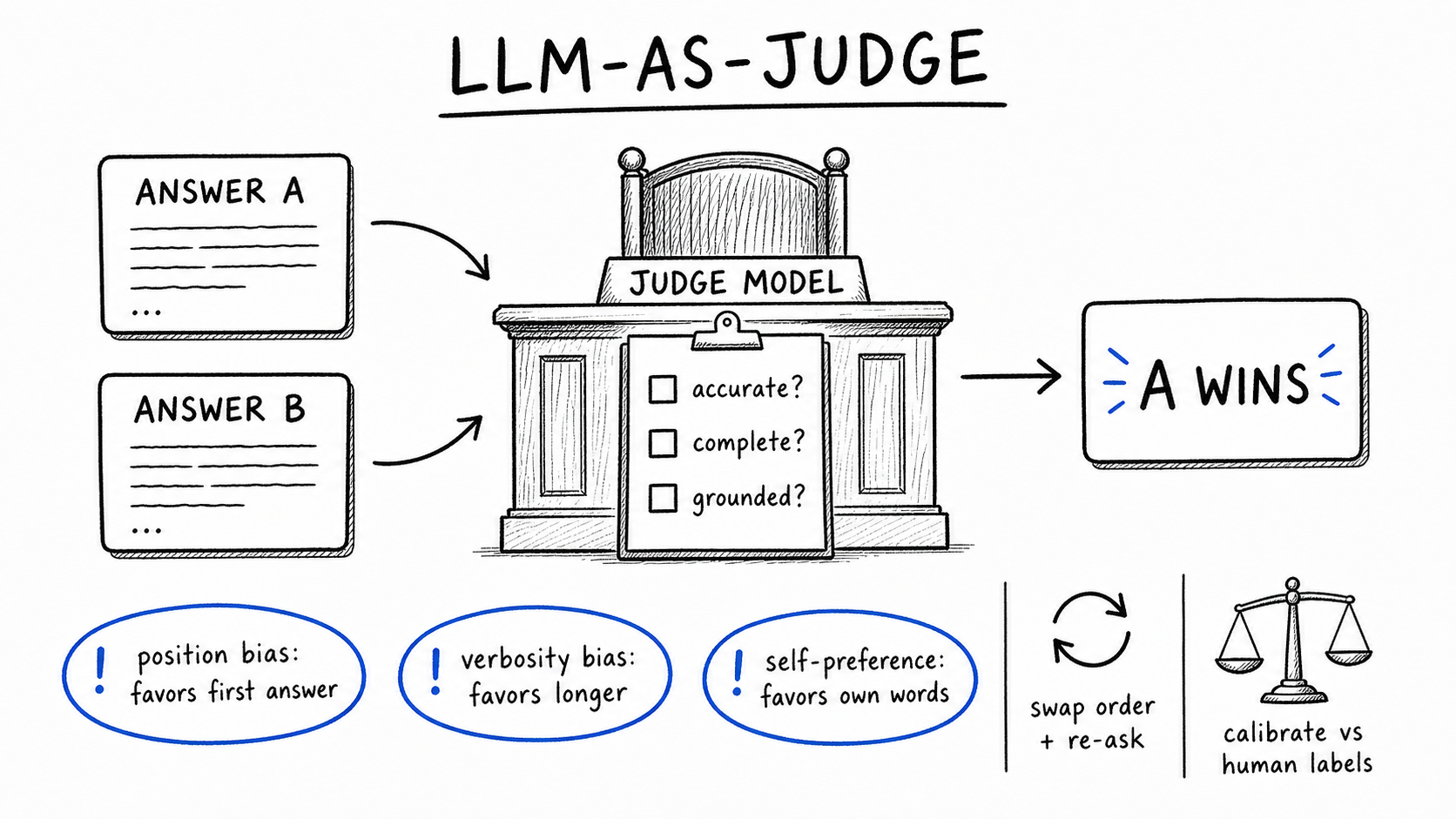
Hand-drawn LLM-as-judge diagram comparing Answer A and Answer B through a rubric, with position, verbosity, and self-preference bias warnings.View full-size diagram ↗

What it is

Using a strong LLM to grade another model's outputs - scoring answers against a written rubric, or picking the better of two responses - in place of human raters or exact-match metrics. It now powers most free-text evals, leaderboards, and automated regression suites.

How it works

The judge gets the task, the candidate output, and grading instructions, and returns a structured verdict. Pairwise mode picks between two answers; single-answer mode scores against a rubric; reference-guided mode adds a known-good answer. Careful pipelines swap answer order, force a fixed verdict format, and first check the judge against human-labelled examples.

A concrete example

Testing a cheaper model for a support agent: a judge compares old vs new drafts on 100 real tickets, run twice with positions swapped - verdicts that flip with the ordering are discarded as noise. The judge is trusted only after it agrees with 30 human-labelled pairs about as often as a second human would.

Why it matters

Human evaluation is too slow and costly for every prompt tweak, and string matching can't grade prose. The MT-Bench work measured GPT-4 agreeing with human preferences over 80% of the time - human-human level - making evals cheap enough for CI. But judge biases flow silently into leaderboards, training rewards, and ship decisions.

What people get wrong: That a smart model is automatically a fair grader. Judges measurably favour the first answer shown, longer answers, and their own writing - swapping two answers' order alone can flip a verdict. A judge is an instrument: calibrate it against human labels, and re-check whenever the judge model or prompt changes.

Today's top 5

LabsThomson Reuters unveils Thomson, a Qwen-based legal model built for ~$40M; internal tests put it ahead of frontier models in some areas.

The build-vs-rent maths just tilted: $40M on an open base against years of frontier API invoices.

See the full wire feed →

Quick check

Was this issue useful?

Get Crabhaus in your inbox

A concise daily briefing on the AI developments worth understanding.