
Crabhaus

What matters in AI, and why.

Sun 30 Aug · Issue 047 · 3 min

Issue 047 · Sun 30 Aug

Inside today's edition

01BizDebian votes: responsible generative AI use allowed
02LabsSimon Willison sizes up Tencent's 770B open Hy4
03AgentsvLLM 0.28.0: 584 commits of inference speedups

The one that matters

Debian votes to allow AI, responsibly

Debian's general-resolution vote on large language models is in, and the winner is 'Responsible Use of Generative AI': the project neither endorses nor prohibits generative tools in development, packaging, or docs. Contributions must meet the same standards of quality, correctness, maintainability, and legal compliance - and using AI does not diminish the contributor's responsibility.

Why it matters

One of the largest volunteer software projects just set the default policy for AI-assisted open source: no ban, no blessing, full human accountability. Two harder anti-AI proposals finished below 'none of the above'. Expect other communities to copy this template - it sidesteps unenforceable rules and puts the burden where maintainers can actually check it: on the quality of what lands.
Learn one thing

Hallucination: why models make things up

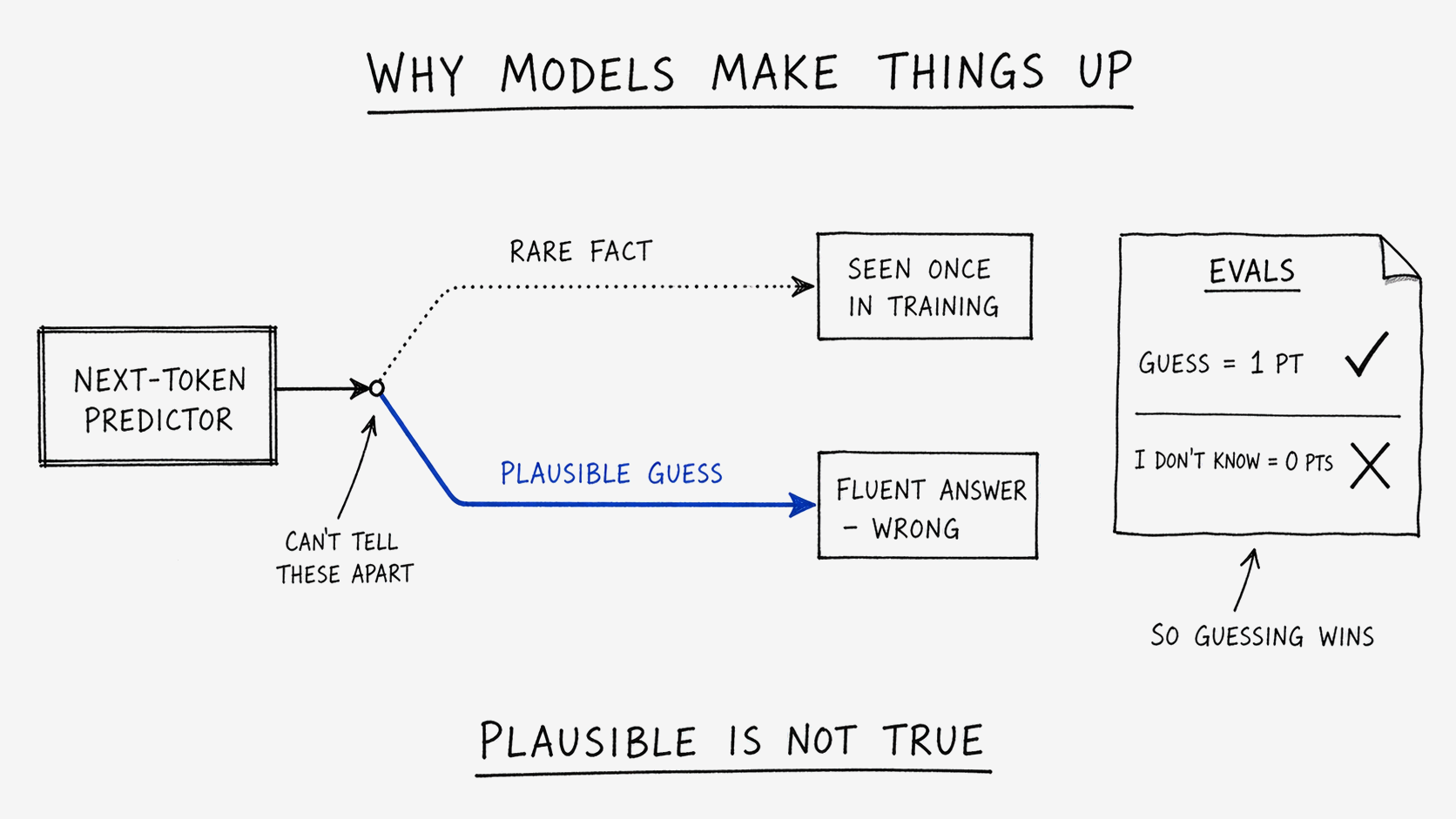
Black-ink diagram titled WHY MODELS MAKE THINGS UP: a NEXT-TOKEN PREDICTOR forks into a faint dotted RARE FACT path to SEEN ONCE IN TRAINING, and a bold cobalt PLAUSIBLE GUESS path to FLUENT ANSWER - WRONG, with the note CAN'T TELL THESE APART. An EVALS sheet scores GUESS = 1 PT with a check, I DON'T KNOW = 0 PTS with an X: SO GUESSING WINS. Caption: PLAUSIBLE IS NOT TRUE.View full-size diagram ↗

What it is

A hallucination is a confident, fluent output that is factually wrong: an invented citation, date, API, or event. It is not a malfunction layered on top of normal operation - it is ordinary next-token prediction producing plausible text that happens to be false.

How it works

Pretraining rewards plausibility, not truth: rarely-seen facts can't be separated from plausible inventions, so even a calibrated predictor errs on them. Evals lock the habit in - most grade pure accuracy, so guessing outscores admitting uncertainty. Anthropic adds a circuit view: a 'known entity' feature can suppress Claude's default refusal; when it misfires, the model confabulates.

A concrete example

In Mata v. Avianca (2023), New York lawyers filed a brief with six case citations ChatGPT had invented, down to docket numbers and quotes. Their check was asking the model whether the cases were real; it said yes. A federal judge sanctioned them - the canonical proof that fluency and truth are independent properties.

Why it matters

Hallucination is a design constraint, not a bug the next release removes. It is why RAG grounds answers in retrieved text, why agents verify with tools instead of trusting recall, and why newer evals reward calibrated abstention. The mechanism tells you what helps - grounding, citations, uncertainty-aware training - and what doesn't: scale alone, or telling the model not to make things up.

What people get wrong: 'The model is lying, and better data will fix it.' Lying requires knowing the truth; a model has no truth flag to consult - the same sampling process produces its right and wrong answers. Some error floor on rarely-seen facts is unavoidable, and as long as leaderboards penalize honest abstention, guessing stays the rational strategy.

Today's top 5

BizDebian votes to allow 'responsible use of generative AI': tools neither endorsed nor banned; contributors own what they submit.

The biggest community distro just set the default policy for AI-assisted open source.

See the full wire feed →

Quick check

Was this issue useful?

Get Crabhaus in your inbox

A concise daily briefing on the AI developments worth understanding.