
Crabhaus

What matters in AI, and why.

Tue 1 Sep · Issue 049 · 3 min

Issue 049 · Tue 1 Sep

Inside today's edition

01BizPentagon's Anthropic blacklist ruled illegal
02AgentsAnthropic points agents at real lab hardware
03AgentsOpenClaw 2.0 ships its largest release

The one that matters

The Pentagon's Anthropic blacklist was illegal

Judge Rita Lin rules the Department of War's 'supply chain risk' designation of Anthropic violated the First and Fifth Amendments: retaliation for Dario Amodei's refusal to allow unrestricted surveillance and weapons use, not a real security judgment. The June label had knocked Claude models out of government use for nearly a month.

Why it matters

It is the first time a US company hit with a designation built for foreign adversaries has won on constitutional grounds. Lin writes that national security is not a 'blank check' to punish critics - the next attempt to strong-arm a model provider through procurement now meets legal precedent. The label survives pending a separate appeal, and the Pentagon still winds down Claude by Sept 30.
Learn one thing

Tracing and observability for LLM apps

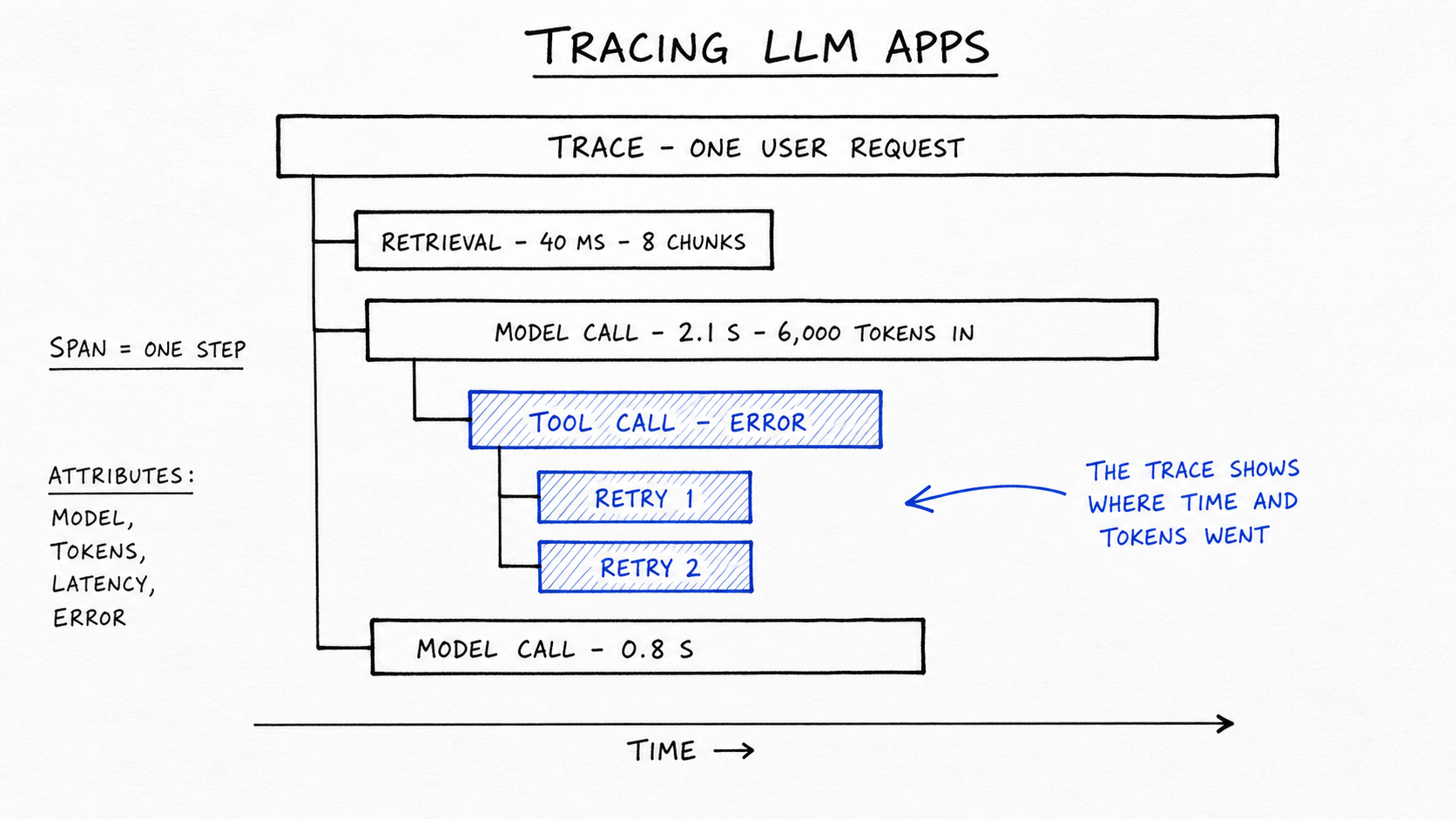
Hand-drawn waterfall trace diagram titled TRACING LLM APPS. A bar labeled TRACE - ONE USER REQUEST branches into nested spans on a time axis: RETRIEVAL 40 MS 8 CHUNKS, MODEL CALL 2.1 S 6,000 TOKENS IN, a cobalt-hatched TOOL CALL - ERROR with RETRY 1 and RETRY 2, then MODEL CALL 0.8 S. Notes read SPAN = ONE STEP; ATTRIBUTES: MODEL, TOKENS, LATENCY, ERROR; THE TRACE SHOWS WHERE TIME AND TOKENS WENT.View full-size diagram ↗

What it is

Tracing records every step of an LLM app - model calls, tool calls, retrievals - as timed, nested spans linked into one trace per request. Each span carries the model name, token counts, latency, and errors, so a nondeterministic run can be reconstructed after the fact instead of guessed at from scattered logs.

How it works

Each unit of work opens a span; parent IDs nest spans into a trace, and W3C Trace Context headers carry the trace across services. OpenTelemetry's GenAI conventions standardize attribute names for model calls, token usage, and tool invocations, so any backend - Langfuse, Arize Phoenix, or a general APM - can render the same data as timelines, cost breakdowns, and eval scores.

A concrete example

A RAG agent answers slowly and wrong. The trace shows retrieval returned 8 chunks in 40ms, the first model call burned 2.1s on 6,000 input tokens (a bloated system prompt), and a tool call errored and silently retried three times. The logged prompt reproduces the bad answer; the fix is verified on the same trace view.

Why it matters

LLM apps fail nondeterministically and regress silently when a prompt, model version, or tool changes - and tokens and latency are the product's unit economics. Traces turn 'it sometimes gives weird answers' into a specific span with a diff, and the captured data doubles as the dataset for evals and regression tests.

What people get wrong: That logging prompts and responses is observability. Flat logs lose causality: which retrieval fed which generation, which retry burned the tokens. Without span structure the path cannot be rebuilt or costs attributed. And traces capture full prompts - treat trace storage as sensitive data.

Today's top 5

AgentsAnthropic previews the Model Hardware Standard: read/write drivers that let agents operate microscopes, liquid handlers, and robot arms.

MCP gave agents software tools; MHS wants to do the same for lab hardware, with safety findings promised before it is open-sourced.

ResearchAnthropic details containment and alignment fixes after July's incidents and plans an independent METR review of what went wrong.

The first concrete remediation list from the summer's defining incident: better containment, third-party evaluator rules, and two named alignment failure modes.

AgentsOpenClaw 2.0 reworks install, browser, memory, and security and adds shared cloud sessions - about half its merged PRs ever, in one release.

Nearly 1,000 contributors shipped it; open-source personal agents are compounding, and shared sessions make them multi-user.

BizAnthropic signs a $35B cloud deal with Nvidia-backed Lambda, on a Texas data center built by Hut 8 with Nvidia holding the lease.

The compute land-grab has not slowed, and Nvidia increasingly sits on every side of the table: chip supplier, investor, and now leaseholder.

LabsGoogle releases Gemini 3.5 Transcribe: 2.6% batch word error rate, 85+ languages, speaker labels, and a streaming API in public preview.

Sub-second transcription that can trigger function calls makes voice a first-class input for agents, not a preprocessing step.

See the full wire feed →

Quick check

Was this issue useful?

Get Crabhaus in your inbox

A concise daily briefing on the AI developments worth understanding.