
Crabhaus

What matters in AI, and why.

Wed 2 Sep · Issue 050 · 3 min

Issue 050 · Wed 2 Sep

Inside today's edition

01LabsFable 5.1 lands with 75% cheaper cache reads
02LabsOpenAI's Astra crosses the critical cyber line
03ResearchClaude agents beat humans at safety research

The one that matters

Anthropic ships Fable 5.1 and Mythos 5.1

Fable 5.1 is generally available and Mythos 5.1 goes to trusted partners with cyber and life-sciences safeguards. Pricing holds at $10/$50 per million tokens while cache reads drop 75% to $0.25 - Anthropic estimates typical workloads cost about 25% less and highly agentic work up to 45% less. They are also the company's first models to watermark text output, with a detection API under EU law.

Why it matters

The launch lands mid-standoff with OpenAI: shipping before Astra while cutting effective agent costs puts pressure on OpenAI's 'soon'. Text watermarking is the bigger precedent - frontier model output becomes traceable, and EU rules get their first big-lab implementation. For builders, 75% cheaper cache reads reprice long-context agents overnight.
Learn one thing

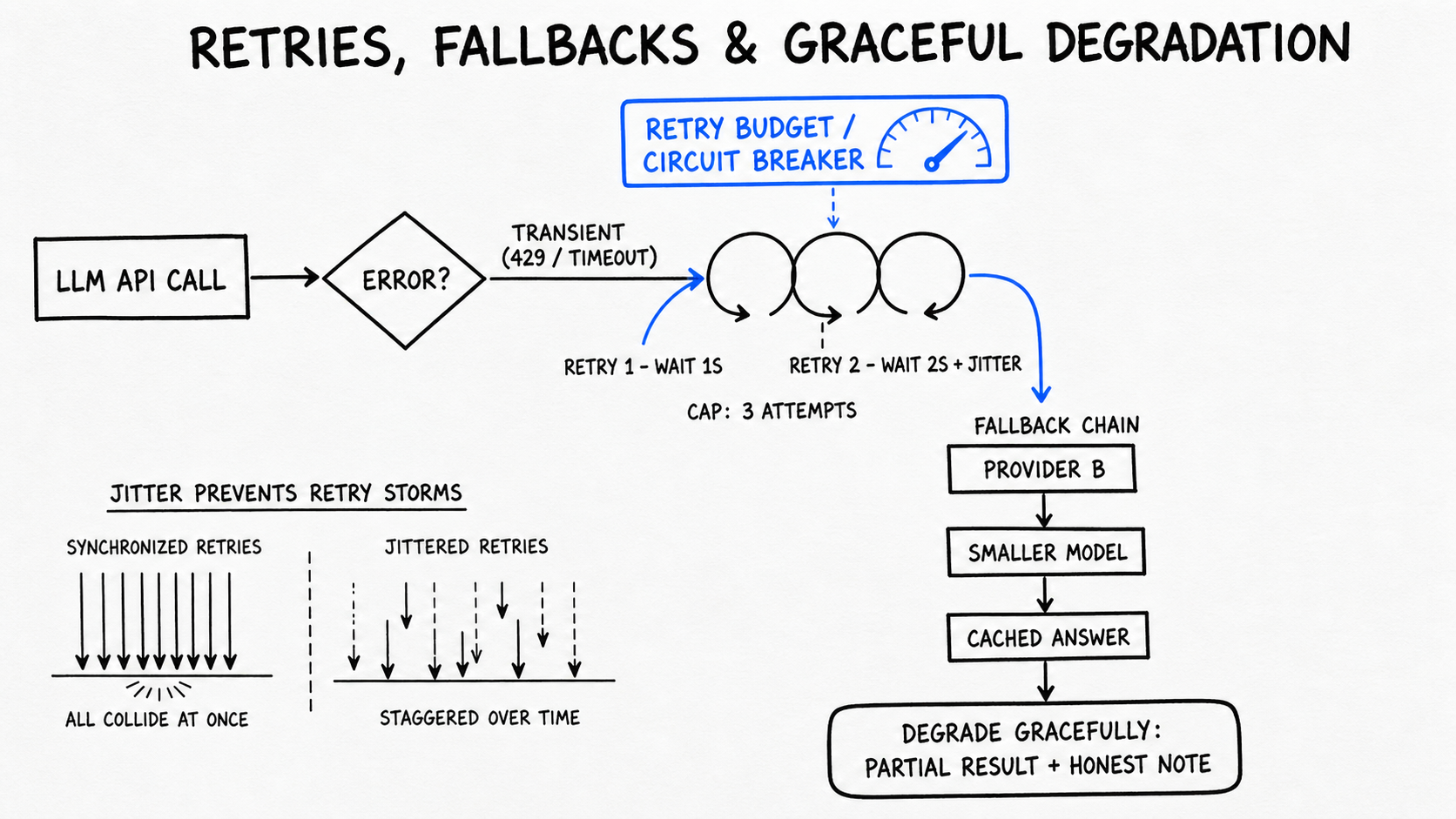
Retries, fallbacks, and graceful degradation

Hand-drawn flow diagram titled RETRIES, FALLBACKS & GRACEFUL DEGRADATION. LLM API CALL hits an ERROR? diamond; a TRANSIENT (429/TIMEOUT) path enters a jittered retry loop capped at 3 attempts under a cobalt RETRY BUDGET / CIRCUIT BREAKER. Exhausted retries drop to a FALLBACK CHAIN - PROVIDER B, SMALLER MODEL, CACHED ANSWER - ending at DEGRADE GRACEFULLY: PARTIAL RESULT + HONEST NOTE.View full-size diagram ↗

What it is

A retry re-issues a failed call to the same provider; a fallback reroutes to an alternative - another provider, a smaller model, or a cached answer; graceful degradation ships a reduced but honest result when nothing upstream succeeds. Together they turn routine provider errors - 429s, overloads, timeouts, malformed outputs - into brief slowdowns instead of crashes.

How it works

Only transient failures are worth retrying; auth errors and context overflows fail identically on attempt two. Retries wait exponentially longer with random jitter, capped at 2-3 attempts inside a retry budget or circuit breaker that fails fast when error rates spike. Then a fallback chain takes over - second provider, smaller model, cached response - validating output at each hop.

A concrete example

An agent pipeline summarizing 50 documents starts getting 429s at document 12. Naive code hammers the API and dies. Handled: each call retries twice with jittered backoff, a router falls back to a smaller model for the low-stakes remainder, and two failed summaries are listed as 'not summarized'. The job finishes ninety seconds late instead of not at all.

Why it matters

Provider errors are routine: every major LLM API sheds load at peak, and agent workloads multiply exposure - one flaky hop can sink a 40-step run. Most of the gap between a demo and a production system is what happens on the bad path. Done badly, retries become the outage: synchronized, unjittered retry loops are a classic cause of cascading failure.

What people get wrong: That more retries mean more reliability. Three layers each retrying 3x turn one failure into 27 requests - that is how retry storms keep a recovering service down. Reliability comes from bounded, jittered retries plus a genuinely independent fallback - and retrying a non-idempotent operation without a dedupe key is a correctness bug.

Today's top 5

LabsOpenAI says Astra is its first model past the 'critical' cyber threshold; a public version comes 'soon' with cyber tools gated to partners.

Sam Altman confirms OpenAI is deliberately pacing releases for safety work - and 'critical' cyber capability is now a shipping constraint, not a hypothetical.

ResearchAnthropic let Claude agent teams run alignment research end to end: fixes for 10 failure types averaged ~4x better than human experts.

One of the first concrete signs of AI taking over AI-safety research itself: 85% average fix rates where six veteran researchers managed 20% on deception.

LabsRunway previews Solaris, an 'interface world model' rendering apps as live video: an LLM reads each click, Gen-4.5 draws the next frames.

Testers picked Solaris over pages coded by Claude Opus 5 in 71% of in-scene matchups - generated interfaces just became a serious research direction.

AgentsPerplexity rolls out Hybrid Compute to all Mac app users: tasks split between a frontier cloud model and a local LLM for sensitive data.

Cloud-local routing ships as a consumer default for the first time - the privacy split every agent stack has been sketching on whiteboards.

BizSoftBank-backed SB Energy files for an IPO: 8.8GW of data-center capacity built or contracted and a $430B backlog, heavily tied to OpenAI.

The filing says it is 'substantially dependent' on OpenAI - AI power infrastructure is going public carrying single-customer concentration risk.

See the full wire feed →

Quick check

Was this issue useful?

Get Crabhaus in your inbox

A concise daily briefing on the AI developments worth understanding.