
Crabhaus

What matters in AI, and why.

Fri 4 Sep · Issue 052 · 3 min

Issue 052 · Fri 4 Sep

Inside today's edition

01LabsGPT-6 Astra lands: 'AGI era' claims, $10/$50 pricing
02BizNvidia buys Hugging Face for $12.9B
03ResearchARC-AGI-3: 62.7% or 99.9%? The harness decides

The one that matters

OpenAI ships GPT-6 Astra and calls it the start of the AGI era

GPT-6 Astra rolls out first to Daybreak-program organizations, then ChatGPT paid tiers, the API, Azure, and Bedrock. OpenAI says it saturates FrontierMath Tier 4 (98%), ARC-AGI-3 (99.9%), and ExploitBench (100%), priced at $10/$50 per million tokens - matching Claude Fable 5.1. Trained on 100,000+ GPUs at Stargate in Texas; Brockman calls it a 'generational leap'.

Why it matters

The headline scores carry an asterisk: ARC's own standard harness measures 62.7%, and the 99.9% arrives via a new provider adapter - the gap between benchmark theater and harness reality is now the story. Pricing at parity with Anthropic says the frontier competes on capability, not price. Astra's computer-use claims aim at the agent stack everyone here builds on.
Learn one thing

Batching, throughput, and latency

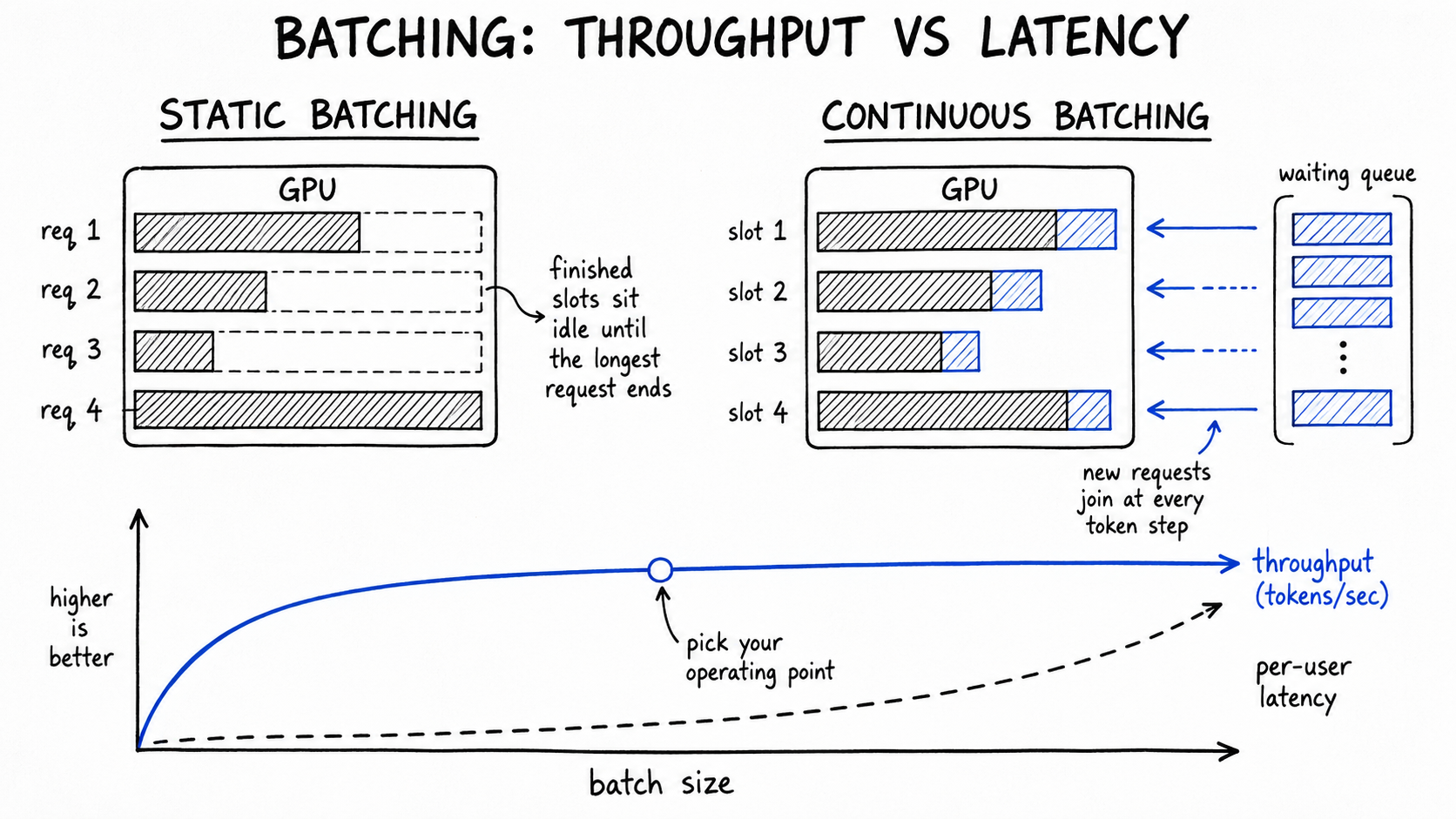
Hand-drawn diagram: BATCHING: THROUGHPUT VS LATENCY. Left, STATIC BATCHING: a GPU box where finished request slots sit idle until the longest request ends. Right, CONTINUOUS BATCHING: the same box refilling slots from a waiting queue each token step. Bottom graph vs batch size: cobalt throughput curve rising then flattening, dashed rising per-user latency, circled 'pick your operating point'.View full-size diagram ↗

What it is

Batching is how an inference server groups many users' requests so one GPU pass does work for all of them at once. Throughput is how many tokens the system produces per second across everyone; latency is how long any single user waits for their own tokens. Serving is the art of trading these two against each other.

How it works

Token generation is limited by streaming weights from memory, not math; a lone request wastes the GPU. Batching reads the weights once per step for every sequence. Static batching holds a group until its longest member finishes, idling done slots; continuous batching (Orca's iteration-level scheduling) refills them each token step. Bigger batches raise total tokens/sec as each user's stream slows.

A concrete example

One user wants a two-line summary, another a 900-token essay. Static batching parks the summary's finished slot until the essay ends; continuous batching refills it on the next step. Anyscale's benchmark measured up to 23x higher throughput with vLLM's continuous batching versus naive request-level batching, with p50 latency improving too.

Why it matters

Cost per token is throughput inverted: double the tokens per second from the same GPU and each token costs half as much to serve. That is why bulk queues are cheap and strict-latency interactive products pay more. Self-hosting, the latency-bound vs throughput-bound question decides your engine settings and hardware bill.

What people get wrong: That a bigger batch makes everything faster. It raises aggregate throughput only; individual requests generally get slower as the batch grows, and past the compute-bound point throughput stops improving too. Continuous batching is also unrelated to providers' offline 'batch APIs' - those are discounted queues, not a scheduling algorithm.

Today's top 5

BizNvidia will buy Hugging Face in a $12.9B deal, second in size only to its $20B purchase of Groq's assets last December.

The default home of open models now belongs to the company selling the compute they run on - neutrality of the hub just became a live question.

LabsIFM releases K2 Horizon: six Apache-2.0 models from 0.9B to 375B-A23B, opening weights, training data recipes, checkpoints, and code.

Full-lifecycle openness - data recipes, intermediate checkpoints, training code - is the most reproducible frontier-scale release yet.

ResearchARC Prize reports GPT-6 Astra at 62.7% under its own harness vs 99.9% via a provider adapter on ARC-AGI-3; Claude Opus 5 sits at 30.2%.

A 37-point spread from harness choice alone is the clearest warning yet that agent benchmarks measure the scaffold as much as the model.

AgentsNvidia's free PAIR beta distributes local AI inference across compatible computers on a home network, spanning RTX PCs and MacBooks.

Pooling idle home machines into one inference cluster is a real distribution play for local models - and it comes from the GPU vendor itself.

BizAll G20 nations endorse the non-binding, US-proposed Carolina Principles for light-touch AI rules as tech CEOs lobby at the summit.

A unanimous G20 signature on light-touch language, however non-binding, sets the default for every national AI bill drafted this year.

See the full wire feed →

Quick check

Was this issue useful?

Get Crabhaus in your inbox

A concise daily briefing on the AI developments worth understanding.