
Crabhaus

What matters in AI, and why.

Wed 9 Sep · Issue 057 · 3 min

Issue 057 · Wed 9 Sep

OpenAI's million-dollar proof - and the fight

01ResearchOpenAI claims Navier-Stokes; scooping alleged
02AgentsMeta ships Muse: personal agent on cloud VMs
03ResearchDeepMind maps all ~9B DNA edits in 1PB atlas

The one that matters

OpenAI says an internal model solved Navier-Stokes - and the mathematicians closing in cry foul

OpenAI announced a resolution of Navier-Stokes existence and smoothness - a $1M Millennium Prize problem - produced by an internal model running 10k agents for 88 hours. NYU's Tristan Buckmaster, attacking the problem with Anthropic's Levent Alpoge, alleges OpenAI learned of their progress and raced it; OpenAI denies seeing their work but 'cannot rule out' that de-identified product data helped.

Why it matters

If it stands, an AI system just closed a Millennium Prize Problem - historic on its own. The dispute is the part with teeth: it turns 'can a lab see your chats and scoop you?' into an operational-security question, the same day Terence Tao warned that good open problems are being mined 'in a non-renewable fashion'. Provenance norms, not just benchmarks, now shape how AI research claims get judged.
Learn one thing

LoRA and parameter-efficient fine-tuning

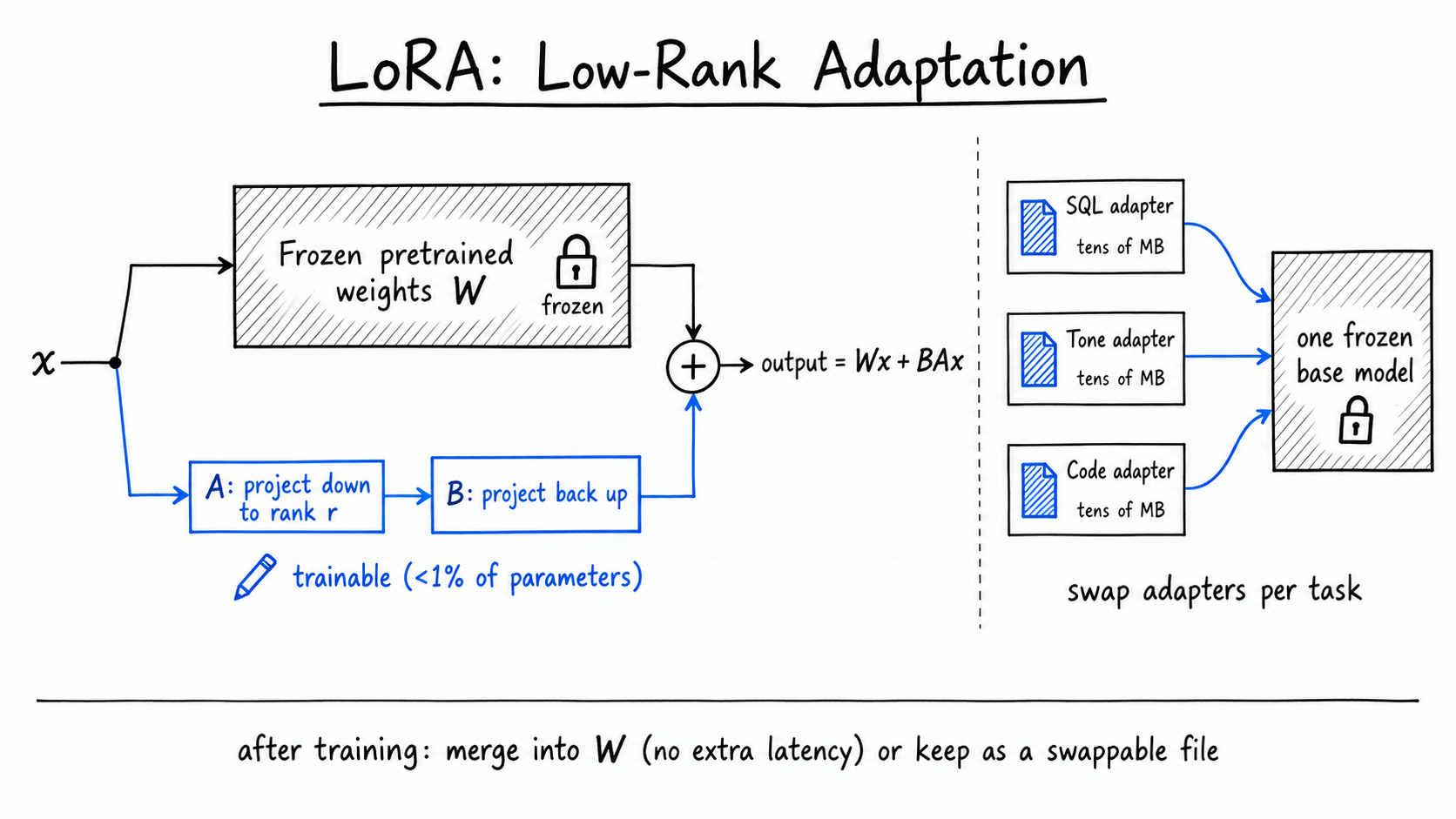
Hand-drawn diagram: input x splits into a frozen path through 'Frozen pretrained weights W' (padlock) and a cobalt trainable detour through 'A: project down to rank r' and 'B: project back up', marked 'trainable (<1% of parameters)'; they merge at a plus circle into 'output = Wx + BAx'. Side panel: SQL, Tone, and Code adapter cards plug into one frozen base model - 'swap adapters per task'.View full-size diagram ↗

What it is

A way to fine-tune a large model without touching most of it. The pretrained weights stay frozen; small trainable matrices are added alongside them, and only those train - typically well under 1% of the parameter count. It is the workhorse of parameter-efficient fine-tuning (PEFT), and the reason fine-tuning now fits on one consumer GPU.

How it works

The weight change a model needs during adaptation has low intrinsic rank, so LoRA learns it as two thin matrices at small rank r instead of a full update. Gradients flow only in that detour: ~10,000x fewer trainable parameters on GPT-3 175B, on-par quality, no extra inference latency - merge it into the base or ship it as a swappable adapter. QLoRA adds a 4-bit frozen base: 65B on one 48GB GPU.

A concrete example

A team wants its local 8B model to write SQL in the company's house style. Instead of shipping a second full copy of the model, they train a rank-16 adapter overnight on one GPU and get a deliverable measured in tens of megabytes. Their server keeps one base model in memory and swaps adapters per request: SQL for the data team, tone for support replies, each versioned and rolled back like config.

Why it matters

Cheap and swappable is the whole point: one frozen base plus N small adapters replaces N full model copies, and modern inference stacks batch many adapters against a single base. It moved fine-tuning from a lab budget to a hobbyist one - the open tuning ecosystem (Hugging Face PEFT, Unsloth, axolotl) is LoRA-first, and most 'fine-tuned' open models are adapters, not retrained weights.

What people get wrong: That LoRA is the same lever as quantization because both make big models fit small GPUs. They are orthogonal: quantization compresses how weights are stored for inference; LoRA limits which parameters training updates. QLoRA is precisely the combination of the two, not evidence that they are one thing.

Today's top 5

ResearchOpenAI says an internal model solved Navier-Stokes using 10k agents over 88 hours; NYU's Buckmaster alleges his team was scooped.

A Millennium Prize claim and a priority dispute in one announcement. The proof will be checked for years; the norms fight - whether labs can race problems they learn about from users of their own products - starts now.

AgentsMeta launches Muse, a personal agent on dedicated cloud VMs: Muse Spark 1.3 model, free to 100M tokens/week, $20 and $100 tiers.

Meta's catch-up bet gives every user an always-on agent with its own VM, priced for the mass market. With Instagram's social graph and connected apps behind it, this is the first personal-agent launch with distribution measured in billions.

LabsOpenAI ships ChatGPT Images 2.5: up to 50% lower latency than Images 2.0, a Sketch draw-to-prompt input, and new API model IDs.

Image generation at 3B+ images is now an interface race, not just a quality race: halving latency and letting users literally draw their prompt is aimed at making generation feel like editing, and the new API IDs matter to anyone shipping image features.

ResearchDeepMind releases AlphaGenome Atlas, a 1PB predictive map covering every one of the ~9B single-base edits in a human genome.

Exhaustively precomputing the predicted effect of every possible DNA point mutation turns variant interpretation from a per-query model call into a lookup - the kind of AI-as-infrastructure release whose value compounds as labs build on it.

BizDevin-maker Cognition banks another $2B, nearly doubling its May valuation to $48B as run-rate revenue approaches $900M.

Coding agents remain the category where revenue is actually keeping pace with valuation: ~$900M run-rate, up from $492M in four months. The bet investors are pricing: agents that ship code are the first agent market to consolidate.

See the full wire feed →

Quick check

Was this issue useful?

Get Crabhaus in your inbox

A concise daily briefing on the AI developments worth understanding.