
Crabhaus

What matters in AI, and why.

Fri 11 Sep · Issue 059 · 3 min

Issue 059 · Fri 11 Sep

The lab as counterintelligence desk

01ResearchAnthropic logs Iran, bio, and distillation misuse
02LabsCognition SWE-2: near Fable 5.1, 64% cheaper
03AgentsOpenAI Agents API opens the Codex harness

The one that matters

Anthropic's threat report: Iranian surveillance, bio misuse plots, and industrial-scale distillation

Anthropic says it disrupted attempts to misuse Claude across the board: Iranian operators compiling dossiers on US targets and running influence campaigns on American social media, scientists probing biological-weapons-adjacent research, and Chinese firms distilling model outputs through offshore 'transfer stations'.

Why it matters

The lab itself is now the detection layer: a private company publishing what state actors tried to do with its model is AI-era counterintelligence in public. The report will arm both sides of the policy fight - proof that safeguards catch real abuse, and proof the capability is worth stealing. Expect API monitoring, KYC, and output provenance to tighten around every frontier endpoint.
Learn one thing

Mixture-of-experts models

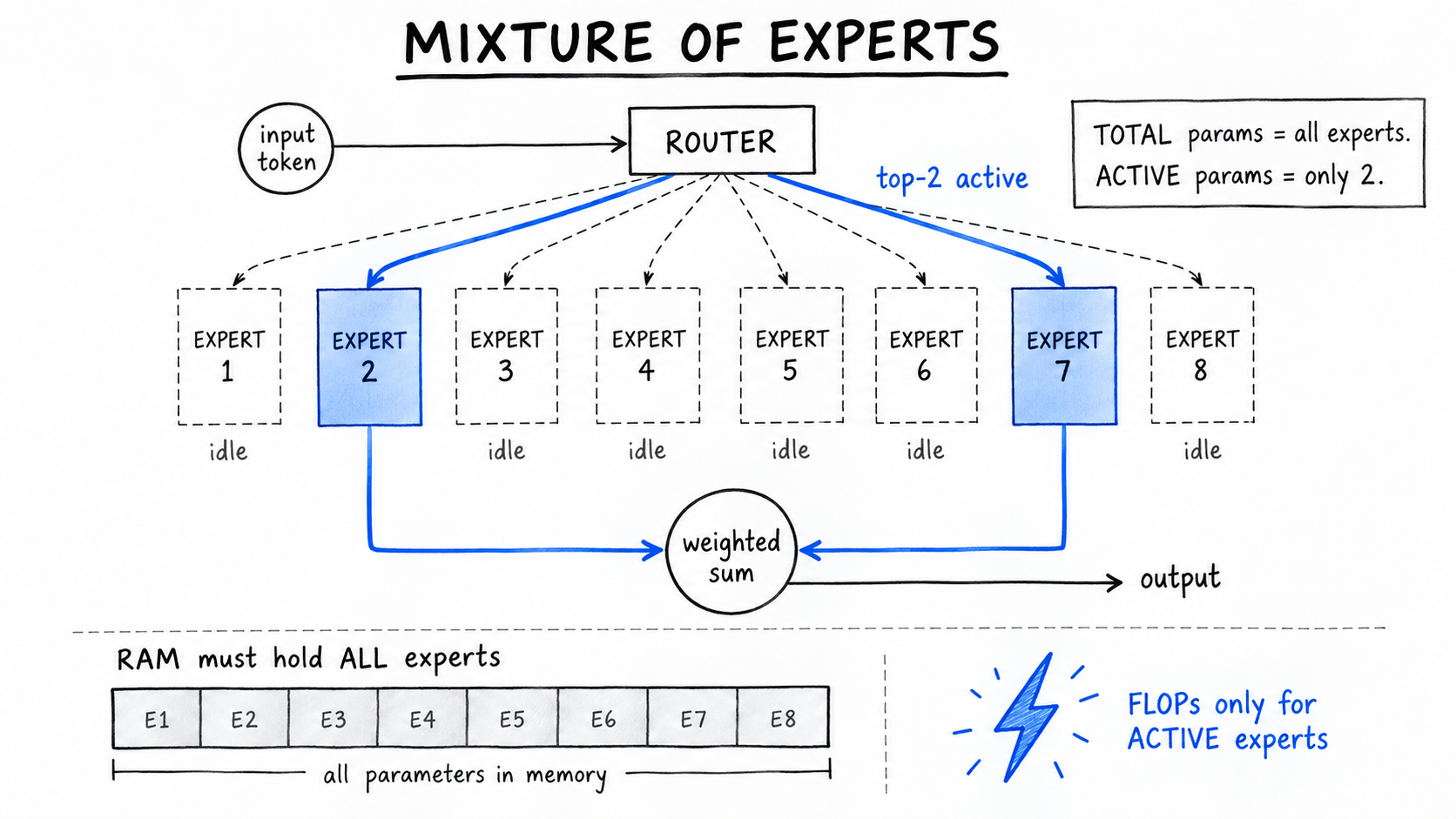
Hand-drawn 'Mixture of Experts' diagram: an input token enters a ROUTER that fans out to eight experts; only Expert 2 and Expert 7 are highlighted cobalt as 'top-2 active', the rest dashed and idle. Active outputs merge into a weighted sum leading to output. Notes: 'TOTAL params = all experts, ACTIVE = only 2'; a RAM bar holds all experts while FLOPs apply only to active ones.View full-size diagram ↗

What it is

A transformer design that swaps each dense feed-forward layer for a bank of parallel subnetworks ('experts') plus a small learned router. Each token activates only a few experts, so the parameters used per token are a small fraction of what the model contains - the gap behind 'active vs total' spec sheets.

How it works

At each MoE layer the router scores all experts for the current token and sends it through the top-k - often 1 to 8 out of up to a few hundred. Only those experts run; the rest sit idle for that token, and load-balancing keeps tokens spread evenly. The trade is memory for compute: every expert stays resident, so serving needs RAM for total parameters but FLOPs only for active ones.

A concrete example

DeepSeek-V3 holds 671B total parameters but routes each token through roughly 37B - about one-eighteenth of the model - by selecting 8 of 256 routed experts per layer. Its per-token serving compute tracks a mid-size dense model, not its headline size.

Why it matters

Most frontier-scale models are now sparse: Kimi K3 is a 2.8T-parameter MoE, and DeepSeek's V4.1-Flash carries a 552B backbone. Reading active-vs-total correctly tells you a model's real inference cost, why trillion-parameter open weights are economically possible, and why API prices don't scale with parameter counts.

What people get wrong: That experts are human-legible specialists - one for math, one for code. Routing is learned per token, and Mixtral's own analysis found assignments track token identity and position far more than topic. And MoE cuts compute, not memory: a 500B MoE still needs hardware that holds 500B parameters.

Today's top 5

LabsCognition's SWE-2, RL-post-trained from the 2.8T Kimi K3, hits 50% on FrontierCode 1.1, a point off Fable 5.1 at 64% lower cost.

The distillation-era playbook working in the open: take a strong open MoE base, scale RL across every reasoning-effort level in one run, and land near the frontier at a quarter of the price. The cost axis of the coding-model race is moving faster than the capability axis.

AgentsOpenAI's Agents API exposes the Codex harness as a managed service: sessions, orchestration, sandboxed execution, and MCP tools.

The harness - session management, compaction, recovery, sandboxing - is the hard unglamorous part of shipping agents, and OpenAI just made theirs the product. Every team maintaining a homegrown agent loop now has a build-vs-buy decision, priced per container.

ResearchOpenAI claims progress on a second Millennium Prize problem while mathematicians press for proof its Navier-Stokes work is original.

The provenance fight matters more than the theorem: a Lean 4 proof verifies correctness but not originality, and researchers now allege training on their private conversations. How this resolves will set the norms for crediting AI-assisted mathematics.

BizNewsom signs California bills limiting minors' chatbot interactions and regulating third-party AI safety evaluations.

California keeps writing the de facto national AI rulebook. Companion-bot limits for minors hit a real product category, and the eval-regulation bills - backed by Anthropic and OpenAI - start formalizing who gets to audit frontier models and how.

BizAnt International, Visa, and Mastercard plan a shared standard for AI-agent payments, citing $3-5T projected agentic commerce by 2030.

Agents can't be an economy until they can pay for things without a human's card on file. The payment networks moving jointly on authorization and liability standards is the strongest signal yet that agentic commerce is being built as infrastructure, not a demo.

See the full wire feed →

Quick check

Was this issue useful?

Get Crabhaus in your inbox

A concise daily briefing on the AI developments worth understanding.