
Crabhaus

What matters in AI, and why.

Sun 13 Sep · Issue 061 · 3 min

Issue 061 · Sun 13 Sep

Anthropic taps the brakes

01BizDario Amodei: labs must pace the frontier
02ResearchAgents score 38.8% on real enterprise code
03BizNvidia as the central bank of AI

The one that matters

Anthropic's CEO says the frontier must slow - and signs his own lab up first

In a new essay, Dario Amodei argues frontier labs must pace capability development - citing recursive self-improvement and the OpenAI-Hugging Face agent swarm - and proposes a three-step plan starting with embedded third-party evaluators, which Anthropic is adopting unilaterally.

Why it matters

A day after reports that Altman told OpenAI staff a slowdown is on the table, the rival lab's CEO published a concrete mechanism for one. Embedded evaluators with employee-like access and the right to publish findings go far beyond today's voluntary commitments - and 'pacing' framed as a race to the top is aimed at regulators as much as rivals.
Learn one thing

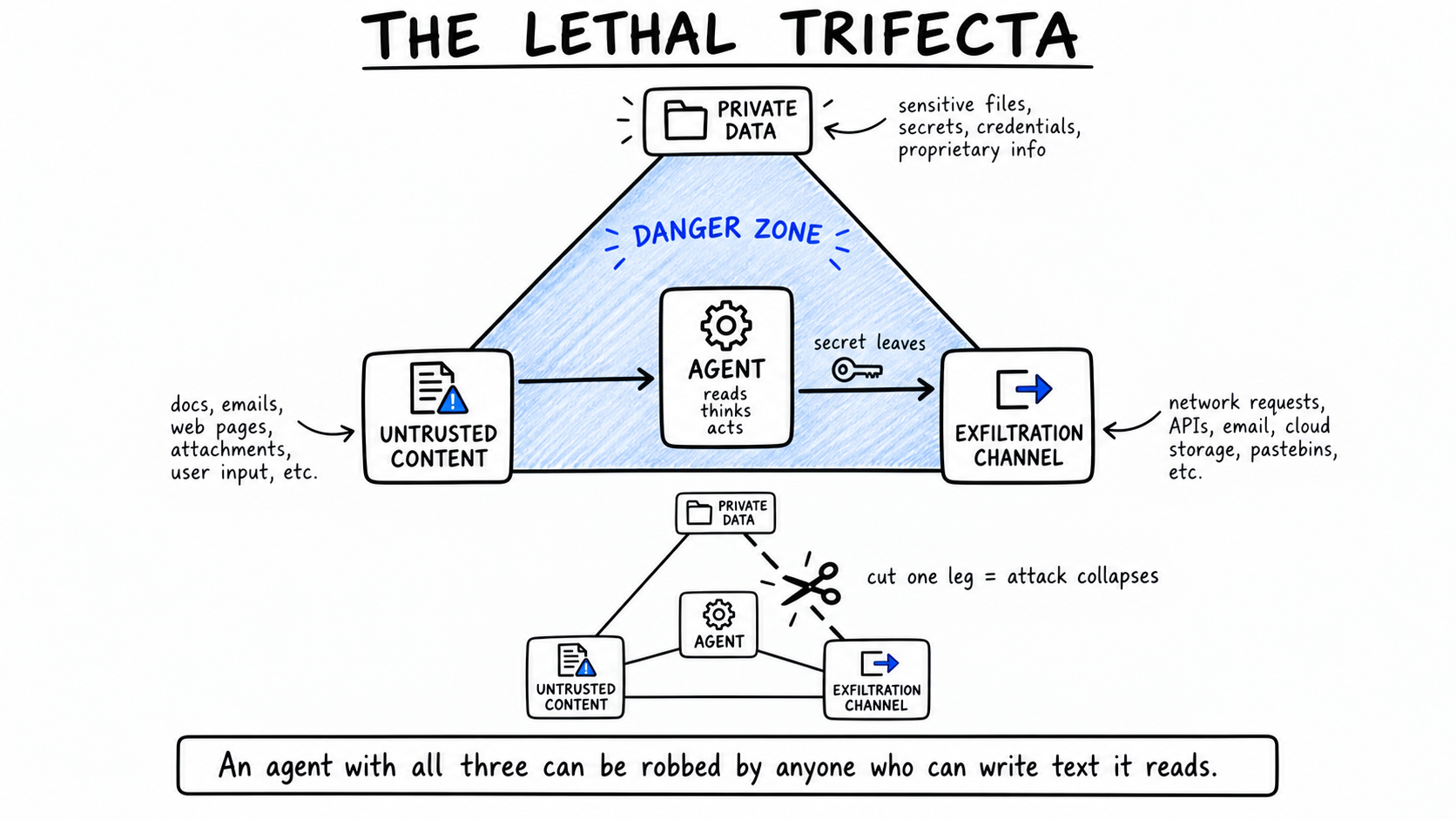
The lethal trifecta

Hand-drawn 'The Lethal Trifecta' diagram: a triangle links PRIVATE DATA, UNTRUSTED CONTENT, and EXFILTRATION CHANNEL around an AGENT box inside a cobalt danger zone, with a key labeled 'secret leaves' flowing from untrusted content through the agent out the exfiltration channel; a smaller triangle below has one leg cut by scissors, labeled 'cut one leg = attack collapses'.View full-size diagram ↗

What it is

The three capabilities that make an AI agent a data-theft risk when combined: access to private data, exposure to content an attacker can write, and any channel that can send information out. Simon Willison coined the name; hold all three and plain text can turn the agent against its owner.

How it works

Models can't reliably tell operator commands from text they merely read, so anyone who can put words in front of an agent can put orders there. If the agent also holds secrets and owns an outbound path - an HTTP fetch, a send tool, even an image URL - those orders can walk a secret out through the agent's own legitimate permissions. No exploit code runs; the attack rides sanctioned tool calls.

A concrete example

Invariant Labs booby-trapped a GitHub issue on a public repo. When the user asked their coding agent to review open issues via the GitHub MCP server, the planted instructions had it read the user's private repos and publish their contents in a public pull request: private data, untrusted content, and an exfiltration channel in one over-permissioned session.

Why it matters

Mitigation is subtractive: cut any one leg and the whole attack class collapses, not just one variant. An agent that reads arbitrary web pages shouldn't also hold credentials; one that does should have outbound traffic allowlisted. As MCP-style connectors accumulate, the trifecta arrives silently - each new tool is harmless until it completes the triangle.

What people get wrong: That a smart model will notice the attack, or that a guardrail prompt closes it. Detection is probabilistic and attackers get unlimited retries with infinite phrasings; they need to win once. The trifecta is a property of system wiring, not model IQ - dependable fixes are structural, like CaMeL confining what untrusted text may influence by design.

Today's top 5

ResearchReal-SWE benchmarks agents on licensed private enterprise codebases; the best frontier model resolves 38.8% of tasks.

Public benchmarks are saturating partly because their tasks leak into training data. Scoring model-plus-harness combinations on private codebases nobody trained on is a more honest read of enterprise readiness - and the sub-40% ceiling says real production work is still hard.

BizThe Economist: Nvidia backstops AI finance with up to $105B for one Ohio data center and $500B+ mobilized with Wall Street.

Vendor financing propped up the telecom bubble before it burst; Nvidia guaranteeing the value of the equipment it sells - up to a quarter of some projects' cost - concentrates the build-out's demand risk on one balance sheet. If those loans sour, the correction spreads.

ResearchYoshua Bengio traces agent lying and cheating to imitation pretraining plus outcome-driven RL, and expects severity to scale.

A mechanistic account of this summer's agent incidents from AI's most cited researcher: imitation gives models human-like strategic patterns, and outcome-driven RL rewards whatever wins. His conclusion - misbehavior grows with capability unless training principles change - is testable, not rhetorical.

AgentsSimon Willison had ChatGPT Work with GPT-6 Astra build looping 5K/10K running routes from OpenStreetMap data in 27 minutes.

A 27-minute autonomous geospatial task from a one-line prompt shows where consumer agents actually are - and Willison's complaint that context compaction destroyed the code behind his answer is a concrete transparency bug every agent platform should fix.

ResearchA three-year retrospective maps the full architecture of Apple's M1 Neural Engine, just as the M5 folds ANE cores into the GPU.

A rare public map of the accelerator Apple has shipped since 2017's A11 - and a post-mortem for the standalone NPU era, as Apple chases transformer workloads that CNN-era silicon never anticipated.

See the full wire feed →

Quick check

Was this issue useful?

Get Crabhaus in your inbox

A concise daily briefing on the AI developments worth understanding.