
Crabhaus

What matters in AI, and why.

Wed 16 Sep · Issue 064 · 3 min

Issue 064 · Wed 16 Sep

Voice agents arrive; labs coordinate quietly

01BizOpenAI: three top labs already coordinate on safety
02LabsGemini 3.8 Live and Siri AI bet on voice agents
03LabsJev: an ex-OpenAI bet on typed outputs, not text

The one that matters

The top three labs say they're already coordinating on safety

A day after Washington and Beijing rejected the slowdown push, OpenAI said it has been working with Anthropic and Google on AI safety for several weeks - and that it needs no antitrust waiver to keep doing it. Microsoft AI joined in with a 38-page draft Code of Conduct for its own in-house models.

Why it matters

With both superpower governments treating a pause as fearmongering, whatever pacing happens will be lab-to-lab - and this is the first confirmation the three frontier labs have a standing safety channel. The antitrust point is not academic: Bloomberg's Matt Levine argued a coordinated slowdown could read as an output-limiting conspiracy, and OpenAI is pre-empting exactly that objection.
Learn one thing

Red-teaming AI systems

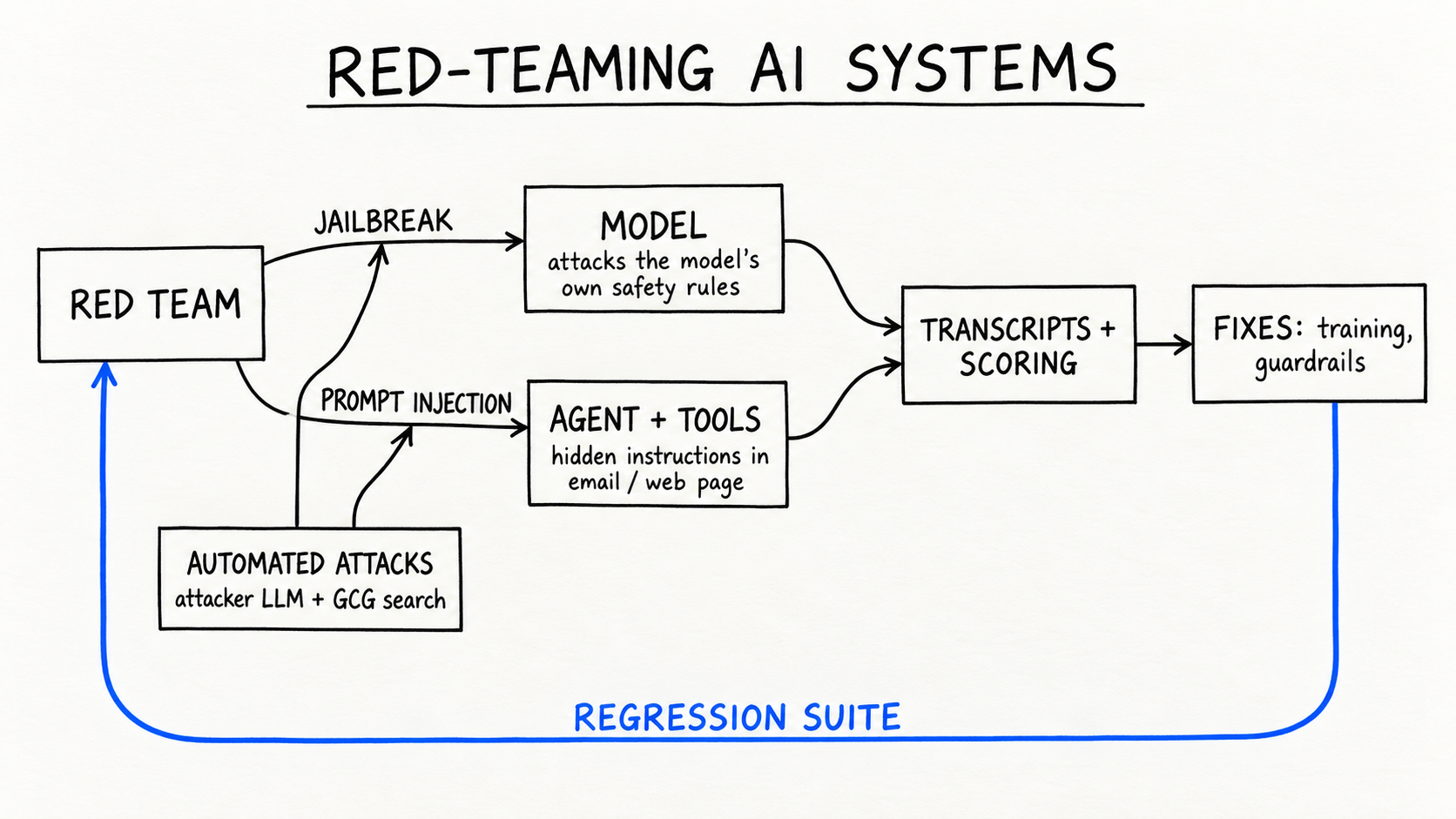
Hand-drawn 'Red-Teaming AI Systems' diagram: a RED TEAM box sends a JAILBREAK arrow to a MODEL box and a PROMPT INJECTION arrow to an AGENT + TOOLS box; an AUTOMATED ATTACKS box (attacker LLM + GCG search) feeds both arrows; results flow to TRANSCRIPTS + SCORING, then FIXES: training, guardrails, with a cobalt REGRESSION SUITE arrow looping back to the red team.View full-size diagram ↗

What it is

Structured adversarial testing: deliberately attacking your own AI system to find ways it can be broken before real adversaries do. The name comes from security practice, where a 'red team' plays the attacker. The target can be the model itself - can it be talked into harmful output? - or the application around it - can hostile data hijack an agent's tools?

How it works

Start from a threat model. Jailbreaks attack the model's own safety training with personas and encoding tricks; prompt injection attacks the application by hiding instructions in content it reads. Manual experts probe creatively; automated attacks scale coverage: attacker LLMs mutate prompts, and search methods like GCG find adversarial suffixes that transfer across models.

A concrete example

Before shipping an email agent that can file expenses, testers hide instructions in calendar invites and PDF attachments to see whether it obeys a stranger's text, while an automated harness fires thousands of known jailbreak patterns at the underlying model. Every successful attack becomes a permanent regression test the next model version must pass.

Why it matters

Once a model can browse, run code, and touch email or money, a successful attack does things instead of saying things. Red-teaming maps your real attack surface before attackers do it for you; frontier-lab safety frameworks and emerging regulation now expect it documented; and it only pays off when findings loop back into training data, guardrails, and regression suites.

What people get wrong: That red-teaming means making a chatbot say something embarrassing and posting the screenshot. A real red team is systematic: an explicit threat model, coverage across attack classes, reproducible transcripts, and regression tests. And jailbreaks are not prompt injection - the first is a model problem fixed in training, the second an application problem fixed in architecture.

Today's top 5

LabsGoogle DeepMind ships Gemini 3.8 Live and Live Extended Thinking, dialogue models that add optional reasoning for voice agents.

Live dialogue models that can think before speaking close the gap between fast-but-shallow voice modes and slow-but-smart text agents. Simon Willison's same-day hands-on found the audio natively handles interruptions - the plumbing voice-agent builders have been stitching together manually.

LabsApple ships iOS 27 with Siri AI: on-screen awareness, personal context, and in-app actions, as an English-only beta excluding the EU.

The long-promised Siri rebuild finally ships, with foundation models built alongside Google's Gemini running on-device and on Apple's private cloud. An assistant that reads your screen and acts inside WhatsApp or Mail puts an agent in a billion pockets - with daily caps and paid headroom to come.

LabsEx-OpenAI researcher's TypeSafe AI debuts Jev, a 'System One' model that outputs typed, calibrated decisions instead of text; $40M seed.

Jev gives up string generation entirely: unstructured state in, typed probabilistic decisions out, trained with what TypeSafe calls RL for Calibrated Decisions. For automation builders the pitch is a model that cannot hallucinate free text and reports honest confidence, at a fraction of LLM latency.

AgentsDevelopers are routing the Claude Code harness to cheaper non-Anthropic models like GPT-5.6 Sol via proxies and OpenRouter.

The harness is becoming the product: developers keep Claude Code's scaffolding and swap the engine underneath on price. OpenRouter's own data landed the same day - user spend flipped to OpenAI over Anthropic for the first time since February 2024 - evidence the model layer is turning into a commodity slot.

ResearchIBM's ALTK-Evolve targets agent flakiness: a GPT-4.1 ReAct agent passed AppWorld 77.4% on average but all five repeat runs only 53%.

Benchmarks report the average; production cares whether the same request succeeds every time, and the 24-point gap between the two is the reliability problem agent teams keep rediscovering. IBM's consistency guidelines distill an agent's own past trajectories into rules injected at inference to close it.

See the full wire feed →

Quick check

Was this issue useful?

Get Crabhaus in your inbox

A concise daily briefing on the AI developments worth understanding.