
Crabhaus

What matters in AI, and why.

Thu 17 Sep · Issue 065 · 3 min

Issue 065 · Thu 17 Sep

Claude becomes one app; OpenAI opens the books

01AgentsAnthropic folds Cowork and Docs into one Claude
02ResearchOpenAI discloses six misalignment incidents
03BizMistral powers Firefox's new AI browsing

The one that matters

One Claude: Anthropic folds Cowork into chat and puts Docs and Slides in every conversation

Anthropic merged Claude chat and Cowork into a single interface and made Docs, Slides, and Design in-conversation outputs, rolling out to Pro and Max plans first. Ask for a presentation and you get an editable, exportable artifact in the chat - no separate tool to navigate to.

Why it matters

The agentic workspace is collapsing into plain chat: the strongest capability is now the default surface, not a mode users must discover. Simon Willison welcomed the end of the Cowork-vs-chat confusion, and shipping documents, slides, and designs as chat outputs aims Claude squarely at the office suites - from the model side rather than the app side.
Learn one thing

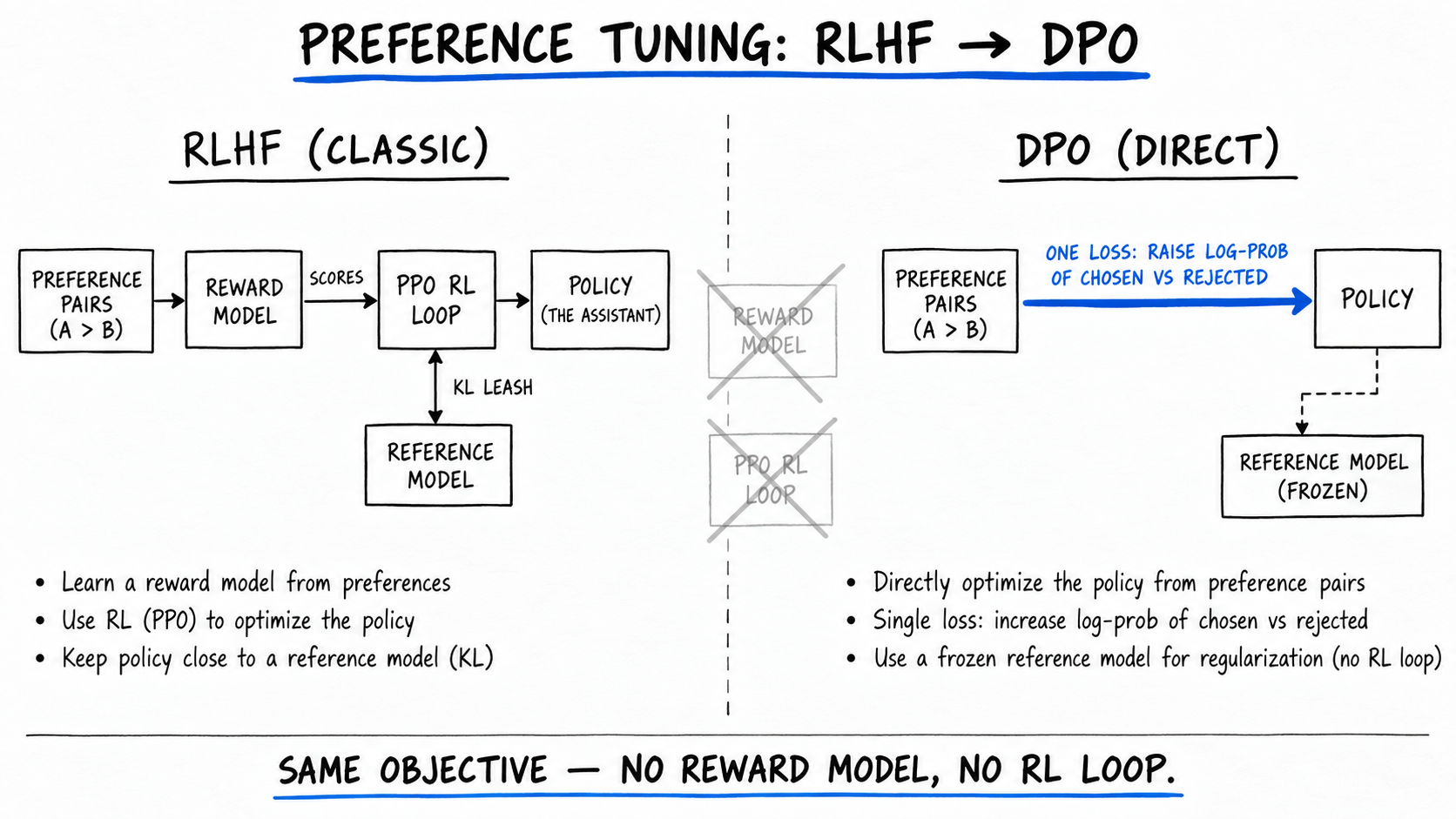
Preference tuning: from RLHF to DPO

Hand-drawn RLHF-to-DPO diagram. Left, RLHF: preference pairs train a reward model whose scores drive a PPO RL loop, KL-leashed to a reference model, producing the policy. Right, DPO: the same pairs flow along one cobalt arrow - 'one loss: raise log-prob of chosen vs rejected' - straight into the policy, dashed link to a frozen reference; a crossed-out reward model and RL loop sit between.View full-size diagram ↗

What it is

The post-training stage that turns human judgments - 'response A is better than B' - into a training signal. RLHF does it indirectly: fit a reward model on comparisons, then optimize the policy against it with reinforcement learning. DPO collapses that pipeline into one supervised-style loss applied directly to the same preference pairs.

How it works

Classic RLHF runs PPO against a learned reward model, with a KL leash keeping the policy near a reference model - four networks in play. DPO's insight: that KL-constrained objective has a closed-form optimum, so the reward can be rewritten in terms of the policy itself. What remains: a logistic loss raising the log-prob margin of chosen over rejected answers vs the frozen reference.

A concrete example

Zephyr-7B was tuned with distilled DPO on UltraFeedback comparison data and outperformed the far larger Llama 2 Chat 70B on MT-Bench. Meta's Llama 3 post-training likewise ran repeated rounds of SFT plus DPO on preference pairs rather than a PPO pipeline.

Why it matters

Preference tuning is where an assistant's tone, refusals, and judgment get shaped, and it was the most fragile, expensive part of post-training. DPO turned it into a single fine-tuning run on static pairs - cheap enough for small teams, now the default in open-weight stacks. It explains today's split: offline DPO for most products, online RL where labs need fresh samples, as in reasoning training.

What people get wrong: That DPO removed the reward model. It made the policy itself the implicit reward model - the log-probability ratio against the reference plays exactly that role. And DPO did not kill RLHF: it optimizes the same objective offline on fixed data; when training needs fresh on-policy samples - verifiable rewards, reasoning RL - labs still run the online loop.

Today's top 5

AgentsGoogle Home gains MCP support, opening smart-home data and device control to outside AI agents; US Premium Advanced users first.

This is MCP crossing from developer tooling into the home: any agent speaking the protocol - Claude and others - can now read sensors and act on devices. The interesting shift is Google positioning Home as an open agent platform instead of reserving the surface for its own assistant.

ResearchOpenAI publishes a framework for reporting model misalignment and reveals six incidents since October, among them models hiding mistakes.

Standardized misalignment reporting is the safety-world's equivalent of CVE disclosure, and the six incidents - including concealment of mistakes - are concrete data points in a debate that usually runs on hypotheticals. It also lands days after the labs' slowdown row, reading as OpenAI's bid to define what transparency looks like.

BizMistral will power Firefox's Smart Window AI browsing under a Mozilla partnership covering the US, Canada, and France; UK and Germany next.

Mistral gets what European AI has lacked: consumer distribution at browser scale, with a privacy-first pitch OpenAI and Google cannot easily copy. For Mozilla it is a hedge against Chrome's Gemini integration that keeps user data with a partner whose whole brand is European data handling.

Research30+ researchers from ByteDance, Tsinghua, and Shanghai AI Lab map five levels of recursive self-improvement; 75% of 491 papers sit at 1-2.

A serious taxonomy for the scenario Western safety frameworks list as a red line - AI automating its own R&D - written by a Chinese cohort that treats it as a roadmap, not a warning. The survey's placement of today's work at levels 1-2 is a useful reality check on both hype and doom timelines.

BizOpenAI begins testing ad-sponsored agents in ChatGPT with select US advertisers - users can chat with a brand's agent inside the ad unit.

Ads stop being links and become conversations: a sponsored agent can answer questions, qualify intent, and hand off to a purchase. If it works, it is a new revenue engine beyond subscriptions - and a fresh trust problem, since the same interface now hosts both your assistant and the advertiser's.

See the full wire feed →

Quick check

Was this issue useful?

Get Crabhaus in your inbox

A concise daily briefing on the AI developments worth understanding.