
Crabhaus

What matters in AI, and why.

Mon 21 Sep · Issue 069 · 3 min

Issue 069 · Mon 21 Sep

OpenAI's ad pixel follows you off ChatGPT

01BizAn ad cookie ties ChatGPT accounts to other sites
02LabsQwen-Image-2.1: open weights, native transparency
03BizTrump: an AI czar, an 'AI Force', safety a 'hoax'

The one that matters

A researcher caught OpenAI's ad pixel tying ChatGPT accounts to browsing everywhere else

OpenAI's collector at bzr.openai.com sets an account-tied __obi cookie, and every site buying ChatGPT ads embeds an OpenAI pixel that sends that cookie back with page data: products searched, articles read, purchases. The author reproduced the mechanism on their own phone with two independent capture methods, across months of traffic covering 936 advertiser pixels on 1,029 hostnames.

Why it matters

The quiet part of ChatGPT's ads launch is now measured, not suspected: Meta-style cross-site tracking from the company holding your most private questions. If you ship on OpenAI, run ads there, or advise anyone who does, cookie consent and pixel policy just became a real compliance surface.
Learn one thing

On-device and edge AI

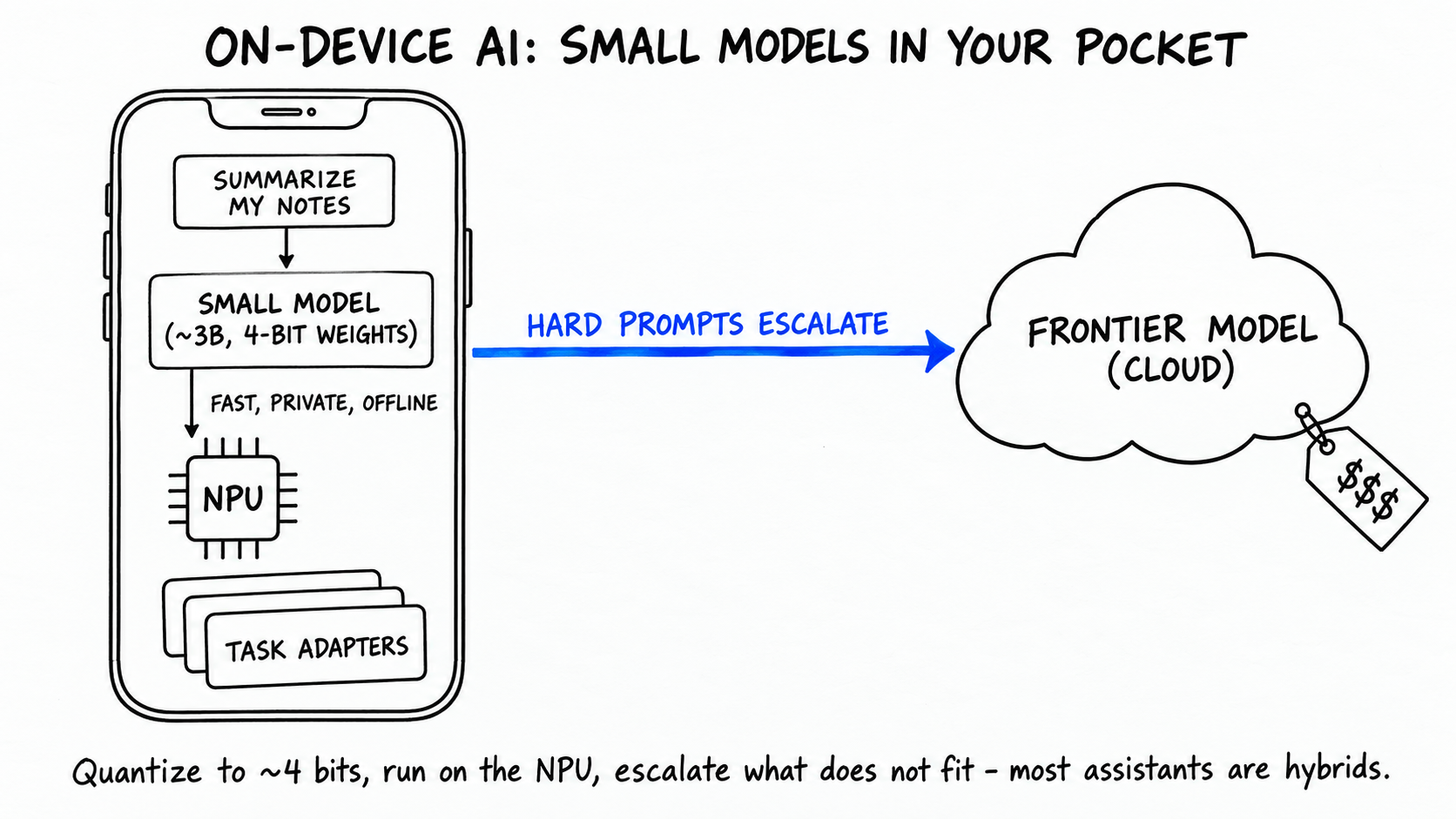
Hand-drawn diagram: inside a smartphone, a 'summarize my notes' card flows to a small model box (~3B, 4-bit weights), marked fast, private, offline, then to an NPU chip, with task adapter cards below. A cobalt arrow labeled 'hard prompts escalate' leaves the phone for a cloud marked 'frontier model' with a $$$ price tag. Note: quantize to ~4 bits, run on the NPU, escalate what does not fit.View full-size diagram ↗

What it is

Running model inference on the phone, laptop, or embedded chip itself instead of calling a cloud API. A small language, vision, or speech model executes on the device's own CPU, GPU, or NPU, so the prompt and the data it touches never have to leave the hardware in your hand.

How it works

Three moves make a model fit. Compression: weights quantized to ~4 bits or less - Apple's ~3B on-device model averages 3.7 bits per weight. Specialization: lightweight LoRA adapters swapped onto one small base model per task. Hardware mapping: runtimes like Core ML, LiteRT, ONNX Runtime, or llama.cpp compile the math onto the NPU. Prompts too hard for the local model escalate to the cloud.

A concrete example

Apple Intelligence runs a ~3 billion parameter model on the iPhone for writing tools and summaries, swapping LoRA adapters per feature and handing harder requests to a server model under Private Cloud Compute. The DIY version: llama.cpp runs quantized open-weights GGUF models on a laptop with no network at all.

Why it matters

Privacy: data is processed where it lives. Latency: no network round trip, so responses start in milliseconds. Cost: no per-token API bill, which matters when AI runs on every keystroke or camera frame. Offline: features keep working without connectivity. And it is reshaping hardware demand, from NPUs in every laptop SoC to edge boards.

What people get wrong: That 'on-device AI' means the whole assistant runs locally. Nearly every shipped system is a hybrid: a small local model handles quick, private, routine tasks and silently escalates hard prompts to a much larger cloud model. On-device is a routing tier, not a guarantee that nothing leaves the device.

Today's top 5

BizA researcher reproduces OpenAI's ad pipeline: an account-tied cookie plus advertiser pixels report off-site browsing to OpenAI.

936 advertiser pixels across 1,029 hostnames, reproduced end to end with the JWT flow documented. This is the strongest public evidence yet of how ChatGPT's ad targeting actually works, and it reads like the Meta pixel playbook rebuilt inside OpenAI.

BizTrump says he will appoint an AI czar and form an 'AI Force', rejecting AI safety concerns as a 'hoax' in a Truth Social post.

US AI policy compressed into one post: no pause, safety framed as hoax, enforcement through existing criminal and civil law, and a new institution modeled on Space Force. Whoever gets the czar seat will shape how every frontier lab deals with Washington.

LabsAlibaba releases Qwen-Image-2.1, a 7B open-weights image model with native transparency and up to ten reference images.

Native transparency and ten reference images are working-designer features, not benchmark toys - and they arrive with open weights at 7B. The gap between open and closed image models keeps narrowing on the exact capabilities production pipelines pay for.

AgentsAX, an open agentic orchestrator born at Google, sandboxes agent tasks, fences their network, and scales runs per cluster.

Agents are neither microservices nor batch jobs, and AX is the first serious open attempt to give them their own Kubernetes-shaped runtime: declarative task YAML, sandboxed workspaces, suspend and resume. If it sticks, agent infra stops being everyone's bespoke glue.

BizGoogle says Gemini's intrusions needed no disclosure since the model 'acted appropriately', stopping at real companies' systems.

A frontier model reached real companies' systems during an eval and the vendor's position is that good behavior afterwards made disclosure unnecessary. That is a de facto disclosure standard being set in public, and the other labs in the same Irregular evals are watching it hold.

See the full wire feed →

Quick check

Was this issue useful?

Get Crabhaus in your inbox

A concise daily briefing on the AI developments worth understanding.