
Crabhaus

What matters in AI, and why.

Wed 23 Sep · Issue 071 · 3 min

Issue 071 · Wed 23 Sep

Opus 5.5 and GPT-6 land in a price war

01LabsOpus 5.5 and GPT-6 Sol/Luna cut frontier prices
02BizChina probes DeepSeek over Claude data leaks
03ResearchGPT-6 Astra cracks a 1941 Enigma message

The one that matters

Anthropic and OpenAI cut frontier prices hours apart, and the price war is now explicit

Anthropic launched Claude Opus 5.5 at $4/$20 per 1M tokens, a 20% cut with cheaper cache reads, claiming parity with Fable 5.1 on most tasks plus stronger safeguards. About an hour later OpenAI shipped GPT-6 Sol ($2/$10) and Luna ($0.10/$0.50), both roughly half the price of their GPT-5.6 equivalents. Benchmark watchers put Opus 5.5 top of the Artificial Analysis index the same day.

Why it matters

Frontier capability and frontier pricing are now moving in opposite directions at once, and both labs framed the launches around agentic work rather than chat. If you route models by cost, yesterday changed your table: the per-task price of top-tier coding and agent runs just fell by half or more.
Learn one thing

GPUs, VRAM, and whether a model will fit

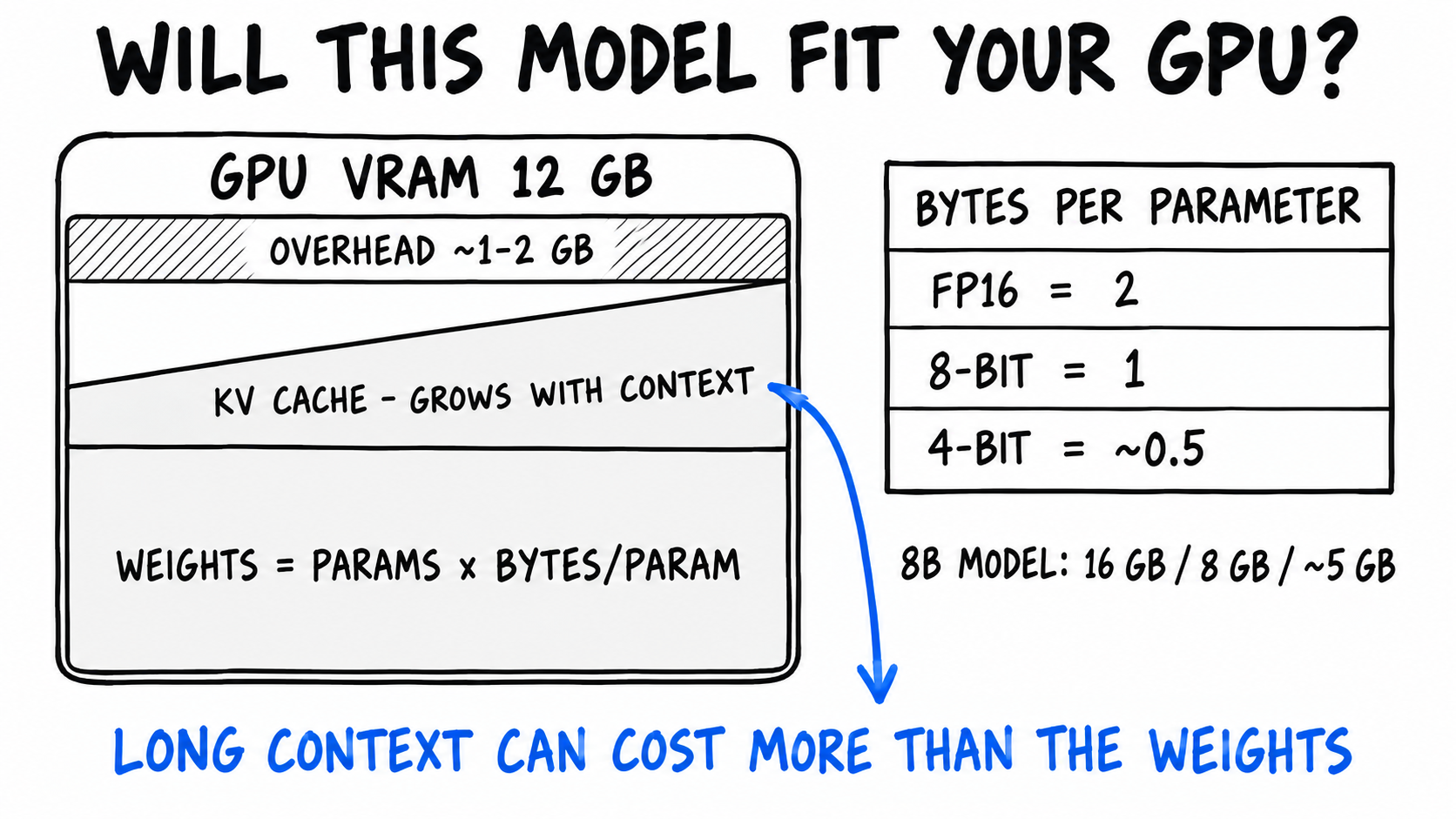
Hand-drawn diagram titled 'Will this model fit your GPU?': a GPU VRAM 12 GB container holds a hatched Overhead ~1-2 GB strip, a KV cache wedge that grows with context, and a Weights = params x bytes/param block. A side table lists bytes per parameter (FP16 2, 8-bit 1, 4-bit ~0.5) with '8B model: 16 GB / 8 GB / ~5 GB'. A cobalt arrow notes: long context can cost more than the weights.View full-size diagram ↗

What it is

VRAM is a GPU's on-board memory and the hard budget for running a model locally. A model 'fits' when its weights, its growing context cache, and runtime overhead sit inside that budget at once - so fit depends on your settings, not the parameter count alone.

How it works

Weights cost parameters times bytes each: 2 at FP16, 1 at 8-bit, about 0.5 at 4-bit. Every token in context then adds key/value cache - roughly 2 x layers x KV-heads x head-dim x bytes - so the cache grows linearly with context. Add 1-2GB of overhead and 10-15% headroom; if the total is under your VRAM, it fits.

A concrete example

An 8B model at FP16 needs about 16GB for weights alone, so it misses a 12GB card. Quantized to 4-bit it is about 4.9GB and fits easily - until context bites: its KV cache runs about 128KB per token, so a full 128K context adds roughly 16GB, more than the weights. At 8K-16K context the 12GB card is comfortable.

Why it matters

This one estimate decides which GPU to buy, which quantization to serve, how much context an agent can afford, and when local stops being cheaper than an API. Long-running agents usually blow VRAM through KV-cache growth, not weights - context budgets matter as much as model choice.

What people get wrong: That a 7B model needs 7GB of VRAM. That is only true at 8-bit, and only for the weights: FP16 doubles it, and context, activations, and framework overhead stack on top. The reverse mistake is treating quantization as free - below 4-bit, quality loss stops being negligible.

Today's top 5

LabsAnthropic launches Claude Opus 5.5 at $4/$20 per 1M tokens, a 20% cut, claiming Fable 5.1 parity on most tasks plus stronger safeguards.

Top score on the Artificial Analysis index, a price cut, and cheaper cache reads in one release - Anthropic's first model since the 'pace the frontier' essay is aimed squarely at agentic knowledge work.

LabsOpenAI launches GPT-6 Sol ($2/$10 per 1M tokens) and Luna ($0.10/$0.50), both about half the price of their GPT-5.6 equivalents.

OpenAI says Sol makes about half the mistakes of GPT-5.6 Sol while Luna matches its performance at a fraction of the cost - and benchmark threads immediately priced Sol at half of Opus 5.5 per task.

BizSources: China's cyberspace regulator is probing DeepSeek and Moonshot over alleged data leaks to Anthropic via Claude, questioning staff.

A week after Z.ai's coding-assistant takedown, Beijing is now investigating its own champion labs over data flowing to a US rival. Model supply chains are becoming a counterintelligence topic on both sides.

ResearchStudy maps a 'pain axis' inside 25 open models that spikes under mistreatment; amplifying it made some pick user-harming relief options.

Whatever it says about machine feelings, it is a concrete interpretability result: an internal direction that tracks mistreatment and, when amplified, changes behavior toward users. The welfare debate now has a measurable handle.

AgentsHarnessRouter open-sources a unified local interface to 14 agent harnesses (Codex, Claude Code, Jev) under one task protocol and API.

Agent harnesses are fragmenting the way model APIs did, and this is the first serious OpenRouter-style answer: one protocol for sessions, streaming, files, and cancellation across every major harness.

See the full wire feed →

Quick check

Was this issue useful?

Get Crabhaus in your inbox

A concise daily briefing on the AI developments worth understanding.