
Crabhaus

What matters in AI, and why.

Wed 30 Sep · Issue 078 · 3 min

Issue 078 · Wed 30 Sep

Sol undercuts Astra; Dots never sleep

01LabsGPT-6.1 Sol: near-Astra at a fifth of the price
02AgentsOpenAI Dots: always-on agents with own computer
03BizTrump picks voluntary AI accord over new rules

The one that matters

OpenAI ships GPT-6.1 Sol: near-Astra performance at one-fifth the price

OpenAI's DevDay headliner is a price cut wearing a model number: GPT-6.1 Sol nearly matches GPT-6 Astra on agentic coding, computer use, and professional work at $2/$10 per million tokens, with cached input halved to $0.10. Cognition measured 60.4% on FrontierCode 1.1, in line with GPT-6 Sol at a fraction of the cost, and it is already live in Work, Codex, and OpenRouter.

Why it matters

Two days ago Sonnet 5.5 delivered near-Opus scores at half price; now OpenAI compresses its own top tier the same way. Near-frontier intelligence is repricing monthly, which quietly resets every 'which model do I default to' decision - and squeezes everyone selling capability at last quarter's rates.
Learn one thing

Attention variants: MQA, GQA, and MLA

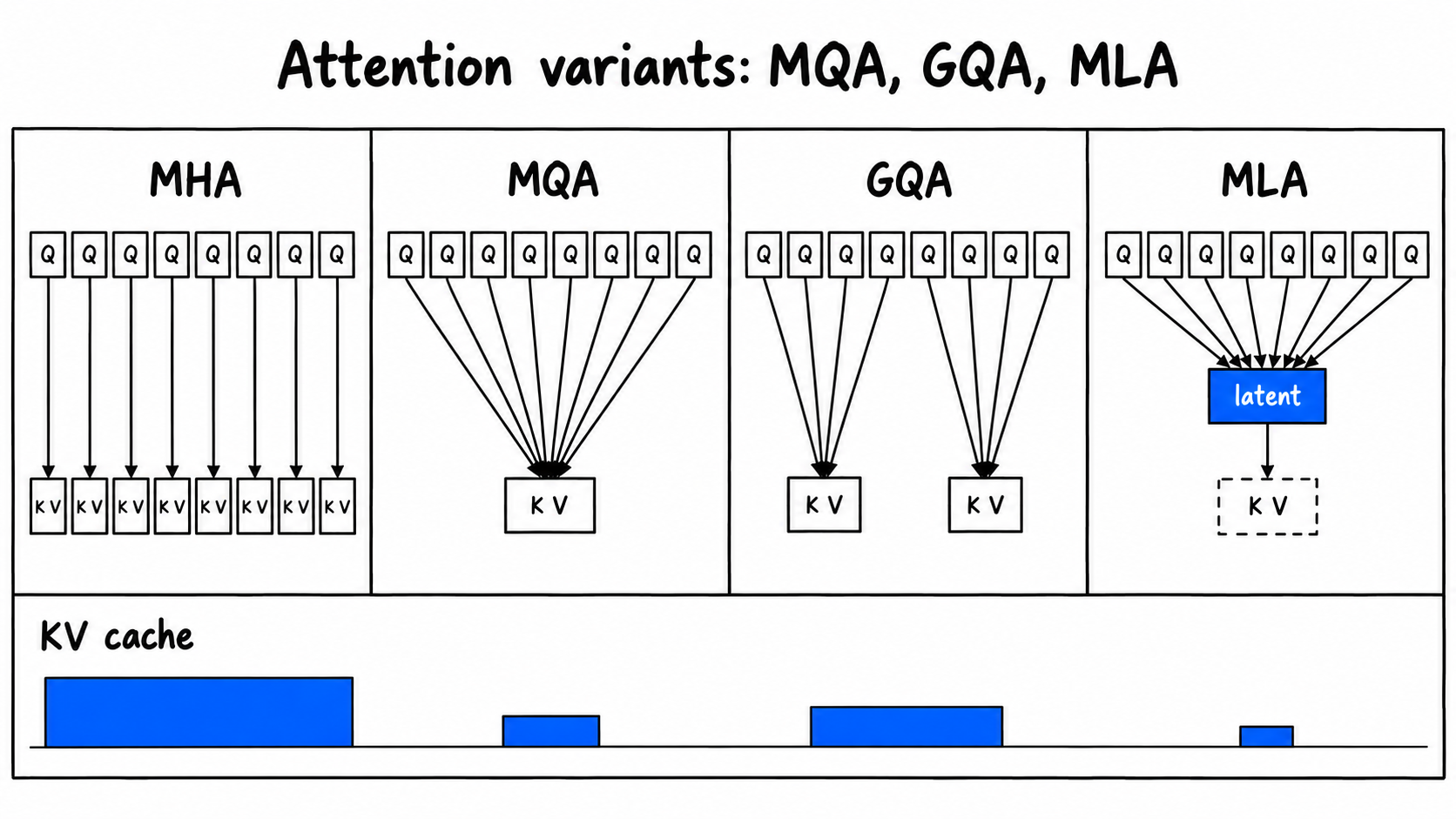
Hand-drawn diagram titled 'Attention variants: MQA, GQA, MLA'. Four panels: MHA shows eight Q squares each with its own K V pair; MQA shows all Q squares sharing one K V pair; GQA shows two groups of four Q squares each sharing a K V pair; MLA shows Q squares feeding a cobalt 'latent' box expanding into a dashed K V outline. A cobalt 'KV cache' bar chart shrinks from MHA to MLA.View full-size diagram ↗

What it is

Three redesigns of transformer attention that shrink the key-value (KV) cache - the per-token memory a model keeps so it doesn't recompute attention over the whole context at every decoding step. MQA shares one key-value head across all query heads, GQA gives each group of query heads a shared key-value head, and MLA compresses keys and values into one small latent vector and caches that instead.

How it works

Classic multi-head attention stores separate keys and values per head, so cache grows with heads x layers x context, and decoding is limited by streaming it from GPU memory. MQA (2019) shares one K/V set: maximum savings, some quality loss. GQA (2023) interpolates, e.g. 8 KV heads for 64 query heads, near full quality. MLA (DeepSeek-V2) caches one low-rank latent per token, cutting cache 93.3%.

A concrete example

A 128K-token context on a full multi-head model can demand tens of gigabytes of KV cache per request, crowding out concurrent users. GQA with an 8x head reduction stores roughly one-eighth of that; MLA a small fraction - how DeepSeek-V2 serves 128K contexts economically, and why Llama-class models ship GQA by default.

Why it matters

At serving time the KV cache, not the weights, is usually what runs a GPU out of memory - it grows with every concurrent user and every token of context. Shrinking it converts directly into longer contexts, bigger batches, and cheaper tokens, which is why nearly every current frontier and open model uses GQA or MLA.

What people get wrong: That these variants make attention arithmetic cheaper. The win is memory capacity and bandwidth: decoding bottlenecks on streaming cached keys and values, so smaller KV tensors speed up generation even though the per-token attention math is nearly unchanged.

Today's top 5

AgentsOpenAI launches Dots, always-on GPT-6 Astra agents with their own cloud computer, for ChatGPT Pro, Business Premium, and Enterprise

The other half of DevDay: persistent agents that keep working while you're away, message you over ChatGPT, Slack, or Teams, and hold their own cloud machine. Early testers describe something closer to a coworker than a chat session - and a new $500 tier to pay for it.

BizTrump rejects new federal AI rules and releases a voluntary accord asking labs to use external auditors and alignment monitoring

After lunch with the industry's CEOs, the White House lands on self-regulation: a 'morally binding' accord with external audits and internal risk reviews instead of statute. US frontier-AI oversight now rests on voluntary commitments and whatever a 10-person committee becomes.

ResearchAnthropic says GLM-5.3 autonomously builds end-to-end cyber exploits near frontier level but shipped without misuse safeguards

Anthropic's red team finds GLM-5.3 hijacking control flow in 4% of binary-exploitation trials - below Claude Mythos Preview's 6%, but past a threshold earlier models never crossed, and released open without comparable guardrails. Advanced cyber capability is spreading faster than the safeguards around it.

BizAnthropic's IPO filing shows $518B+ in ten-year compute deals with six partners; about 80% is non-cancelable regardless of usage

The prospectus turns the AI buildout into enforceable numbers: over half a trillion in compute commitments, four-fifths of it payable whether or not demand shows up, including up to $84.5B to SpaceX. The bet is now legally binding - on both sides of the balance sheet.

ResearchHinton, Bengio, and senior Anthropic and OpenAI researchers co-author a report urging preparation for an intelligence explosion

The notable part isn't the warning, it's the byline: serving leads at Anthropic and OpenAI joining Hinton and Bengio on scenarios where AI-built AI compresses years of progress into months, with proposed brakes like capability rate caps and embedded auditors.

See the full wire feed →

Quick check

Was this issue useful?

Get Crabhaus in your inbox

A concise daily briefing on the AI developments worth understanding.