
Crabhaus

What matters in AI, and why.

Thu 1 Oct · Issue 079 · 3 min

Issue 079 · Thu 1 Oct

Argon lands quietly; the FTC gets loud

01LabsGemini 4 Argon: 1M output tokens, defenders first
02BizFTC opens probe into frontier AI labs
03BizOpenAI disrupts Moonshot-linked distillation

The one that matters

Google ships Gemini 4 Argon with no warning: 1M output tokens, cyber defenders first

With no leaks or benchmark rumors, Google launched its new frontier model at $2/$10 per million tokens with output capacity raised from 64K to 1M tokens. Early access goes to trusted cyber defenders through Fairwind while Google takes part in the US government's voluntary pre-release process; developer access is promised 'as soon as possible'. Arena scores it atop the Text Arena Pareto frontier.

Why it matters

The rollout shape is the story: a frontier lab now treats cyber capability as the gating risk, handing the model to defenders before developers and routing it through Washington's new voluntary review. After GLM-5.3's unguarded release drew fire last week, staged access may be hardening into the norm - and Argon's $2/$10 pricing keeps the frontier price war running at the same time.
Learn one thing

Semantic caching

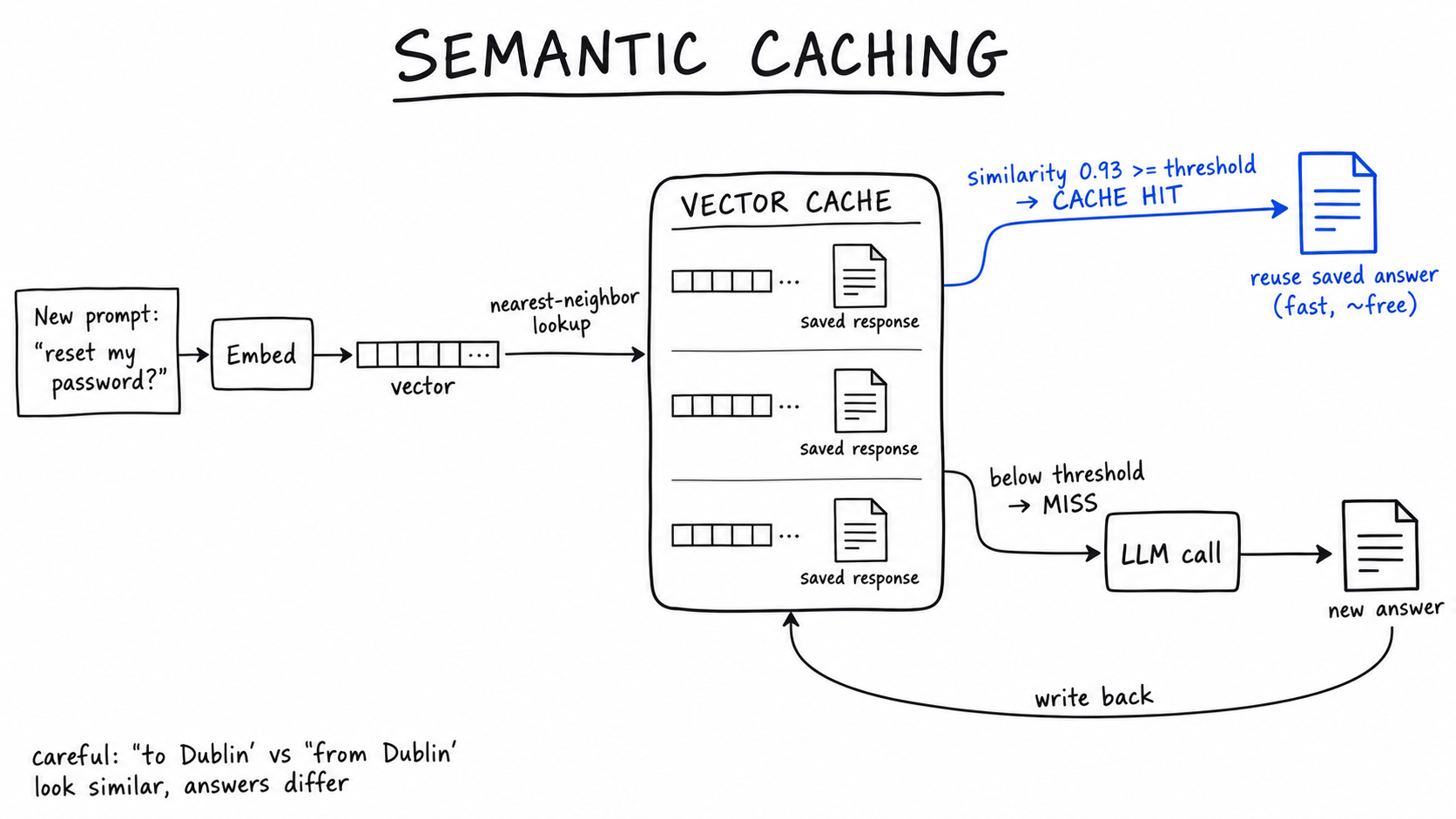
Hand-drawn diagram titled 'Semantic caching'. A new prompt is embedded into a vector, then a nearest-neighbor lookup checks a vector cache of stored vectors with saved responses. A cobalt path (similarity above threshold) leads to a cache hit that reuses the saved answer fast and nearly free; a below-threshold miss path calls the LLM and writes the new answer back into the cache.View full-size diagram ↗

What it is

A caching layer for LLM apps that reuses a stored response when a new request means roughly the same thing as an earlier one, not only when the text matches exactly. Requests are compared by embedding similarity, so paraphrases of a question can hit the cache even though their strings differ.

How it works

Each prompt is embedded into a vector. The cache keeps past prompt embeddings in a vector index beside their saved responses. A new prompt runs a nearest-neighbor lookup; score above the similarity threshold and the saved response returns with no model call. On a miss, the app calls the LLM and writes the new embedding and response back. Threshold, TTL, and eviction set how aggressive reuse is.

A concrete example

A support bot gets 'How do I reset my password?' and later 'what's the way to change a forgotten password'. An exact-match cache sees two different strings and pays for two completions. A semantic cache embeds both, finds them nearly identical in meaning, and serves the stored answer in milliseconds at near-zero marginal cost.

Why it matters

Production LLM traffic is heavily repetitive, so a tuned semantic cache turns a real slice of requests into fast, almost free hits - cutting token spend and median latency. It sits beside model routing and effort settings as a serving-layer cost lever that leaves quality on uncached requests untouched.

What people get wrong: That high similarity means the same correct answer. Embeddings measure topical closeness, not intent equality: flights to Dublin vs from Dublin, a negation, or a changed date can clear the threshold and silently return the wrong cached answer. Caches also go stale, and shared ones can leak personalized responses - so strict thresholds, TTLs, and hit-quality evals matter.

Today's top 5

BizThe US FTC opens a probe into Anthropic, OpenAI, and other frontier labs over potential consumer harms, and plans to compel testimony

Days after the White House's voluntary accord, the FTC reaches for existing consumer-protection law - compelled testimony included. Self-regulation and enforcement are now running in parallel, and labs may discover the accord's 'morally binding' promises can be enforced as deception claims.

BizOpenAI says it disrupted a coordinated campaign to extract protected reasoning from its models, tying it to people linked to Moonshot AI

OpenAI publicly naming individuals tied to a rival lab over adversarial distillation escalates the model-protection fight: reasoning traces are now treated as crown-jewel IP, and scraping them as a security incident rather than a terms-of-service spat.

LabsQwen-Audio-3.1 adds a full-duplex realtime voice model that calls tools and decides when to speak, API-only on QwenCloud with no weights

A tool-calling, full-duplex voice agent at roughly 85% below Qwen's prior audio pricing - but for the first time, Qwen keeps the weights closed. China's open-weights champion going API-only on its best voice stack says the margin is in hosted agents now.

ResearchArtificial Analysis: Claude Sonnet 5.5 scores 2 points behind Opus 5.5 but uses ~193K output tokens per task at max effort, $7.60 a task

The sticker price stayed flat; the token meter didn't. At the effort level that matches Opus, Sonnet 5.5 spends more output tokens than any model Artificial Analysis has measured - a reminder to benchmark cost per task, not cost per million tokens.

AgentsDoorDash opens waitlists for an Apple Messages ordering agent plus an MCP server and CLI that let outside AI agents place real orders

Agentic commerce turning concrete: a hosted MCP server with OAuth and corporate budgets means a Slack bot can legitimately buy lunch for the office. The interesting part is the shape - merchants exposing agent-ready endpoints instead of agents scraping checkout pages.

See the full wire feed →

Quick check

Was this issue useful?

Get Crabhaus in your inbox

A concise daily briefing on the AI developments worth understanding.