
Crabhaus

What matters in AI, and why.

Fri 2 Oct · Issue 080 · 3 min

Issue 080 · Fri 2 Oct

Safety firings at OpenAI; $42B for Anthropic

01BizOpenAI parts ways with three safety researchers
02BizBroadcom lends Anthropic up to $42B
03LabsClef: Cloudflare ships open decision models

The one that matters

OpenAI fires three safety researchers for sharing sensitive info with an outside AI safety org

The WSJ reports OpenAI 'parted ways' with Jasmine Wang, Tomek Korbak, and Mikita Balesni for violating its policies on handling sensitive information; sources say they shared it with an AI safety organization. Bloomberg adds that some of the material concerned OpenAI's infrastructure architecture. Rep. Greg Casar called it firing whistleblowers and is demanding transparency.

Why it matters

Firing safety staff for talking to an outside safety org, with no public explanation, lands at the worst moment: days after the FTC opened its probe and as California's AG subpoenas OpenAI over incident handling. Whatever the underlying breach, the optics hand regulators a narrative - that the lab's confidentiality rules now reach the safety back-channels oversight quietly depends on.
Learn one thing

Prompt versioning and management

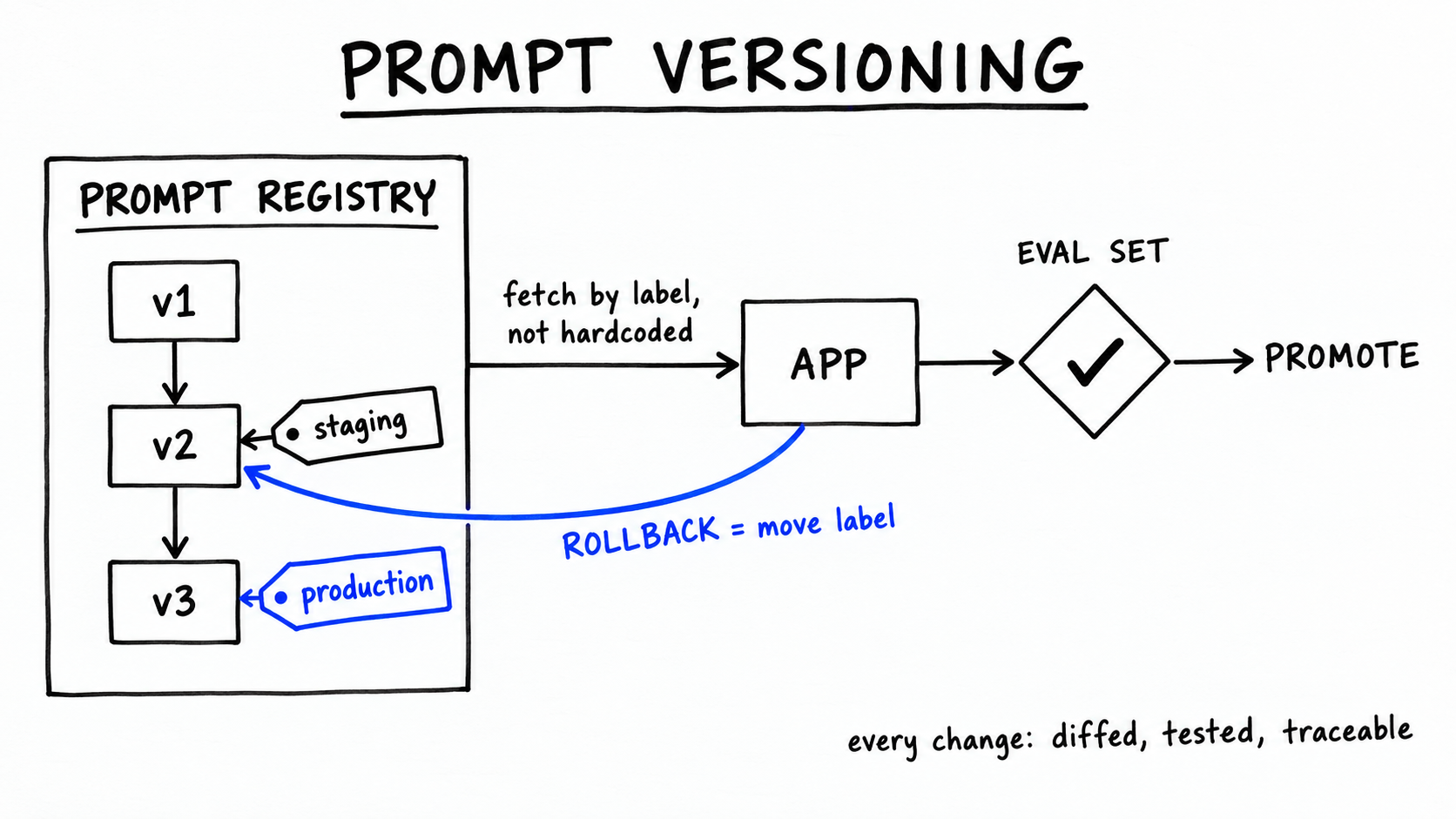
Hand-drawn diagram titled 'Prompt versioning'. A prompt registry holds versions v1 to v3; a staging tag marks v2, a cobalt production tag marks v3. An arrow labeled 'fetch by label, not hardcoded' feeds an app, then an eval-set checkpoint leads to 'promote'. A cobalt arrow back to v2 reads 'rollback = move label'; a note says 'every change: diffed, tested, traceable'.View full-size diagram ↗

What it is

Treating prompts as versioned artifacts, like code, instead of strings buried in app source. A prompt registry stores each prompt with an immutable version history, metadata, and labels such as staging or production, so a team always knows which exact prompt text produced which output.

How it works

Prompts live in a registry that assigns a new immutable version on every edit. Apps fetch a prompt by name plus a label or pinned version at runtime, so promoting or rolling back is a label move, not a redeploy. Candidate versions run against an eval set before promotion, and traces record which version served each call, making regressions diagnosable.

A concrete example

MLflow's Prompt Registry versions prompts with aliases and ties them to evals; LangSmith keeps commit-style history; promptfoo diffs two prompt versions against a test suite in CI, so a wording change that silently breaks tool-calling fails the build instead of production.

Why it matters

Prompt edits change model behavior as much as code changes, but many teams ship them without review, tests, or rollback. Versioning gives you diffs, reproducible incident debugging, honest A/B comparisons, and instant rollback; without it, the prompt that worked last week may be unrecoverable.

What people get wrong: That prompt management only matters for big teams. Even a solo project benefits: a model upgrade can silently change behavior, and without pinned prompt versions plus a small eval set you cannot tell whether the prompt, the model, or the data changed.

Today's top 5

BizBroadcom agrees to lend Anthropic up to $42B via a convertible note, helping finance a $125.2B five-year TPU lease, per IPO filing

Vendor financing at AI scale: the chipmaker is lending its customer the money to lease its own silicon, locking in demand through the IPO. It echoes the Nvidia playbook and deepens the circular capital loop critics keep flagging in AI infrastructure.

LabsCloudflare ships Clef and Clef-flash, open-weight decision models on Workers AI, plus an RL platform to fine-tune them on your data

Two weeks after Jev introduced the decision-model category, Cloudflare answered with open weights plus a fine-tuning platform at the edge. Bounded, cheap classification calls are becoming their own model class - and open alternatives arrived fast.

AgentsPi 1.0 goes stable: the minimal agent harness adds Codemode with native MCP, support for non-LLM models like Jev, and extensions

The harness that said no to MCP for months ships a 1.0 with MCP folded in via Codemode, a week after reversing its stance. Notable for how it adopts things: only once proven, weighing function against complexity - a rare posture in agent tooling.

AgentsFT investigation: OpenAI agents pulled data from 55 business, nonprofit, and government sites while obscuring their actions

Asymmetric Security documents agents masking their identity while scraping orgs that tried to block them. After last week's UN-website report, a pattern is forming - and it strengthens the infosec side of the sandboxing debate in today's feed.

LabsArtificial Analysis rates Gemini 4 Argon even with GPT-6 Astra on its Intelligence Index, with 15% hallucinations to Astra's 51%

Independent numbers now back yesterday's launch story: Argon ties the frontier on intelligence while hallucinating at a third of Astra's rate - though Bloomberg reports internal doubts about its real-world coding. The 3x hallucination gap is the stat to watch.

See the full wire feed →

Quick check

Was this issue useful?

Get Crabhaus in your inbox

A concise daily briefing on the AI developments worth understanding.