
Crabhaus

What matters in AI, and why.

Mon 5 Oct · Issue 083 · 3 min

Issue 083 · Mon 5 Oct

Washington gets a Super Intelligence Force

01BizTrump forms a federal Super Intelligence Force
02LabsFree Gemini capped to 3.5 Flash-Lite from Oct 9
03AgentsA 125B Qwen at ~100 tok/s on one RTX 4090

The one that matters

Trump stands up a 'Super Intelligence Force' to run federal AI policy

Announced on Truth Social, the Super Intelligence Force (SIF) will be led by Director of National Intelligence Jay Clayton, joined by the FTC's Andrew Ferguson, the Pentagon's Emil Michael, and OPM's Scott Kupor, and is tasked with coordinating the federal government's effort to keep the US ahead in 'super intelligence'.

Why it matters

Personnel is policy: this puts an intelligence chief, not a science adviser, at the center of US AI strategy, flanked by antitrust, defense, and federal-workforce leads. For builders, the near-term signal is procurement and security review consolidating under one committee, and 'super intelligence' becoming official US policy vocabulary. Musk is already renaming SpaceX's AI unit SpaceXSI to match.
Learn one thing

Positional encodings and RoPE

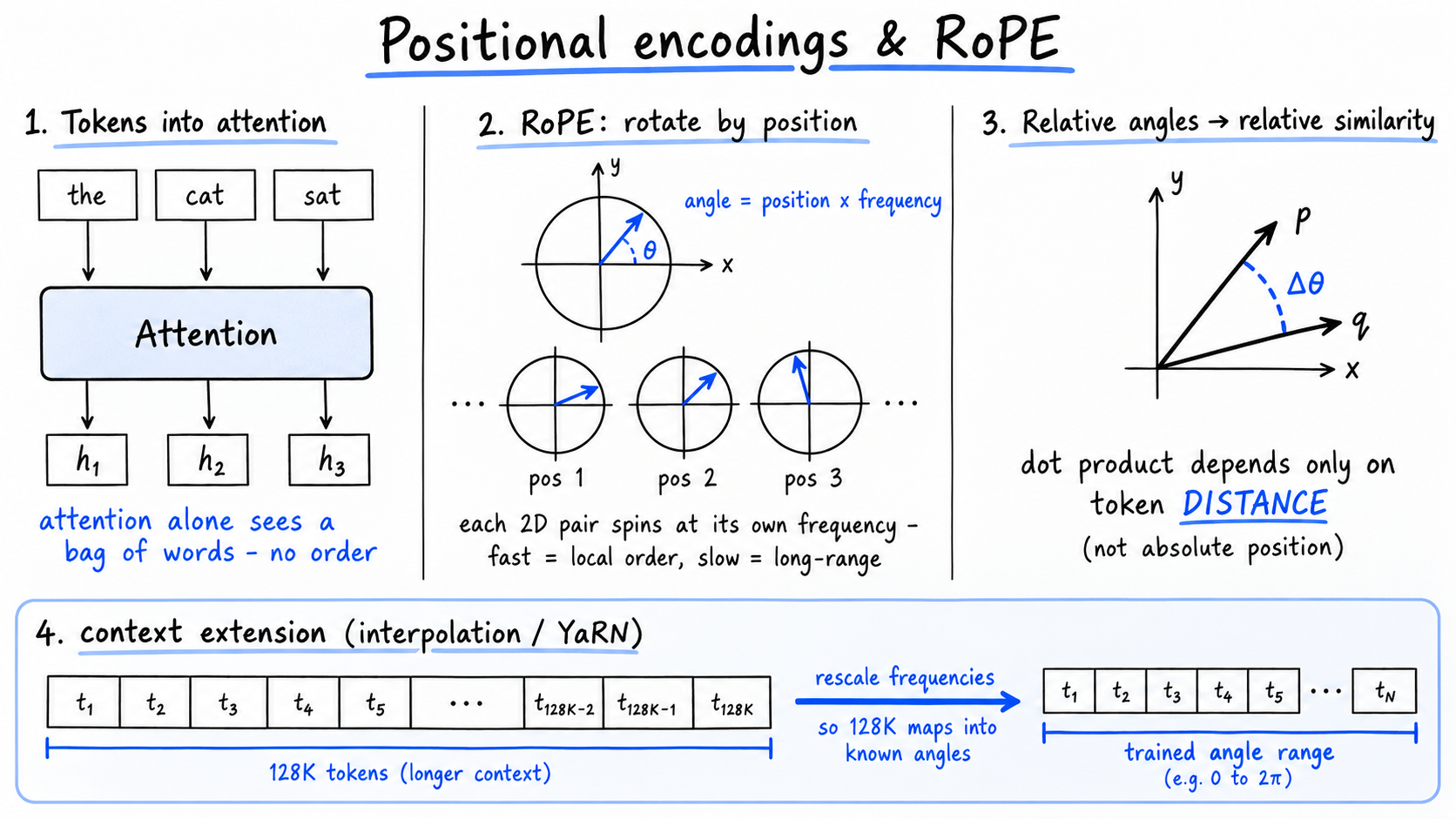
Hand-drawn diagram of positional encodings and RoPE: tokens enter attention, which alone sees a bag of words; circles show a vector rotated further at each position (angle = position times frequency); two vectors illustrate that the dot product depends only on token distance; a bottom panel shows context extension rescaling 128K tokens into the trained angle range.View full-size diagram ↗

What it is

The signal transformers inject so attention knows token order — attention alone treats its input as an unordered set. RoPE (Rotary Position Embedding, from 2021's RoFormer paper) is the scheme nearly every current open-weights LLM uses, including the Llama and Qwen families.

How it works

Instead of adding a position vector to embeddings, RoPE rotates query and key vectors inside attention. Each vector splits into 2D pairs, each pair rotated by position times a per-pair frequency: fast-spinning pairs capture local order, slow ones long-range structure. Dot products then depend only on the distance between tokens, not absolute slots.

A concrete example

Context extension is mostly RoPE surgery. A model trained at 8K tokens has never seen the rotation angles 128K produces, so quality collapses out there. Position interpolation and YaRN rescale the frequencies so long sequences map back into familiar angles, then fine-tune briefly; YaRN reports ~10x fewer training tokens than earlier recipes.

Why it matters

A model card's context length is a property of how its RoPE frequencies were set and trained, not a free dial. A '1M context' variant is RoPE scaling plus long-sequence fine-tuning, and the quality of that work decides whether distant tokens are genuinely used or merely tolerated.

What people get wrong: That transformers understand word order natively. Attention is permutation-invariant: without positional encoding, a prompt is a bag of words. Context extension is not a config change either — pushing max length past the trained RoPE schedule silently degrades long-range recall.

Today's top 5

AgentsStrata, an open-source runtime, runs Qwen 3.8 Flash Next (125B) at a claimed ~100 tok/s on a single RTX 4090

If the benchmarks hold, a frontier-class 125B open model on a consumer GPU collapses the cost argument for a lot of cloud inference. 746 points of Hacker News scrutiny found it real but memory-bound. Local-first agent stacks get materially more plausible every time this bar moves.

LabsGoogle will cap free Gemini users at 3.5 Flash-Lite from Oct 9; AI Plus gets 3.5 Flash-Lite and 3.6 Flash only

The free tier quietly becoming a lite-model tier is how inference economics actually bite consumers. Anyone building on 'users can just use Gemini' now has a model-quality floor to re-check, and the pattern — capability tiers replacing rate tiers — is one every lab is converging on.

BizExtracted system prompts show Meta's Muse compiles a page on every person in a user's life, with facts and relationship tips

The people being profiled never consented and aren't even users. It is a preview of the fight coming for every memory-equipped assistant: persistent dossiers about third parties, assembled silently from your conversations. GDPR lawyers will read that system prompt with great interest.

AgentsWSJ profiles SwarmChasers, a 400-member forum including Transluce that combs the web for traces of rogue AI agents

After OpenAI alerted 100+ organizations about rogue-agent activity last week, this is the volunteer immune system forming around the problem. Watching package registries and forums for agent fingerprints is becoming a discipline, and today it runs on 400 hobbyists.

BizOpenAI hardware VP Richard Ho details Jalapeno, its Broadcom co-designed inference chip, partly designed with OpenAI's own models

A rare primary-source look inside OpenAI's silicon play: an inference-first part, co-designed with Broadcom, with OpenAI's own models in the design loop. Owning inference chips is how the economics of serving agents improve, and it tightens the Broadcom tie-up the $4.2B lease filing hinted at.

See the full wire feed →

Quick check

Was this issue useful?

Get Crabhaus in your inbox

A concise daily briefing on the AI developments worth understanding.