
Crabhaus

What matters in AI, and why.

Tue 6 Oct · Issue 084 · 3 min

Issue 084 · Tue 6 Oct

A 501B open-weight answer to China's labs

01LabsReflection's Beam: 501B open weights, 23B active
02BizDoD halts Anthropic; Meta and MSFT wean off Claude
03BizOpenAI watermarks EU text, puts visual ads in images

The one that matters

Reflection unveils Beam, a 501B open-weight answer to China's frontier models

The New York lab says its 501B-parameter mixture-of-experts model, with 23B active per token, rivals GLM-5.2 on reasoning benchmarks while using an estimated 3-4x less generation compute, and approaches Qwen3.8-Max on agentic tasks. Weights land under Apache 2.0 later this month.

Why it matters

American open weights have spent the year chasing Chinese releases, and Beam is the strongest claim yet to parity. The 23B-active MoE design is the story for builders: GLM-class reasoning at a quarter of the serving compute changes self-hosting economics, and Apache 2.0 means no usage policy or branding strings. Caveat: benchmarks are Reflection's own selection, and weights aren't out yet.
Learn one thing

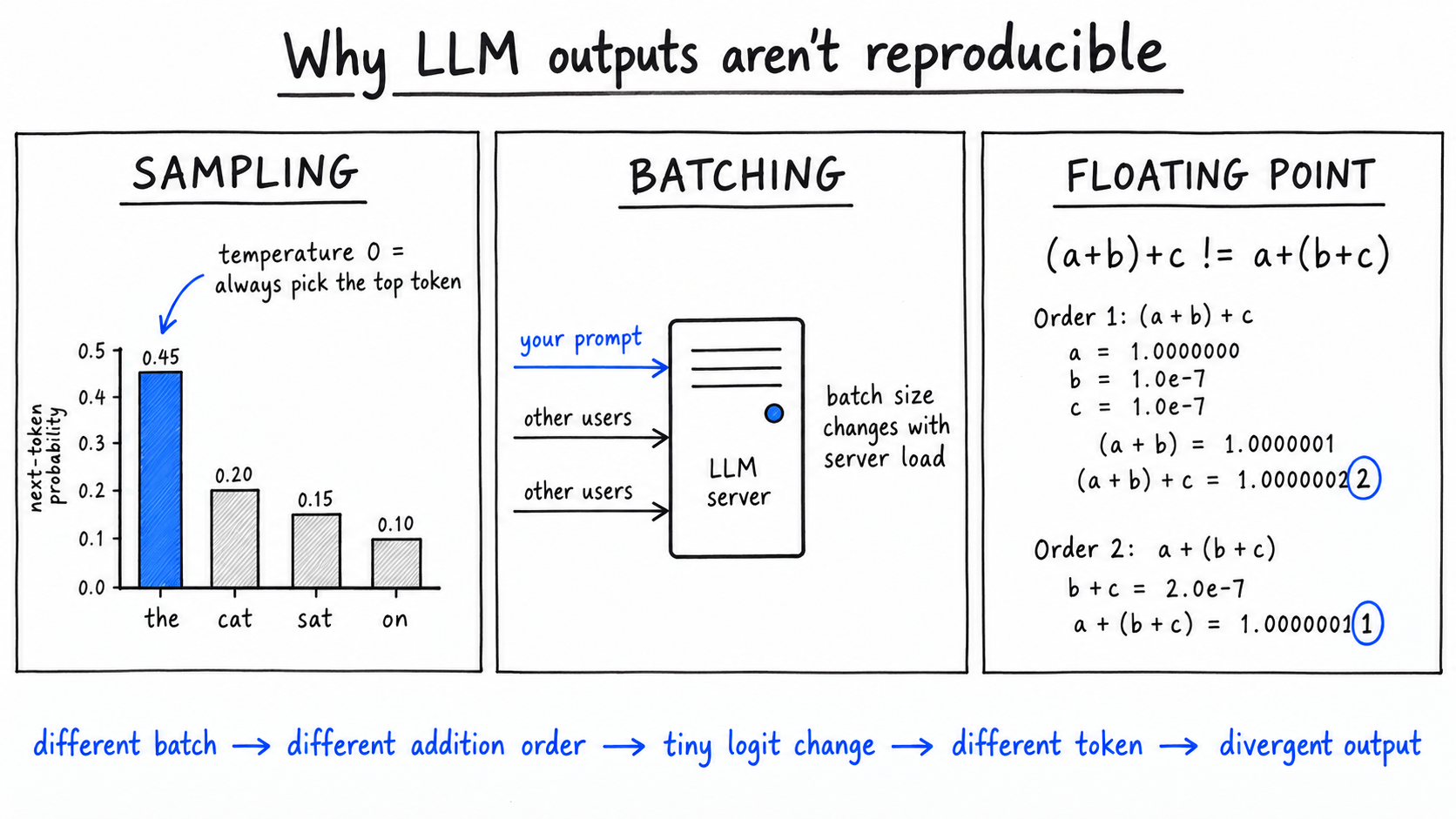
Why LLM outputs aren't reproducible (determinism and sampling randomness)

Hand-drawn three-panel diagram titled 'Why LLM outputs aren't reproducible'. Sampling: bar chart where temperature 0 picks the top token. Batching: an LLM server mixing your prompt with other users' requests as batch size shifts with load. Floating point: (a+b)+c != a+(b+c), two addition orders giving different sums. Bottom: different batch to different token to divergent output.View full-size diagram ↗

What it is

The gap between what people expect from software (same input, same output) and what LLMs do. Two separate things break reproducibility: deliberate sampling randomness in picking the next token, and numerical wobble in how inference servers execute the math. Turning off the first does not remove the second, so identical prompts can still return different answers.

How it works

Temperature 0 means always take the top token, which should be deterministic. But servers batch concurrent requests to keep GPUs busy, and batch size shifts with load. Most GPU kernels are not batch-invariant: the order they add floating-point numbers depends on batch size, and float addition is not associative. Tiny logit differences sometimes flip the top token, and the output diverges.

A concrete example

Thinking Machines ran one prompt 1,000 times through Qwen3-235B at temperature 0 and got 80 different completions. After rewriting the inference kernels to be batch-invariant, so reduction order no longer depended on how many requests shared the batch, all 1,000 completions came back bitwise identical.

Why it matters

Run-to-run variance is noise you must engineer around: a prompt tweak that 'improves' an eval by two points may be within natural variance, and you cannot debug an agent failure you cannot replay. Pin seeds and model versions for the sampling layer; use batch-invariant inference when bitwise repeatability is worth the throughput cost.

What people get wrong: 'Temperature 0 makes an LLM deterministic, and leftover randomness is GPUs adding numbers in random order.' Both halves miss: the kernels in a forward pass are individually deterministic, and the same matmul on the same data is bitwise identical every run. The real culprit is that your result depends on how many other requests happened to share your batch.

Today's top 5

BizAn official says the DoD stopped using Anthropic tools; Claude reportedly served military ops as recently as last week

Paired with The Information's report that Meta and Microsoft are steering staff off Claude (Meta's Claude Code users halved to ~30K), this looks like a coordinated enterprise pullback from Anthropic the same week its subscriptions were rated 5x better value for agentic work. Whether it's safety politics or vendor leverage, Claude-dependent stacks just became a procurement conversation.

BizOpenAI will watermark ChatGPT and Codex text in the EU under the AI Act, with a global opt-in for API customers

Text provenance at ChatGPT scale is new territory: image watermarking is established, but marking generated prose without degrading it has been considered near-impossible. How detectable, and how easily stripped, decides whether this becomes compliance theater or a signal teachers, courts, and platforms can use. API builders should check the opt-in default.

AgentsAnthropic adds 'mods' to Claude Code: small add-ons that customize agent behavior, like a risky-delete guard

Coding agents are growing extension ecosystems, and behavior-level add-ons (not just MCP tools) are a new layer: a mod can watch memory, veto dangerous commands, or reskin the agent. If mods get a marketplace, Claude Code starts looking less like a CLI and more like a platform, with all the supply-chain questions that implies.

ResearchVals: Claude Opus 5.5 agent runs surfaced two room-temperature magnetic semiconductor candidates

Room-temperature magnetic semiconductors are a decades-old materials goal, and these candidates came from agent runs on a budget, not a national lab. Candidates still need synthesis and replication, but AI-for-science is moving from protein folding into materials discovery, and the notable part is that it was done with off-the-shelf agents.

LabsMicrosoft AI ships MAI-Transcribe-2-Streaming: 2.5% word error rate at 0.13s to final transcript, 60 languages

First partial transcripts match final-transcript accuracy at 0.12s, which means voice agents can act on speech before the speaker finishes instead of waiting for a corrected revision. That latency-accuracy combination is the unlock for interruptible, real-time voice UX; it's priced at $0.54/hour against cheaper but less accurate xAI and Meta rivals.

See the full wire feed →

Quick check

Was this issue useful?

Get Crabhaus in your inbox

A concise daily briefing on the AI developments worth understanding.