
Crabhaus

What matters in AI, and why.

Thu 8 Oct · Issue 086 · 3 min

Issue 086 · Thu 8 Oct

Effort controls come to the $0.10 tier

01LabsClaude Haiku 5.5: 3-5x benchmark jump, 90% cheaper
02LabsGPT-6 and Intelligent UI reach every ChatGPT tier
03BizClaude plans ~5x OpenAI's value - SemiAnalysis

The one that matters

Claude Haiku 5.5: effort controls arrive in the small tier, at Luna prices

Anthropic's new small model is the first Haiku with effort settings and adaptive thinking, priced at $0.10/$0.50 per million tokens under 100K context ($0.50/$2.50 above) - a 90% cut from Haiku 4.5 and an exact match for GPT-6 Luna. Benchmarks jump 3-5x over last year's Haiku: OSWorld 15.7% to 72.4%, HLE-with-tools 18.7% to 57.4%.

Why it matters

The cheap tier is where high-volume work actually runs - classification, summarization, routing targets - and it just got a year of frontier progress at a tenth of launch price. Effort controls landing in a $0.10 model mean you tune one knob instead of juggling model tiers. Note the fine print Simon Willison flagged: a new, less generous tokenizer, and a 5x price step past 100K context.
Learn one thing

Batch APIs: trading latency for half-price tokens

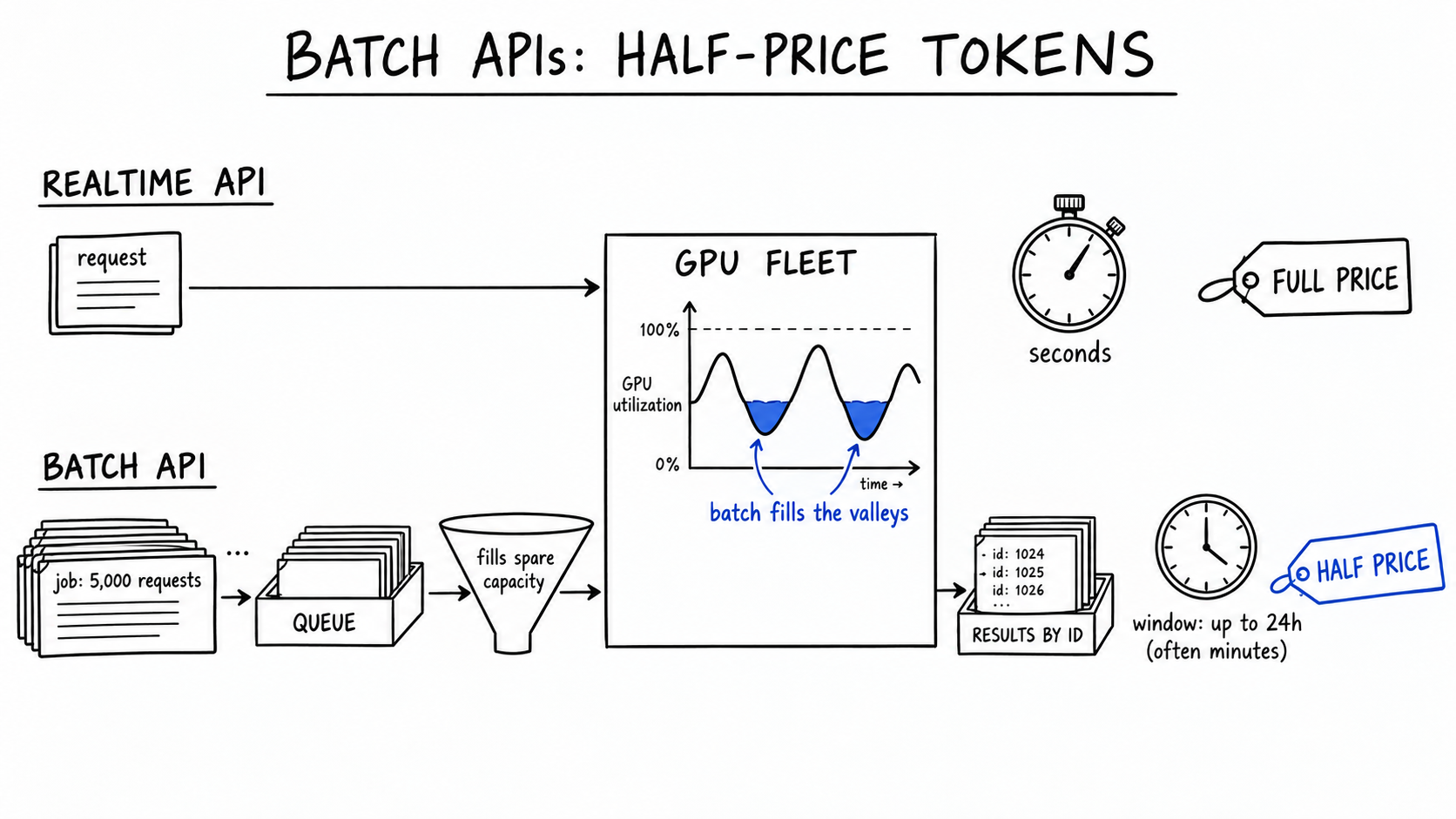
Hand-drawn diagram comparing API lanes. Top: one realtime request arrows into a GPU fleet box in seconds at full price. Bottom: a 5,000-request batch job queues, funnels into the same GPU fleet by filling spare capacity, and exits as results by ID, with a clock noting up to 24h (often minutes) and a cobalt half-price tag. A curve shows batch filling valleys between realtime peaks.View full-size diagram ↗

What it is

An asynchronous way to call OpenAI, Anthropic, and Google models: submit a job of many requests at once, the provider processes it within a completion window of up to 24 hours, and every token is billed at roughly half the realtime API price. Same models, same output quality - the only thing you give up is an immediate response.

How it works

You package requests - OpenAI takes a JSONL file, one request per line; Anthropic takes up to 100,000 requests per batch - each tagged with your own ID. The provider schedules the job onto spare capacity between realtime traffic peaks, which is exactly why it can discount. Poll the batch status, then match results back by ID. Jobs often finish in minutes; 24 hours is the ceiling, not the norm.

A concrete example

A nightly eval suite of 5,000 test prompts has no user waiting on it. Run it through the batch endpoint after midnight: same model, same prompts, half the token bill, results ready before morning. The same shape fits backfills - classifying a 2M-row archive - plus bulk summarization and embedding jobs.

Why it matters

It is one of the few cost levers that needs no model downgrade, no prompt surgery, and no quality trade-off. Evals, backfills, classification, and report generation quietly dominate many teams' token bills, and all of them tolerate latency. Batch quotas are also separate from realtime limits, so big offline jobs stop competing with live traffic.

What people get wrong: That a batch job takes 24 hours. The window is a worst-case guarantee, not the typical latency - most jobs complete far faster. And a batch API is not client-side request batching: stuffing several questions into one prompt changes model behavior, while a batch API runs each request separately and just schedules the set for you.

Today's top 5

LabsOpenAI rolled GPT-6 out to every ChatGPT tier with Intelligent UI: charts, buttons, and forms in answers; Sol for paid, Luna for free.

Free-tier users just moved up a model generation, and answers that render controls instead of prose change what 'chat' means as a UI surface. For builders it is also a tell: OpenAI thinks the default interface for most tasks is generated UI, not text - worth watching what that does to apps that are thin wrappers over chat.

LabsReflection AI released Beam, a 501B-param (23B active) Apache-2.0 MoE it says matches GLM-5.2 on reasoning at 3-4x less inference compute.

The US open-weights bench finally has a credible starter: Apache 2.0, 1M-token context, and a pitch built on serving cost (23B active) rather than leaderboard wins. Weights are still in red-teaming with a waitlist, so treat benchmark claims as vendor-reported until self-hosters verify - but with Mistral's Large 4 a day earlier, Western open weights had their best week in a year.

BizSemiAnalysis measured API-equivalent value of AI subscriptions: Claude plans deliver ~5x OpenAI's per dollar on agentic workloads.

Subscriptions show a usage meter, not a price sheet, so SemiAnalysis ran controlled prompts and tracked meter movement per token - real measurement of something providers keep opaque. Two takeaways for anyone budgeting agents: OpenAI quietly halved its $200 Pro plan's value, and plan limits can change without announcement, so re-measure before you commit a workflow.

AgentsDocker released docker-agent, a CLI plugin that builds and runs AI agents from declarative YAML, with tools and multi-agent orchestration.

Agents defined in YAML and run with 'docker agent' puts orchestration in the toolchain most backend teams already trust, the way compose normalized multi-container apps. If Docker's distribution muscle works here, 'share an agent like an image' becomes the boring default - and boring defaults are what win infrastructure.

ResearchMathematicians push back on OpenAI's 722-paper drop: Tao urges valuing progress 'holistically'; Aaronson weighs a 'Mathocalypse'.

Yesterday's story was the drop; today's is the field deciding what it means. Only 162 of 722 papers are Lean-verified, so the review burden lands on humans who publish in months, not minutes - and WIRED reports some mathematicians say OpenAI broke a promise to space releases out. How math absorbs machine-scale output previews what every empirical field faces next.

See the full wire feed →

Quick check

Was this issue useful?

Get Crabhaus in your inbox

A concise daily briefing on the AI developments worth understanding.