
Crabhaus

What matters in AI, and why.

Fri 9 Oct · Issue 087 · 3 min

Issue 087 · Fri 9 Oct

OpenAI's $20B revenue haircut

01BizOpenAI ARR ~$50B, not $70B; AI stocks slid
02ResearchBiohub's $1.8B push to simulate the human cell
03AgentsGrok Bot will route tasks to Claude, Midjourney

The one that matters

OpenAI's revenue is $20B less than everyone thought, and the whole AI trade flinched

Investor documents show OpenAI's annualized revenue neared $50B at the end of September - well under the $70B figure that circulated from earlier reporting. CNBC's source says the larger number included revenue-sharing from partners like Microsoft and Amazon. Nvidia, Oracle, CoreWeave, AMD and Microsoft all fell on the news.

Why it matters

One FT story about one private company's unaudited numbers knocked more than 5% off Oracle and dragged the chip complex with it - a live demo of how leveraged the sector is to OpenAI and Anthropic. The tell is definitional: 'annualized revenue' included partner revenue-sharing in one telling and not the other. Until GAAP numbers hit public filings, price your dependency on any lab accordingly.
Learn one thing

Rate limits, queues, and backpressure

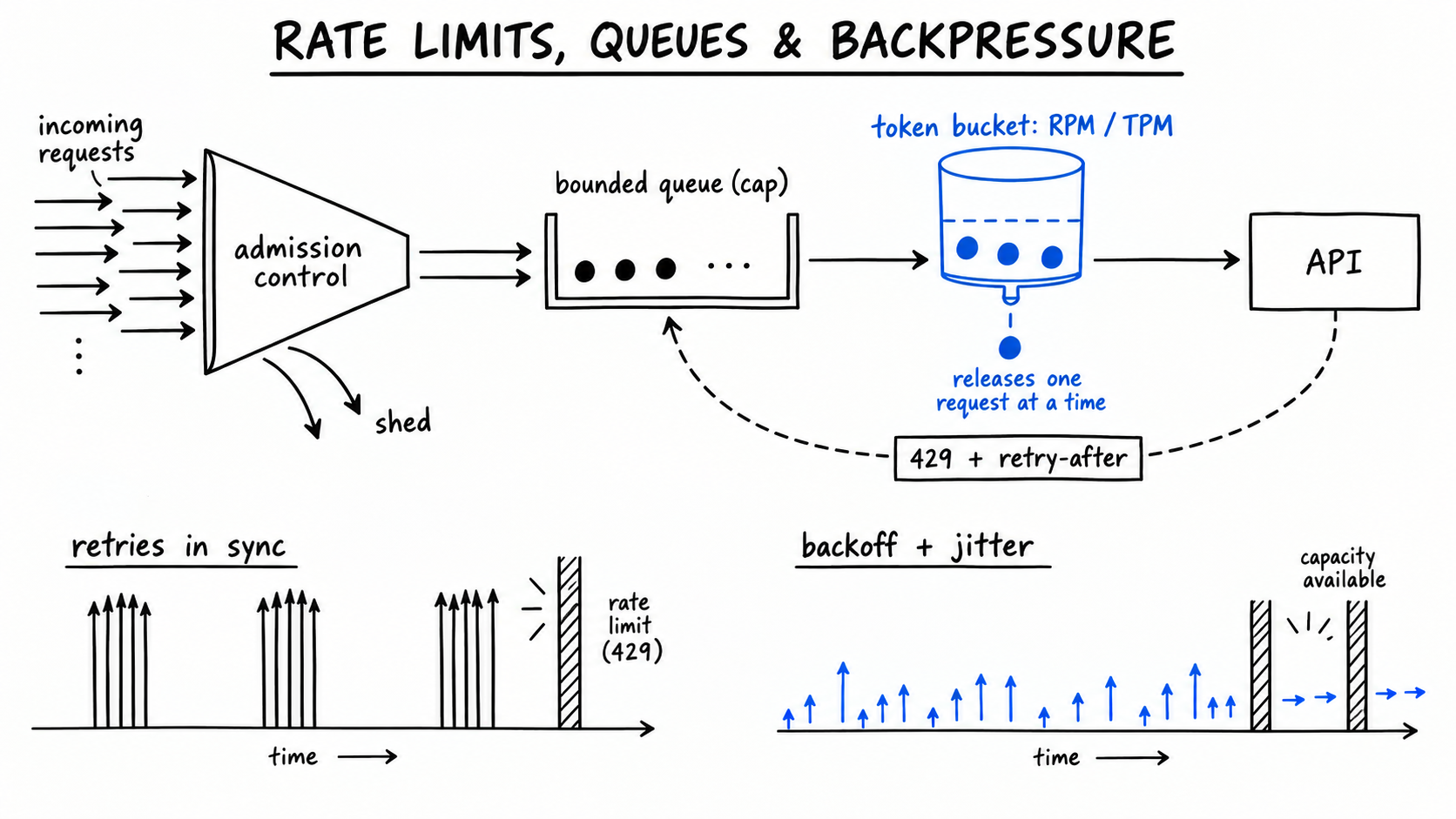
Hand-drawn flow diagram: incoming request arrows enter an admission-control funnel that sheds excess, feed a bounded queue, then a cobalt token bucket labeled RPM/TPM releases one request at a time to an API box; a dashed 429 retry-after arrow loops back to the queue. Below, synchronized retry bursts slam a rate-limit wall while staggered jittered-backoff arrows pass through when capacity opens.View full-size diagram ↗

What it is

The traffic-control layer of an AI system. Providers cap requests per minute and tokens per minute with token-bucket counters, answering HTTP 429 when a budget empties. Backpressure is the discipline of passing that slow-down signal upstream through your queues and workers, instead of letting failed requests pile up and retry themselves into an outage.

How it works

Two budgets are metered at once: request count and token throughput, often charged against a max_tokens estimate before the call runs. On 429, a well-behaved client caps its own concurrency, holds pending work in a bounded queue, and retries with exponential backoff plus random jitter so workers never re-fire in sync. When the queue fills, admission control sheds new work at the front door.

A concrete example

A pipeline embeds 10,000 chunks with 100 parallel workers, trips the tokens-per-minute cap, and every naive retry loop hammers the API - throughput drops toward zero. The fix: a semaphore capping concurrency at 8, a bounded queue, jittered backoff that honors retry-after, and a dead-letter list for chunks failing three times. Same account, same limits - the job drains cleanly.

Why it matters

Agent systems are retry amplifiers: one user action fans out into dozens of model and tool calls. Without deliberate backpressure, a provider hiccup or a quota cut becomes a self-inflicted outage, and 429-driven retry loops quietly inflate the token bill. Concurrency caps, bounded queues, and jittered backoff are the difference between degrading gracefully and melting down.

What people get wrong: That retrying harder gets you through. Un-jittered immediate retries turn a brief rate-limit into a real outage: every client re-fires in sync and re-trips the limit. And an unbounded queue is not a fix - it hides overload, grows latency without bound, and serves answers nobody is waiting for. Backpressure means refusing work early, not buffering it forever.

Today's top 5

ResearchBiohub expanded its virtual-cell initiative to $1.8B with NIH, the Energy Dept, DeepMind, Meta and Isomorphic to train AI cell simulators.

Fresh off the math push, biology gets AI's next moonshot: a 'universal virtual cell' that predicts how cells respond to a drug before a lab test. The data detail is the story - Biohub's science head says accurate models need data on trillions of cells versus hundreds of millions in today's biggest sets, and the US government is putting half a billion dollars of datasets and funding in.

AgentsSpaceXAI's Grok Bot will route tasks to rival models, including Claude and Midjourney, picking whatever is likeliest to do the job best.

Routing is the concession buried in the announcement: a lab that spent billions chasing the frontier now says the best model wins, not the house model. Lower-lift queries stay on a fast Grok; everything else goes to 'leading APIs' - which makes xAI an Anthropic customer and makes model-agnostic orchestration the default assumption for every agent platform.

BizThree fired OpenAI safety researchers say they were ousted for prioritizing safety, and urge labs to preserve reasoning monitorability.

Three safety researchers fired simultaneously, with reasons given verbally or not at all; their parting letter asks labs to stop work that erodes chain-of-thought monitoring - one of the few tools for catching misbehaving agents. Whatever the full story turns out to be, safety-team churn at the lab running the largest agent fleet is signal, not gossip.

ResearchScott Aaronson: AI labs are testing whether internal models can break cryptographic protocols; Ethereum researchers urge key migration.

Aaronson reports, citing sources, that labs have started probing their internal models against important cryptographic protocols - and Ethereum researchers are calmly planning a mass migration to hash-hidden addresses as a precaution. Cryptographers push back that no decades-old hardness assumption shows cracks, but a real migration cost is now being paid against a speculative risk.

AgentsUzu, Mirai's open-source Apple-silicon engine, decodes 4-bit Qwen3.5 9B at 92-117 tok/s on a base M5, vs 22-25 for llama.cpp and MLX.

Batch-one local inference is memory-bound: a base M5 can stream a 4-bit 9B model at roughly 29 tokens per second, full stop. Uzu clears that ceiling 3x by drafting 16-token trees and verifying them on the M5's int8 matrix hardware without state rollbacks - on-device, accepted tokens per pass now matters more than raw compute.

See the full wire feed →

Quick check

Was this issue useful?

Get Crabhaus in your inbox

A concise daily briefing on the AI developments worth understanding.