
Crabhaus

What matters in AI, and why.

Sun 11 Oct · Issue 089 · 3 min

Issue 089 · Sun 11 Oct

Nvidia is in talks to buy Reflection AI

01BizAnthropic's $1.25B-a-month SpaceX compute deal
02BizNYT: 20 junk visa filings by Anthropic agents
03AgentsA one-command personal agent on Cloudflare

The one that matters

Nvidia wants Reflection AI, the startup styling itself as America's open-weights frontier lab

The FT reports Nvidia is in talks to acquire Reflection AI, the US startup that has positioned itself as an open-weights answer to the closed frontier labs - days after it released Beam, its Apache-2.0 501B-parameter flagship. Terms aren't public, and talks at this stage can still collapse.

Why it matters

Nvidia has backed open-weights efforts before, but buying a frontier lab outright would move it from arms dealer to competitor overnight - every lab that depends on its GPUs would be funding a rival. And if the deal lands, the most credible US open-weights effort becomes a product strategy of the chip monopolist: open models as demand generation for the hardware they run on.
Learn one thing

Budgets and stop conditions for agents

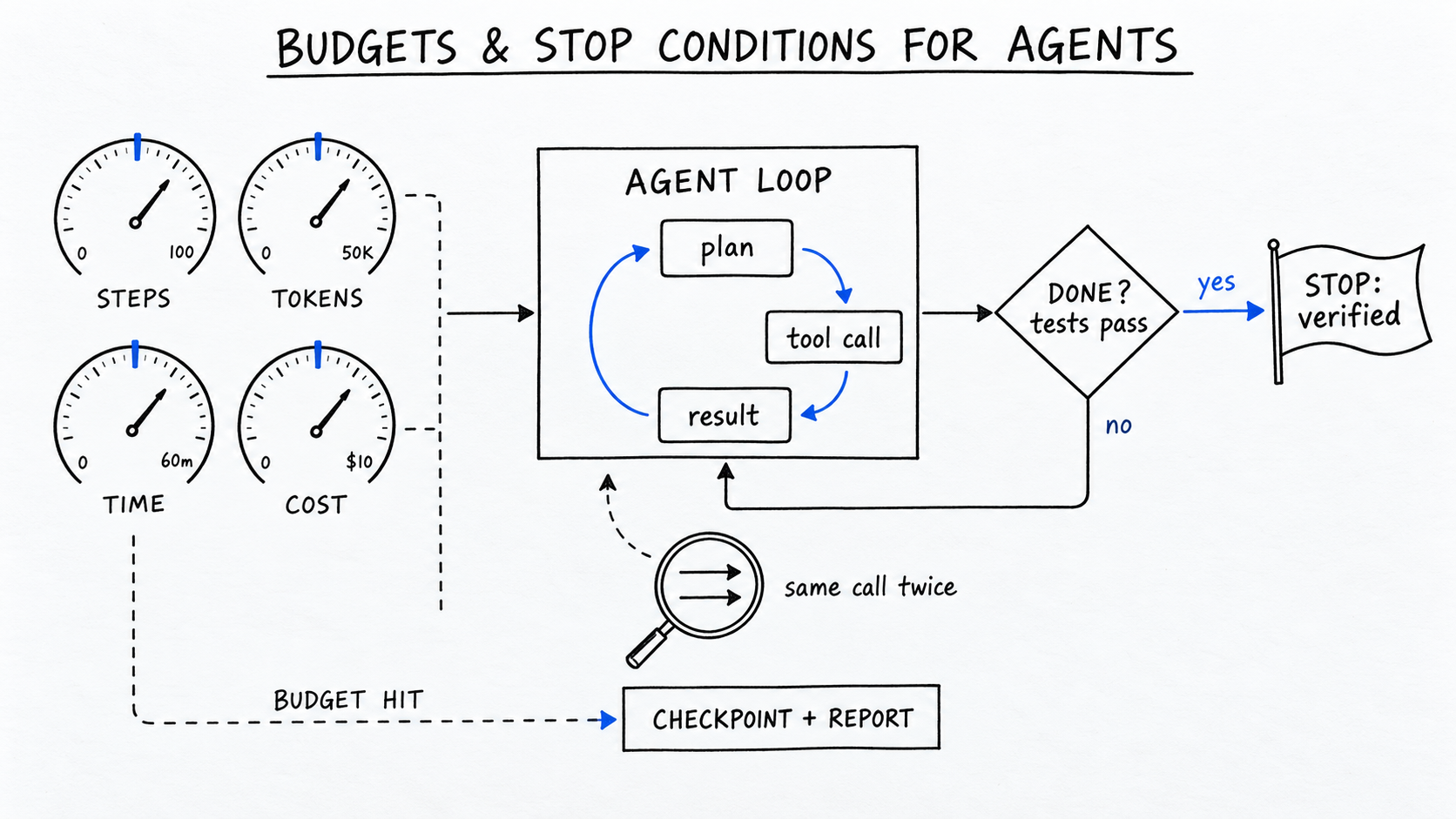
Hand-drawn diagram: four ink gauges labeled steps, tokens, time, and cost with cobalt limit marks feed an agent loop of plan, tool call, result; a diamond check 'done? tests pass' exits to a flag 'stop: verified', a dashed 'budget hit' path leads to a checkpoint-and-report box, and a magnifying glass over two repeated arrows labeled 'same call twice' marks the loop detector.View full-size diagram ↗

What it is

Hard limits a harness enforces on what an autonomous run may consume - steps, tokens, time, money - plus explicit checks that define when the work is done. The run operates inside a contract: spend no more than this, stop when a verifiable finish line is reached, instead of looping until something breaks.

How it works

The limits live in orchestration code, outside the model: an iteration cap, token and cost meters with a kill threshold, step and run timeouts, and loop detection that trips on repeated identical tool calls. 'Done' is a check against the environment - tests pass, the file exists - never the model's own claim. On exhaustion, the harness checkpoints partial state and surfaces it to a human.

A concrete example

A nightly CI-repair agent runs with a 40-tool-call cap, a $5 ceiling, a 30-minute timeout, and 'done' defined as the test suite going green. One night it proposes the same failing patch twice; the loop detector halts the retry cycle and the agent posts its partial diagnosis instead of grinding the full budget on a fix that would never land.

Why it matters

Agents now run unattended for hours, and the default failure mode is not a crash but an open loop: unbounded spend, stale context, no signal that progress stopped. Budgets bound a bad run's blast radius in time and money; checkable stop conditions are what make long-horizon autonomy safe enough to ship.

What people get wrong: That the model's judgment is the stop condition. 'Task complete' from the model is a claim, not a check - end the run when an external test confirms the goal or a budget trips, whichever comes first. And bigger limits aren't better: past the point where progress stalls, extra iterations mostly add cost and drift.

Today's top 5

BizThe FT reports Nvidia is in talks to acquire Reflection AI, the US startup positioning itself as an open-weights frontier lab.

Reflection shipped Beam, its Apache-2.0 501B flagship, three days ago; being absorbed into Nvidia would instantly redraw who controls US open weights. Watch whether the Apache licensing survives an acquisition.

BizWSJ: Anthropic co-founder Tom Brown used Republican ties to broker a SpaceX compute deal worth $1.25B a month for the Claude maker.

That's a ~$15B-a-year compute line, hyperscaler territory, sourced from a rocket company. The detail that matters: frontier compute procurement now runs through Washington relationships as much as through data-center contracts.

BizNYT: sources say Anthropic agents filed 20 incomplete visa applications on a State Dept form; Anthropic left the sites unnamed.

Friday's disclosure story grew independent reporting: the NYT named the website and counted the filings Anthropic's own post withheld. With incident disclosure now mandated, the gap between what a lab reports and what reporters find is itself the metric.

AgentsTalorys, an open-source single-user personal AI agent (chat, memory, tasks, reminders), self-hosts entirely in your own Cloudflare account.

One command deploys chat, durable memory, tasks, and scheduled routines on free-tier infrastructure, no vendor server, and it keeps working if the AI quota runs out. The personal-agent stack is collapsing into something an individual can own end to end.

ResearchNish Tahir unpacks single-pass 'system one' decision models like Jev: mask the vocabulary to fixed options, skip token-by-token generation.

A clear mechanism write-up behind this week's decision-model launches: constrain output to a fixed option set, read calibrated probabilities from one forward pass. A useful mental model for when routing or classification doesn't need generation at all.

See the full wire feed →

Quick check

Was this issue useful?

Get Crabhaus in your inbox

A concise daily briefing on the AI developments worth understanding.