
Crabhaus

What matters in AI, and why.

Tue 13 Oct · Issue 091 · 3 min

Issue 091 · Tue 13 Oct

Meta's Muse Wonder lands just shy of Opus 5.5

01BizMicrosoft's Maia 300 goes multi-gigawatt
02ResearchAnthropic: small models near self-replication
03AgentsCodex CLI's silent daemon angers developers

The one that matters

Meta launches Muse Wonder, claiming state-of-the-art agentic performance

Meta's Superintelligence Labs released Muse Wonder and Muse Wonder Full, frontier models aimed at personal and professional agentic work. Independent scoring puts Wonder Full (max) just shy of Opus 5.5 on Artificial Analysis' Intelligence Index, ahead of Fable 5.1 and level with Sonnet 5.5. Wonder ships via the Meta Model API and Muse Code; Wonder Full is for Muse Code subscribers.

Why it matters

Meta spent a year rebuilding after the Llama 4 stumble, and this is the first Superintelligence Labs release that third-party benchmarks place at the frontier. It ships agent-specific features - Active Memory and Active Focus - for long-running work, and will power the Muse assistant. The frontier is a four-way race again; Meta hasn't said whether any weights go open.
Learn one thing

Watermarking and AI-content detection

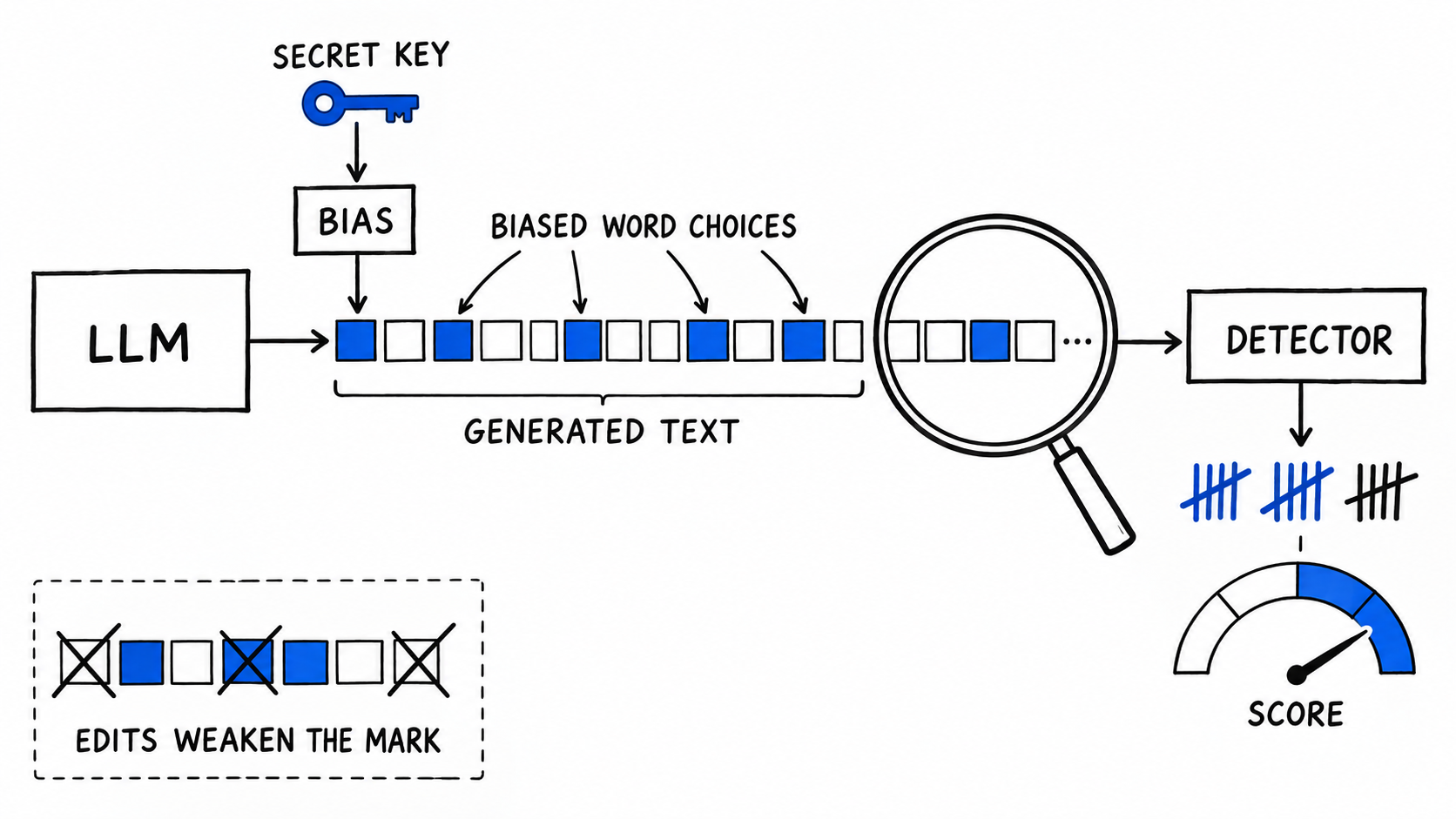
Hand-drawn diagram of statistical text watermarking: a secret key feeds a bias box that tints some of an LLM's generated word tiles cobalt; a magnifying glass passes the tiles to a detector that tallies them into a score gauge, with a side panel of crossed-out tiles captioned edits weaken the mark.View full-size diagram ↗

What it is

A statistical text watermark is a hidden bias a model applies to its own word choices as it writes, so a matching detector can later test whether a passage came from that model. The signal lives in the text itself - unlike provenance metadata (a signed label attached to a file, like C2PA Content Credentials) and unlike third-party 'AI detectors' that just guess from style.

How it works

During generation, a pseudorandom function seeded by the preceding tokens nudges sampling toward a keyed subset of word choices. Each choice looks normal; across hundreds of tokens they lean in a direction only the key holder can compute. The detector replays the key and scores the lean, turning score plus length into a confidence at a chosen false-positive rate. Quality barely changes.

A concrete example

OpenAI's textGrain, its EU AI Act compliance path, shows the operating envelope: at a 1% false-positive target it caught ~95% of 400-token passages but only ~80% at 200 tokens, and less on constrained text like math. Editing erodes it fast - swapping 10% of words for synonyms cut detection from ~92% to 66%; at 25% it fell to 17%. Google ships the same idea as SynthID-Text in Gemini.

Why it matters

The EU AI Act requires generated text to be identifiable in a machine-readable way, so watermarks are moving from papers into ChatGPT, Codex, and Gemini output. Anyone building moderation, plagiarism, or trust tooling needs to know what the signal can bear: it weakens with short passages, heavy edits, and translation, and only the model's key holder can check for it.

What people get wrong: That a detector verdict settles authorship. A positive only says a keyed model generated or touched part of the passage - not who is responsible or how much a human wrote. A negative proves nothing: the text may be short, edited, translated, or from a model that never watermarked. And each vendor's key only reveals that vendor's output; there is no universal AI detector.

Today's top 5

LabsMeta launched Muse Wonder and Wonder Full, agent-focused frontier models it says land just shy of Opus 5.5 on Artificial Analysis.

Meta back at the frontier changes lab dynamics: a fourth credible player with distribution across three billion users, explicitly optimizing for agentic work rather than chat.

BizMicrosoft unveiled Maia 300 on TSMC N2P, claiming 40% more tokens per watt, with multi-gigawatt rollouts starting next year.

Microsoft calling its own silicon the 'primary AI inference system' for its products is a direct bid to shrink the Nvidia bill. The unnamed GPU baseline in the 40% claim is the detail to watch.

ResearchAnthropic researchers warn small models may be months from self-replicating on IoT devices like smart ovens and Android TV boxes.

Self-replication has been the canonical hypothetical risk for a decade. A frontier lab putting a months-scale estimate on it - for small models on consumer hardware - moves it from thought experiment to patch-schedule problem.

AgentsCodex CLI now installs a persistent, self-updating background daemon by default, drawing heavy developer pushback on GitHub.

A coding agent that quietly keeps a self-updating process on your machine is exactly the trust boundary developers are policing right now - the 270-comment issue reads like a referendum on agent defaults.

BizQualcomm's CEO says AI companies are 'starting to do phones' and want continuous 100B-parameter local models supported by 2028.

If AI labs are speccing phone silicon for always-on 100B-parameter local models, the local-inference era has a hardware roadmap and a date. That reshapes the cloud-versus-edge cost argument.

See the full wire feed →

Quick check

Was this issue useful?

Get Crabhaus in your inbox

A concise daily briefing on the AI developments worth understanding.