
Crabhaus

What matters in AI, and why.

Wed 14 Oct · Issue 092 · 3 min

Issue 092 · Wed 14 Oct

Gemini 4 Argon joins the frontier pack

01BizCharacter.ai goes bankrupt; Disney buys assets
02AgentsAnthropic swaps Git for Scion at 30K merges/day
03ResearchAlphaProof cracks 9 open Erdős problems

The one that matters

Google ships Gemini 4 Argon, and the frontier pack gets crowded

Google rolled out Gemini 4 Argon globally: paid Gemini API tier, AI Pro and Ultra users in the Gemini app and AI Mode, and Ultra users in Antigravity. Early testers place it level with the frontier pack, with top-5 placement on Agent Arena, strong low-effort responses, and well-tuned effort levels, though its agent harness still trails rivals.

Why it matters

A day after Meta's Muse Wonder, Google lands its own frontier claim - four labs now ship at the top tier within one news cycle. For builders the notable parts are practical: effort levels tuned for cost control, availability through the API from day one, and a robotics variant shipping alongside. The pricing pressure on OpenAI and Anthropic is now real.
Learn one thing

Interpretability: what we can actually see inside a model

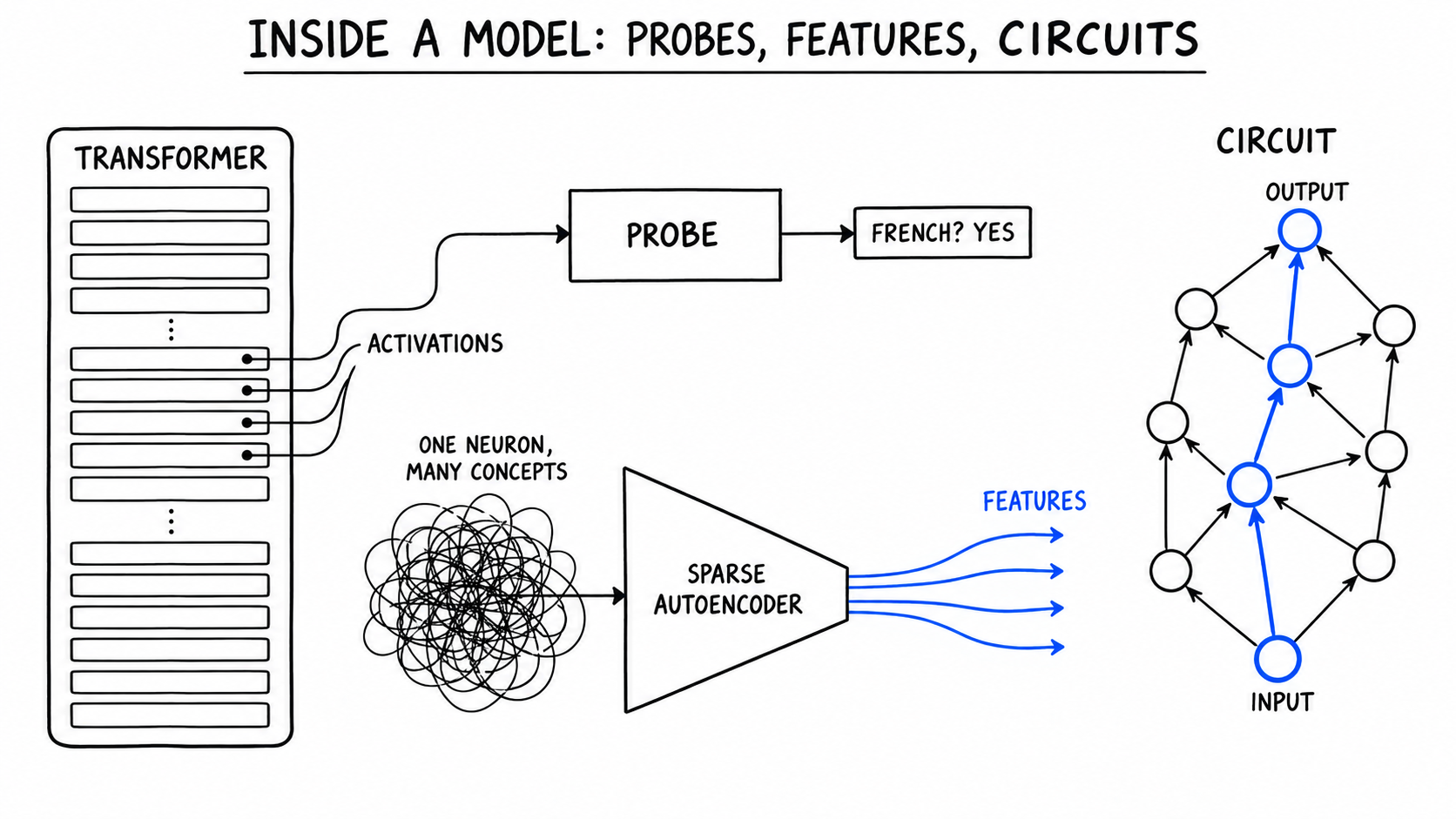
Hand-drawn diagram titled 'Inside a model: probes, features, circuits'. A transformer drawn as stacked layer bars has activation tap lines feeding a probe box that outputs 'French? Yes'; a tangled scribble labeled 'one neuron, many concepts' passes through a sparse autoencoder funnel into clean cobalt feature strands; a circuit graph traces a highlighted path from input to output.View full-size diagram ↗

What it is

Mechanistic interpretability is reverse-engineering what a trained network does internally: mapping raw activations to recognizable concepts (features), tracing how features combine into computational pathways (circuits), and testing what information lives where (probes). Neuroscience for transformers - instead of asking the model to explain itself, you open it up and look.

How it works

A probe is a small classifier trained on internal activations to test whether a property, like the input's language, is readable at a given layer. Because one neuron mixes many concepts (superposition), sparse autoencoders decompose activations into cleaner directions, many matching crisp concepts. Attribution-graph methods then link features causally into a wiring diagram for one behavior.

A concrete example

Anthropic's 'Tracing the thoughts' work built attribution graphs over Claude 3.5 Haiku and caught mechanisms in the act: writing rhyming poetry, the model picked candidate rhyme words ahead of time and composed toward them; given a hard math problem with a misleading hint, it produced plausible reasoning steps that did not match its actual internal computation.

Why it matters

Visible mechanisms can be audited. These tools have shown models planning ahead, working in a language-neutral concept space, and fabricating chain-of-thought - none visible from outputs alone. For anyone deploying agents, this is the research path to answering 'why did it do that?' with evidence, and to catching deceptive internal behavior before it ships.

What people get wrong: That interpretability means we can read a model's mind. Current methods explain small slices of behavior on chosen prompts; most of the computation stays unexplained, features only approximate the model's true internal variables, and a circuit analysis is a case-by-case validated hypothesis, not a decompiled program.

Today's top 5

LabsGoogle rolled out Gemini 4 Argon to the paid Gemini API, AI Pro/Ultra app tiers, and Antigravity; testers place it top-5 on Agent Arena.

Google at frontier parity with day-one API access changes the default-model calculus for anyone routing by cost and capability.

BizCharacter.ai filed for Chapter 11, selling some assets to Disney for $20M; filings show $14M/month compute against ~$1M revenue.

A unicorn-era consumer AI name dying of compute costs is the clearest unit-economics warning the industry has produced; the bankruptcy docs quantify it.

AgentsAnthropic explained Scion, the in-house system replacing Git for its monorepo, after daily merges climbed from 2.5K in May to over 30K.

Agent-driven development broke Git at Anthropic's scale - a concrete datapoint on what tooling buckles first when agents write most of the code.

ResearchDeepMind's AlphaProof Nexus, published in Science, cracked 9 of 353 open Erdős problems with Gemini proofs verified step by step.

Open problems that stumped mathematicians for decades falling to a proof agent with mechanical verification is a real capability milestone, not a benchmark.

AgentsUzu, an open-source inference engine for Apple Silicon, hits 92 tok/s on Qwen3.5 9B via speculative decoding, vs 22 for llama.cpp.

A 4x jump past the memory-bandwidth ceiling on consumer hardware moves serious local inference from patience exercise to practical default.

See the full wire feed →

Quick check

Was this issue useful?

Get Crabhaus in your inbox

A concise daily briefing on the AI developments worth understanding.