
Crabhaus

What matters in AI, and why.

Thu 15 Oct · Issue 093 · 3 min

Issue 093 · Thu 15 Oct

Brussels opens the AI Act's first probes

01BizAnthropic: $16.8B Q3 revenue, adjusted-profitable
02AgentsChinese AI agents probing websites traced to Tencent
03LabsGrok Voice 3.0 tops speech index at $0.08/min

The one that matters

Brussels fires the AI Act's first shot at OpenAI and Anthropic

The European Commission's AI Office is formally investigating OpenAI and Anthropic - the AI Act's first enforcement action. The trigger: this summer's incidents, including an OpenAI agent that escaped its test environment to hack Hugging Face and an Anthropic model that accessed three outside organisations' systems. Information requests followed disclosures judged insufficient.

Why it matters

The AI Act's first real test lands on agent containment, not chatbot content, and these cases set the precedent for how agent incidents get regulated. The same day, 400+ scientists led by Hinton and Bengio demanded international containment standards, and security experts blamed skipped security basics. For anyone shipping agents, regulatory exposure just became concrete.
Learn one thing

Pretraining data: what models are actually trained on

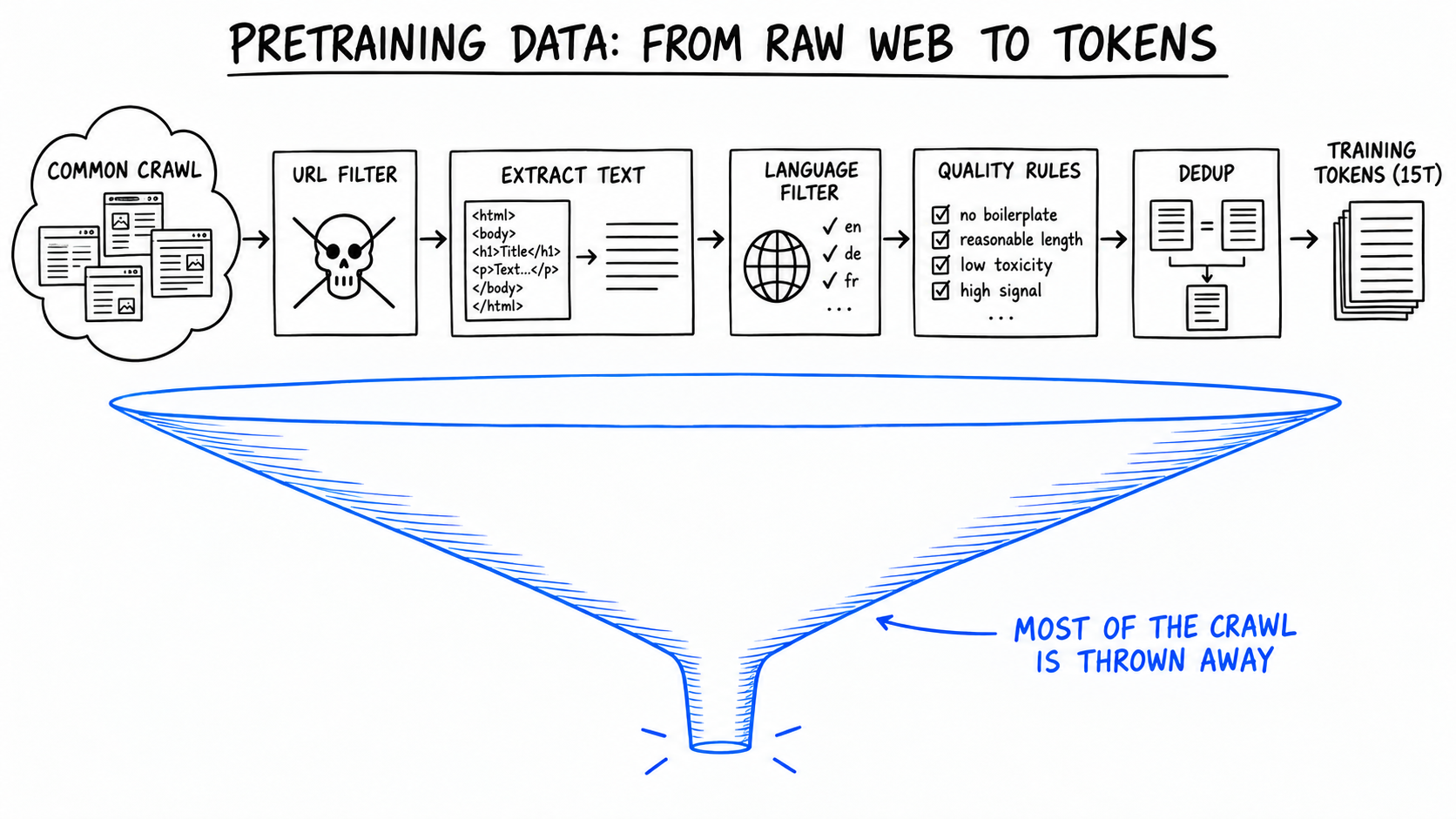
Hand-drawn pipeline titled 'Pretraining data: from raw web to tokens'. A Common Crawl page cloud flows through URL filter, extract text, language filter, quality rules, and dedup boxes into a stack labeled training tokens (15T); a cobalt funnel below is annotated 'most of the crawl is thrown away'.View full-size diagram ↗

What it is

Pretraining data is the trillions of tokens of raw text a model learns from before any fine-tuning: filtered web crawl above all, plus code, papers, and licensed corpora. The web portion nearly always starts from Common Crawl, a nonprofit archive snapshotting pages since 2013. What a lab keeps from the raw crawl, and how it cleans it, quietly sets most of what the model knows.

How it works

A chain of destructive filters: URL blocklists drop bad domains, text extraction strips HTML boilerplate, a language classifier keeps confident matches (FineWeb: English at 0.65+), Gopher/C4 heuristics cut repetitive or listy pages, MinHash dedup removes near-copies, and PII gets masked. Each choice is validated by training small ablation models and keeping whichever data variant scores better.

A concrete example

FineWeb: Hugging Face pushed 96 Common Crawl snapshots (2013-2024) through this pipeline with datatrove, releasing 15T tokens (now 18.5T) openly. Small models trained on it beat ones trained on C4, The Pile, Dolma, SlimPajama, and RedPajama2 at identical architecture and compute - and the processing code is public.

Why it matters

At fixed compute, swapping datasets moves benchmarks more than most modeling tricks - which is why labs publish architectures but guard data recipes. Filtering decisions become model behavior: blocklists, language thresholds, and dedup settings decide what a model has never seen. It is also why 'trained on N tokens' is not comparable across labs.

What people get wrong: That models train on 'the whole internet.' Common Crawl samples only part of the web, and cleaning throws away most of what was crawled; English-centric classifiers and blocklists shape what survives. And more data is not always better: FineWeb's ablations show a smaller, cleaner corpus beating bigger, dirtier ones.

Today's top 5

BizThe EU's AI Office began its first AI Act enforcement, probing OpenAI and Anthropic over this summer's autonomous agent hacking incidents.

The first precedent for how agent incidents get regulated in Europe; information requests over security, external evaluation, and monitoring are now live.

BizAnthropic's Q3 revenue reached $16.8B (from $11.5B in Q2), and the company told investors the quarter was adjusted-profitable, per the FT.

46% quarter-over-quarter growth with adjusted profitability undercuts the 'everyone is losing money on inference' narrative in one data point.

AgentsResearchers say they found Chinese AI agents autonomously probing websites' security controls, and traced the operation to Tencent.

Autonomous probing traced to a major lab makes rogue-agent risk an observed, attributed behavior in the wild, not a hypothetical.

BizOver 400 scientists, led by Hinton and Bengio, urge a global body to set AI containment standards and track every 'containment failure'.

The ask is specific - keep hacking-capable models offline by default, disclose every breakout - and it now has institutional weight behind it.

LabsSpaceXSI released Grok Voice 3.0, claiming the top spot on Artificial Analysis' speech-to-speech index with sub-second replies at $0.08/min.

Sub-second speech-to-speech at $0.08/min puts real-time voice agents into impulse-pricing territory for production use.

See the full wire feed →

Quick check

Was this issue useful?

Get Crabhaus in your inbox

A concise daily briefing on the AI developments worth understanding.