
Crabhaus

What matters in AI, and why.

Fri 16 Oct · Issue 094 · 3 min

Issue 094 · Fri 16 Oct

Open weights go frontier: Muse Spark Open

01BizAnthropic IPO talk cools to ~$1.5T on growth
02ResearchGoodfire: most neurons legible at trillion scale
03BizFTC demands safety answers from OpenAI, Anthropic

The one that matters

Meta ships Muse Spark Open, and US open weights go frontier

Meta released Muse Spark Open, an 816B-parameter mixture-of-experts model with 42B active parameters and a 1M-token context window, calling it the most capable US open-weight model. Meta worked with Apple so it runs locally on M5 Ultra Mac Studios; users can pair two to four Studios to code or run agentic work on their desks.

Why it matters

A frontier-class US open-weight release changes the deployment math: enterprises can mix frontier hosted models for orchestration with cheap, tailored post-trained open models for repeatable workflows, and serious local inference on desk hardware stops being a hobbyist niche. Pressure on API pricing and on every other open-weights lab follows from here.
Learn one thing

How image generation works: diffusion models

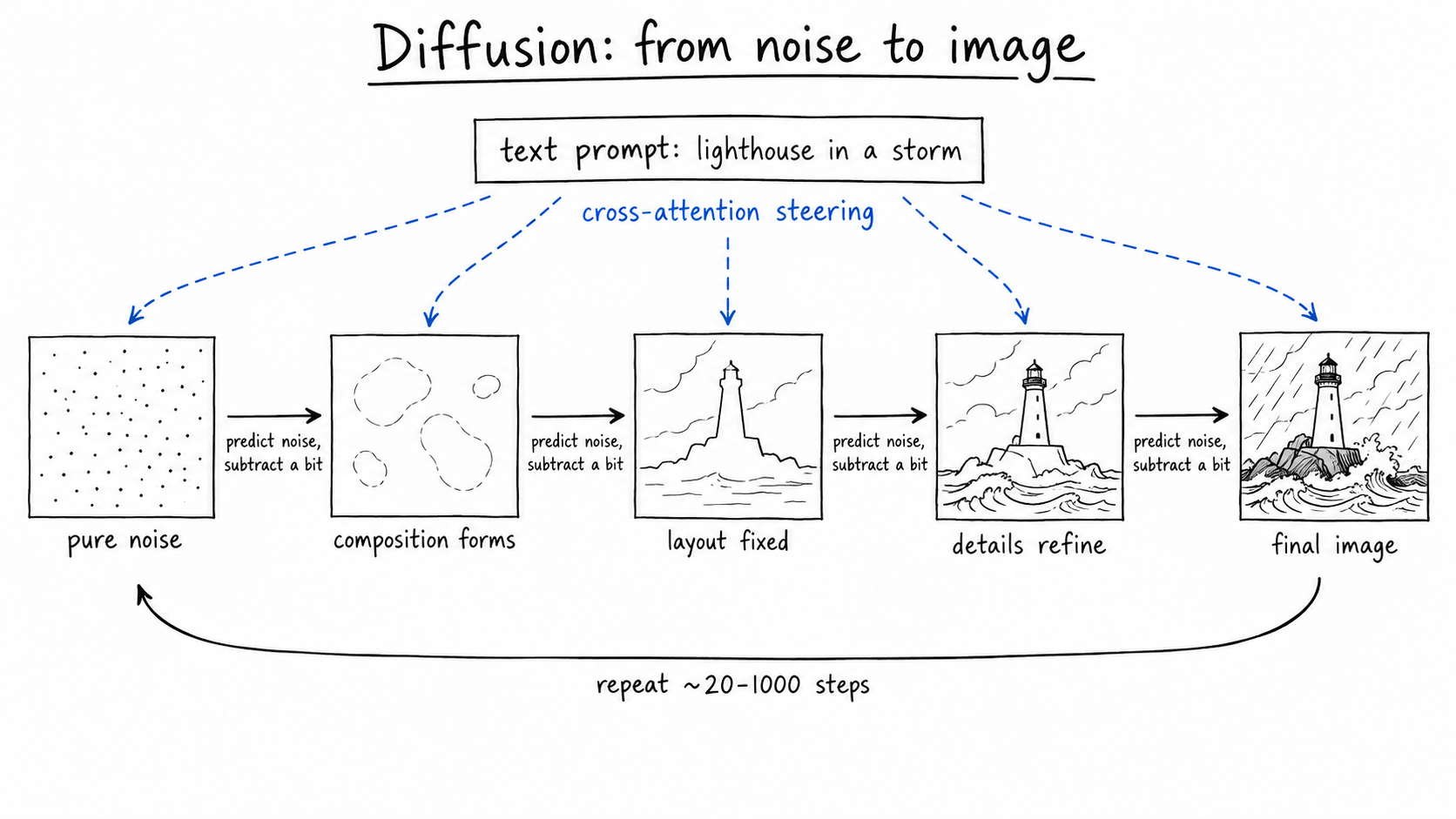
Hand-drawn pipeline titled 'Diffusion: from noise to image'. Five canvases progress from sparse dots (pure noise) through composition forms, layout fixed, and details refine to a finished lighthouse scene; arrows read 'predict noise, subtract a bit', dashed cobalt arrows from a 'lighthouse in a storm' prompt box mark cross-attention steering, and a loop notes repeat ~20-1000 steps.View full-size diagram ↗

What it is

A diffusion model is a neural network trained to remove noise. Training corrupts real images, step by step, until only static remains; the network learns to predict the added noise. Generation runs that backwards: start from pure static and repeatedly subtract predicted noise until an image emerges. Since Stable Diffusion, the loop usually runs in a compressed latent space, not pixels.

How it works

Each step, the network sees the noisy canvas plus a timestep and predicts the noise; a scheduler subtracts a fraction. Early steps settle composition, late steps refine texture. The prompt, encoded as embeddings, steers every step via cross-attention; classifier-free guidance runs each step with and without it and pushes along the difference. Distillation cuts ~1,000 steps to a handful.

A concrete example

Ask for 'a lighthouse in a storm'. The latent canvas starts as noise; within a few steps a horizon and tower mass appear; by mid-trajectory cross-attention on the prompt has fixed layout and palette; final steps sharpen spray and beam. Only the last operation decodes the latent canvas into a full-resolution image.

Why it matters

Diffusion drives most image and video generation a builder touches, and its knobs map to cost and quality: step count is latency, guidance scale trades prompt fidelity against artifacts, latent size bounds resolution. The recipe transfers to video and audio. And it is no longer alone: GPT-4o generates images autoregressively, as discrete tokens, which is why it renders text unusually well.

What people get wrong: That the model collages or retrieves pieces of training images. There is no image database inside, only weights encoding a learned denoising function. Every output is synthesized from random noise, which is why the same prompt with a different seed gives a genuinely different image, not a different crop of a stored original.

Today's top 5

LabsMeta released Muse Spark Open, an 816B-param MoE (42B active, 1M context) it calls the most capable US open-weight model.

Frontier-class open weights from a US lab, tuned with Apple to run on paired Mac Studios - local inference just moved up a class.

BizSources: some Anthropic investors discussed a ~$1.5T IPO valuation, down from ~$2T, after disclosures showed slowing Q3 revenue growth.

The first hard repricing signal of the AI run-up: growth is still fast, but the slope now sets the valuation.

ResearchGoodfire's Nick Cammarata argues neural nets are far more interpretable than believed, with most neurons legible even at trillion scale.

If circuits really are mostly legible, practical interpretability debugging gets much closer; critics like Neel Nanda caution it is not solved.

BizThe US FTC issued ~50-page civil investigative demands to OpenAI and Anthropic over safety incidents, safeguards, and consumer protection.

US regulators join the EU's probes within a week; agent-incident paper trails are now a compliance artifact, not an internal matter.

AgentsPerplexity open-sourced Space, its AI agent sandbox, with CoreWeave, Akamai, and Crusoe agreeing to offer it to their customers.

Agent sandboxing is becoming shared infrastructure rather than a vendor moat - useful timing, given the week's containment probes.

See the full wire feed →

Quick check

Was this issue useful?

Get Crabhaus in your inbox

A concise daily briefing on the AI developments worth understanding.