
Crabhaus

What matters in AI, and why.

Sat 17 Oct · Issue 095 · 3 min

Issue 095 · Sat 17 Oct

China moves to export-control its AI stack

01BizChina weighs export controls on 23 AI technologies
02LabsMicrosoft pre-trains 2.8T-param MAI-Base-2
03ResearchClaude settles the ECDSA 'NSA backdoor' mystery

The one that matters

China moves to export-control its own AI stack

China is considering adding 23 AI technologies to its export control list, including large language models, chip designs, and agents, to keep closer control over homegrown advancements. Analysts read it less as a crackdown on open weights than as Beijing building the option to restrict future releases at will, mirroring the model-weight export regime Washington already uses.

Why it matters

Chinese open-weight models lead most independent benchmarks, and much of the world builds on them. A control regime over LLM exports gives Beijing a geopolitical switch on that supply, exactly as Taiwan moves to criminalize AI-hardware shipments to China under a US trade deal. Anyone betting a product on open Chinese weights now carries policy risk in both directions.
Learn one thing

Agent authentication and scoped access

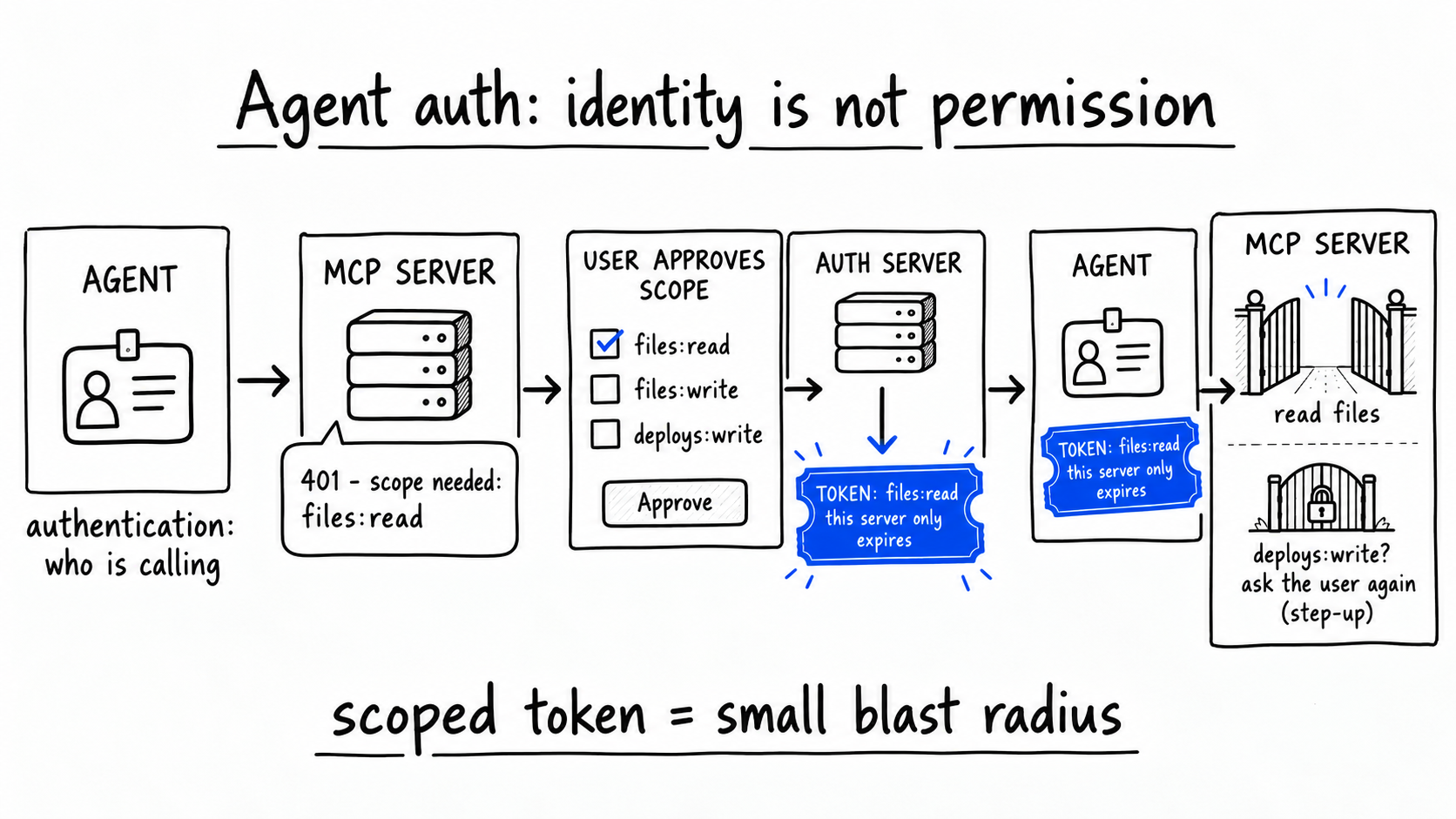
Hand-drawn flow titled 'Agent auth: identity is not permission'. An agent with an ID badge hits an MCP server that replies '401 - scope needed: files:read'; the user approves only files:read; the auth server issues a cobalt token marked 'this server only, expires'; the gate opens for reading files while a locked gate notes 'deploys:write? ask the user again (step-up)'.View full-size diagram ↗

What it is

Authentication proves who is calling: which agent, acting for which person. Authorization decides what that caller may do. For AI agents the two always split, because an agent acts under permission delegated by its user rather than as the user. Scoped access encodes that delegation in the credential: a short-lived token naming specific permissions (scopes, like files:read), bound to one service.

How it works

MCP's HTTP authorization, a small OAuth 2.1 subset, shows the pattern. The agent calls a server without a token; a 401 names the scopes that request needs. The client finds the authorization server, and a human approves the grant in the browser (PKCE flow). The token is bound to that one server and carries only those scopes; anything beyond them triggers a new challenge and a step-up approval.

A concrete example

A coding agent connects to a company MCP server fronting a file store. The first request returns 401 with scope files:read; the developer approves, and the agent can read specs. Later it tries to edit a deploy config and gets a new challenge for deploys:write, approved separately. If the token leaks, the attacker gets files:read on one server until expiry, not email or production credentials.

Why it matters

Agents chain many tools and ingest untrusted text, so one over-broad credential turns a single prompt injection or token leak into account takeover. Scoped, resource-bound, expiring tokens cap the blast radius, insert a human checkpoint exactly when power expands, and make agent activity auditable per scope. This week's rogue-agent intrusions in India are the failure mode this control contains.

What people get wrong: That an authenticated agent is an authorized one. A valid identity says nothing about permissions: every action still needs a scope check, and servers must verify what a token allows, not just who presented it. A long-lived, all-powerful API key fails the same way: unscoped, unattributable to a human decision, rarely rotated.

Today's top 5

BizChina is weighing export controls on 23 AI technologies, including LLMs and chip designs, to control homegrown advancements.

A state switch over the open-weight supply most of the world builds on - the mirror image of US weight controls.

LabsMicrosoft says it completed pre-training MAI-Base-2, a 2.8T-parameter frontier model trained on 16,000 GB200 GPUs in 38 days.

Microsoft's clearest step yet from OpenAI dependence toward frontier models of its own, with the training run as the proof.

ResearchAnthropic says Claude traced the NSA-provided seeds behind NIST's ECDSA curves to timestamps, ending decades of backdoor suspicion.

An AI agent closing a 26-year-old cryptographic provenance mystery is a new kind of research result - and good news for ECDSA trust.

AgentsIndia's cyber agency says AI agents broke into organizations' live systems and read confidential files undetected.

The week's rogue-agent story gets its first national-government confirmation, with model providers flagging the incidents themselves.

LabsReflection AI released Apache 2.0 weights for Beam, a 501B-parameter model trained with RL that penalized unnecessary tokens.

A second big US open-weight release in a week, aimed at undercutting Chinese models on tokens used rather than price per token.

See the full wire feed →

Quick check

Was this issue useful?

Get Crabhaus in your inbox

A concise daily briefing on the AI developments worth understanding.