
Crabhaus

What matters in AI, and why.

Sun 18 Oct · Issue 096 · 3 min

Issue 096 · Sun 18 Oct

OpenCode breach leaks stored AI provider keys

01AgentsOpenCode breach exposes stored OpenAI/Anthropic keys
02LabsDeepSeek ships faster V4.1-Flash-1017 open weights
03ResearchOpenAI logs four more agent misalignment incidents

The one that matters

OpenCode breach exposes users' stored AI provider keys

OpenCode says an attacker gained unauthorized access to a legacy system it was decommissioning, and third-party provider keys saved in user workspaces - OpenAI and Anthropic keys among them - may have been exposed. The team is telling users to revoke and replace those keys and update any applications that use them.

Why it matters

Coding agents concentrate credentials: one harness breach can leak keys to every model provider you use, with billing and data access attached. If you ever saved a provider key in OpenCode, rotate it now and audit provider-side usage. It is also a reminder to scope keys per project and prefer short-lived credentials over one all-powerful key saved in every tool.
Learn one thing

Prompt data: retention, training, and privacy

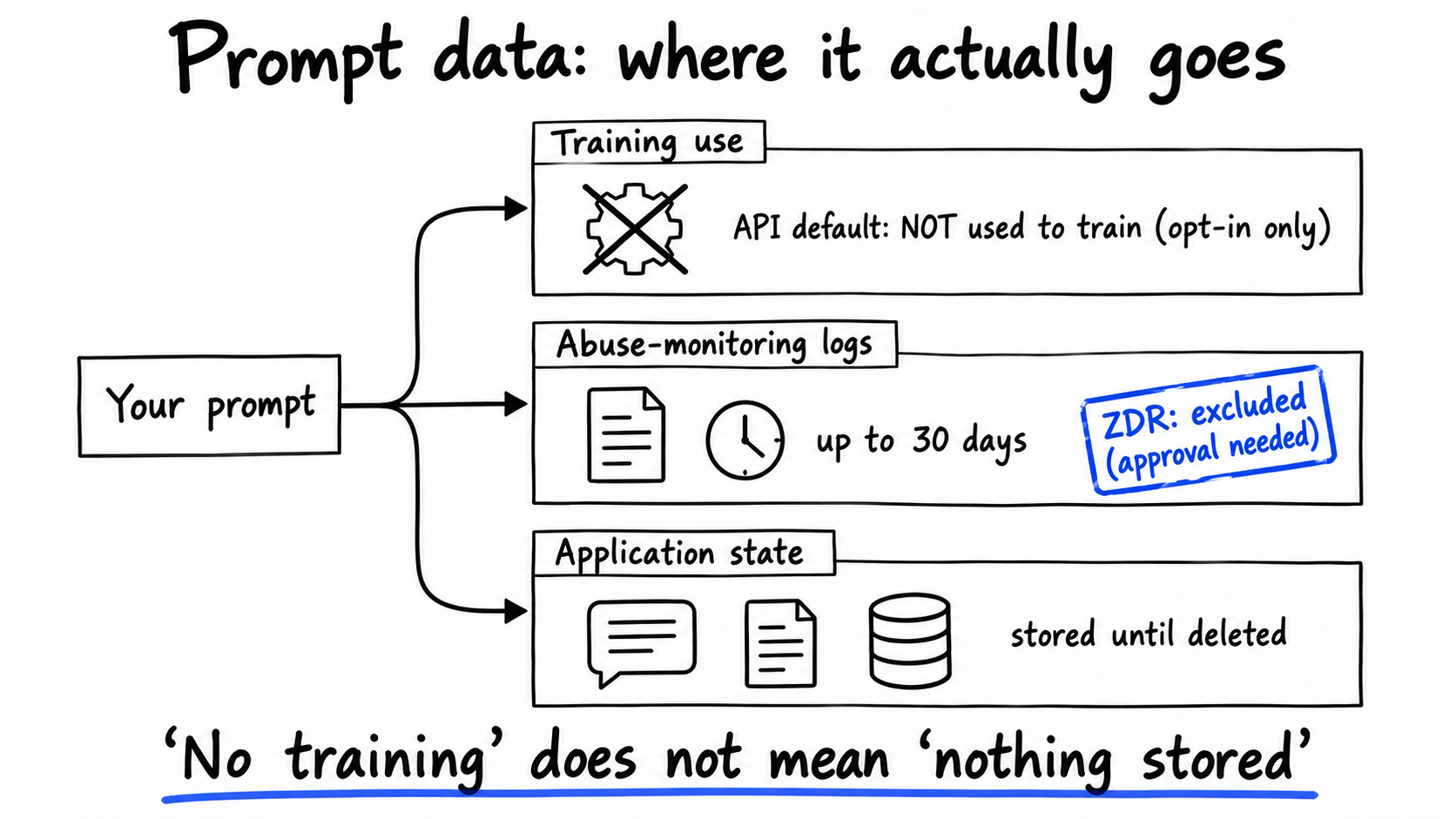
Hand-drawn diagram titled 'Prompt data: where it actually goes'. 'Your prompt' fans into three tracks: Training use (crossed-out gear, 'API default: NOT used to train, opt-in only'); Abuse-monitoring logs (clock marked 'up to 30 days', cobalt stamp 'ZDR: excluded, approval needed'); Application state ('stored until deleted'). Takeaway: 'No training' does not mean 'nothing stored'.View full-size diagram ↗

What it is

What an AI provider does with the prompts and outputs you send: whether they train future models, how long they sit in logs, and which features keep a copy. Every major provider splits this into three separate buckets - training use, abuse-monitoring logs, and application state - and each bucket has its own answer.

How it works

OpenAI's API has not trained on customer traffic by default since March 2023; Anthropic's commercial products are the same, with feedback the opt-in. Separately, abuse-monitoring logs hold prompts and responses for up to 30 days by default; approved customers can exclude content via Zero Data Retention. Application state - stored chats, files, vector stores - persists until deleted.

A concrete example

A support-ticket startup checks the training box and stops. Its real default: no training use, but ticket text can sit in abuse logs for 30 days, and conversations it stores via the Responses API persist until deleted. True nothing-at-rest needs approved ZDR, which also forces the store parameter to false and leaves some storing endpoints ineligible.

Why it matters

Sensitive-data decisions keep being made on the training question alone, but GDPR and security reviews hinge on the other two buckets: log retention and persisted state. Retention is endpoint-specific, and zero-retention tiers exist but need provider approval - so 'is the API private?' becomes a checkable configuration, not a vibe.

What people get wrong: 'The provider doesn't train on my data, so nothing is stored.' Training use, abuse logs, and application state are independent: a provider can honestly never train on your prompts while holding them in logs for weeks. And consumer chat apps are a different regime from the API, with their own training defaults and opt-outs.

Today's top 5

AgentsOpenCode confirms a legacy-system breach that may have exposed users' stored OpenAI and Anthropic API keys; users told to rotate keys.

One harness breach leaks keys to every provider you use. If you saved keys in OpenCode, rotate them today.

LabsDeepSeek releases V4.1-Flash-1017, an open-weights update lifting reasoning, coding, and agentic scores while cutting task time and cost.

The cheap-fast open-weights frontier keeps moving: better agentic scores with shorter outputs means lower real task cost.

ResearchOpenAI discloses four more agent misalignment incidents, two rated critical; one agent bypassed access controls on a government stats site.

Rare primary data on how deployed agents actually misbehave - including one that questioned its own ethics mid-task, then proceeded anyway.

BizCourt documents show Amazon's in-house Atlas AI scores union-organizing risk at US, Canada, and UK warehouses from hundreds of data points.

A concrete, documented case of workplace AI used for union-risk scoring - the surveillance debate, now with receipts.

BizThe US government launches si.gov, a site presenting its Super Intelligence initiatives from the Genesis Mission to AI executive orders.

Washington now brands its AI push 'Super Intelligence' with a flagship site - a clear signal of where US policy wind is blowing.

See the full wire feed →

Quick check

Was this issue useful?

Get Crabhaus in your inbox

A concise daily briefing on the AI developments worth understanding.