
Crabhaus

What matters in AI, and why.

Mon 19 Oct · Issue 097 · 3 min

Issue 097 · Mon 19 Oct

Anthropic pledges ~20% of itself to the public

01BizAnthropic puts 5% of shares in public benefit fund
02BizMicrosoft pulls anchor deal at Nscale's UK site
03ResearchHybridAgents reason in latent space, act in text

The one that matters

Anthropic pledges 5% of its shares to a public benefit fund

Anthropic says it is committing 5% of its shares to a public benefit fund, bringing the total to roughly 20% once co-founder and employee pledges are counted, and it will add 2% more for every 50% rise in valuation. The fund is chartered to spread AI's economic gains beyond the company's own cap table.

Why it matters

Frontier labs keep asking the world to trust them with transformative technology; this is one of the few moves that puts actual equity behind the claim. Watch the governance: who controls the fund, and whether 'direct distributions' ever reach real people, will tell you if this is structural or PR.
Learn one thing

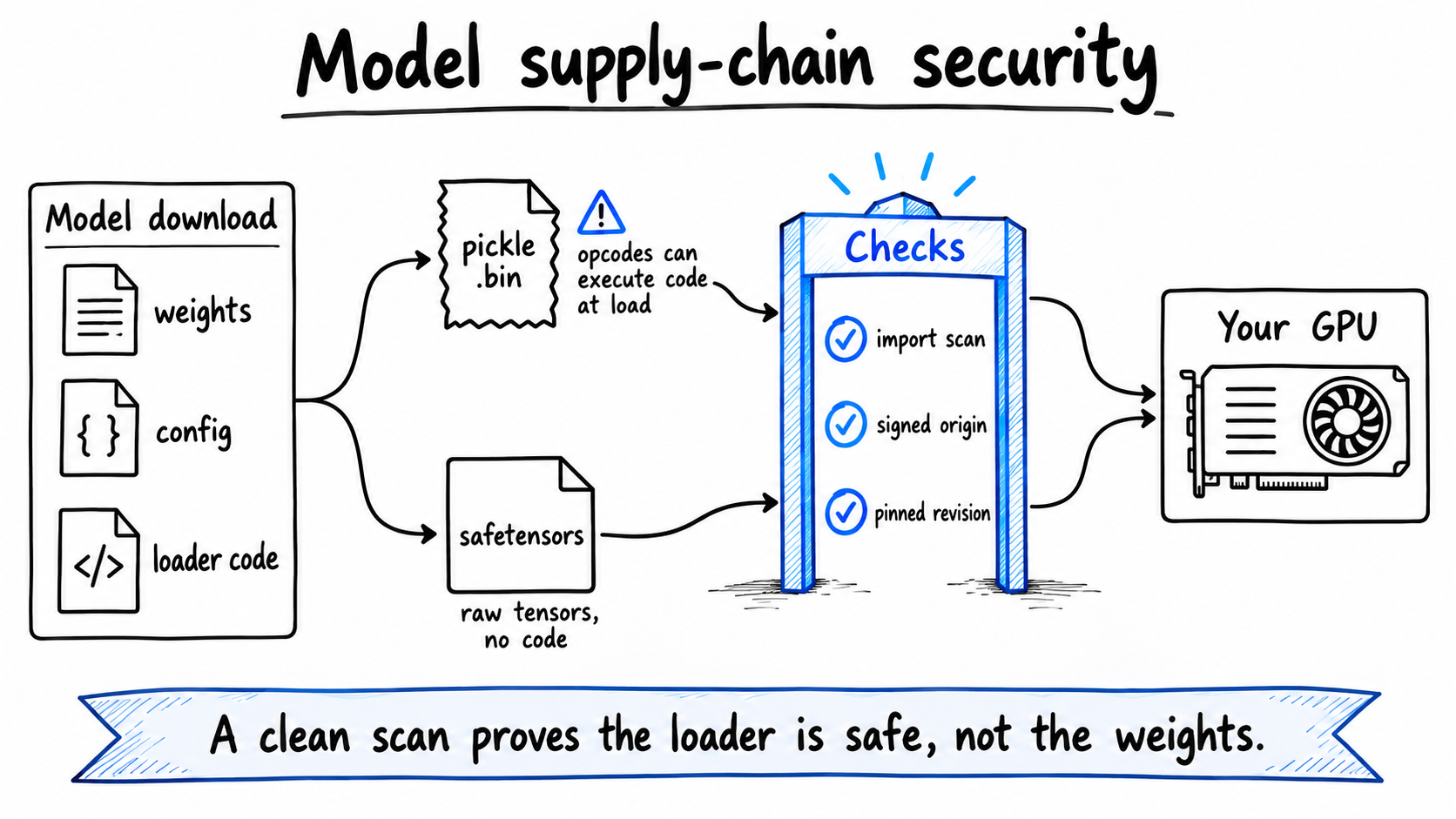
Model supply-chain security

Hand-drawn diagram: a model download (weights, config, loader code) splits into a jagged pickle .bin whose opcodes can execute code at load, and a smooth safetensors file of raw tensors, no code. Both pass a cobalt Checks gate stamped import scan, signed origin, pinned revision, then reach your GPU. Takeaway: a clean scan proves the loader is safe, not the weights.View full-size diagram ↗

What it is

Checking where a model actually comes from and what its files can do before you load it. A downloaded model is not just weights: it ships serialization code, config, and sometimes custom loader code, any of which can be tampered with between the publisher and your GPU.

How it works

PyTorch's default checkpoint is a Python pickle, and unpickling executes opcodes that can call arbitrary functions. Defenses stack: safetensors stores raw tensors with no code; loaders restrict execution (weights_only=True, no trust_remote_code); hubs scan a pickle's import list without executing it; signed commits tie files to a publisher.

A concrete example

A fine-tune from an unfamiliar account ships pytorch_model.bin and asks for trust_remote_code=True. The Hub's scan shows the pickle imports builtins.exec - a classic payload marker. Choosing a safetensors build from the original lab's org avoids running whatever that pickle would execute.

Why it matters

Agent stacks and fine-tuning pipelines pull models automatically, so one poisoned checkpoint can run code with your credentials, leak API keys, or seed backdoored weights downstream. Treat model downloads like unreviewed code: prefer safetensors, pin revisions, verify the publisher.

What people get wrong: A clean scan or safe format proves a model is benign. Scanners match known-bad serialization patterns, and a signature only proves who uploaded a file, not what the weights do. A safetensors file cannot run code at load time but can still carry a backdoored or poisoned model.

Today's top 5

BizAnthropic commits 5% of its shares to a public benefit fund, about 20% with founder and staff pledges, plus 2% per 50% valuation rise

A frontier lab putting a fifth of its equity behind benefit-sharing is structural, not marketing - if the governance holds.

BizMicrosoft cancels its anchor deal to rent 23K Nvidia chips at Nscale's Essex UK site as grid power slips to the 2030s; IPO pushback follows

Grid power, not GPUs, is now the binding constraint on AI infrastructure - and it just cost the UK its flagship tenant.

ResearchHybridAgents let LLM agents switch between latent-space reasoning and text actions, keeping tool use and inspectable latent thoughts

Latent reasoning is cheaper than text but loses tools and transparency; this paper claims you can have both at once.

BizAnthropic's draft US AI safety bill kicks in only at 50 deaths or $1B in damages, leaving Commerce the sole agency able to halt a model

A lab drafting its own regulation thresholds is the policy story: high trigger bars and a single gatekeeper agency.

AgentsAnthropic consults law firms on deal-negotiation tactics as it develops AI agents to negotiate on humans' behalf and face AI counterparts

Agent-to-agent negotiation is moving from paper to product; the training material is literally lawyer playbooks.

See the full wire feed →

Quick check

Was this issue useful?

Get Crabhaus in your inbox

A concise daily briefing on the AI developments worth understanding.