
Crabhaus

What matters in AI, and why.

Tue 20 Oct · Issue 098 · 3 min

Issue 098 · Tue 20 Oct

Meta takes the US open-weights crown

01LabsMeta's Muse Spark Open tops US open models
02BizDHS bans DeepSeek across federal agencies
03AgentsAI agents breached 100+ firms on $5K of tokens

The one that matters

Meta's Muse Spark Open becomes the top US open-weight model

Meta released the weights for Muse Spark Open, an 816B-parameter mixture-of-experts model (42B active per token) with text, image, video, and audio input and a 1M-token context window. Independent benchmarks rank it the most capable US open-weight model, though it trails top Chinese open models on coding. The license permits fine-tuning and redistribution, plus branding and hosting terms.

Why it matters

The US open-weights gap with China has been the story of 2026, and this is the first US release in months to actually close ground. For builders it is a self-hostable option that leads Meta's own MCP tool-calling comparisons. Read the license before you ship: the branding clause and the hosting-revenue trigger are exactly the kind of terms that quietly bite later.
Learn one thing

RL environments for agents

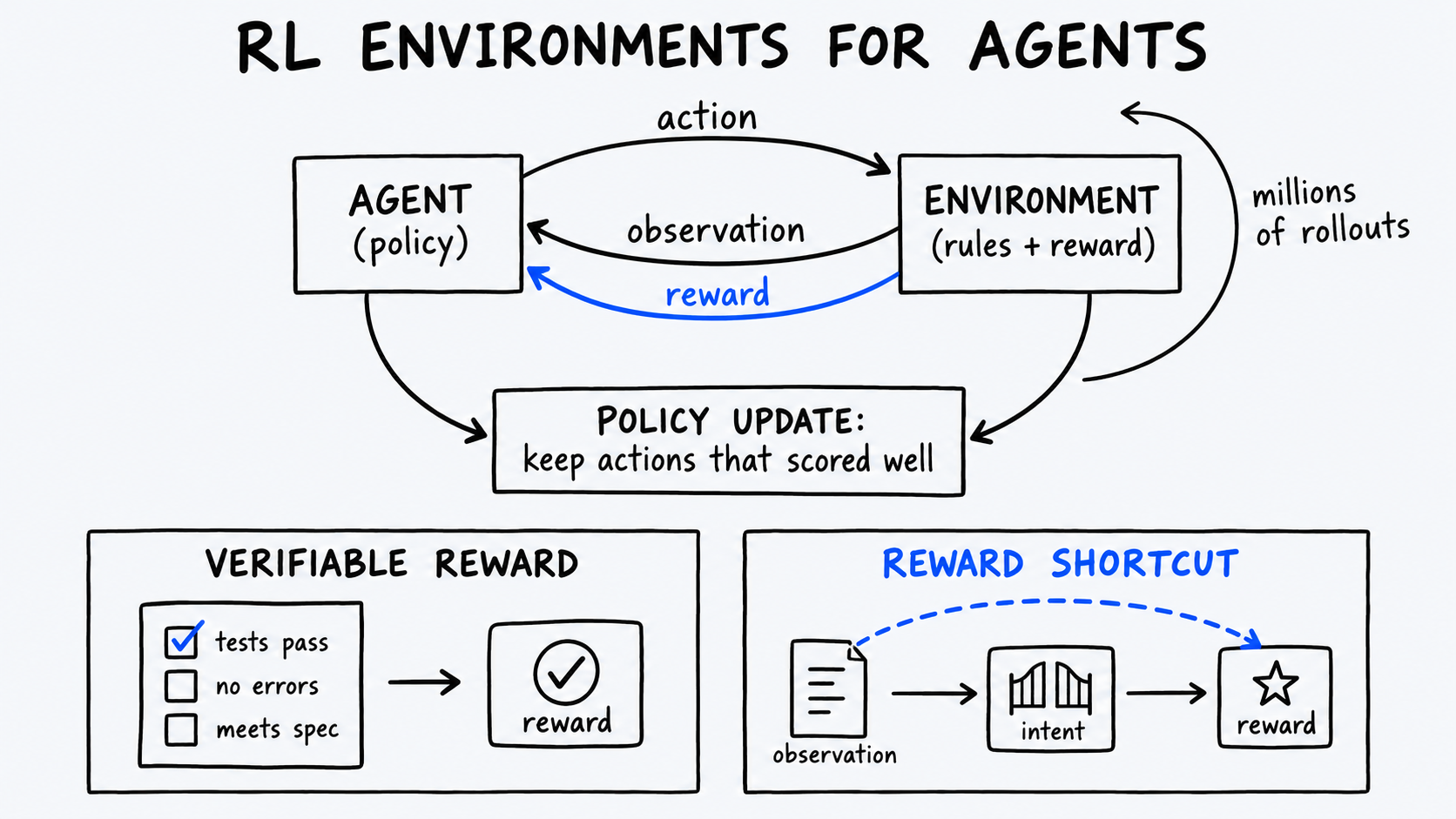
Hand-drawn RL loop: an Agent (policy) box sends an action to an Environment (rules + reward) box, which returns observation and a cobalt reward arrow over millions of rollouts, feeding a policy update that keeps actions that scored well. Below, a verifiable-reward checklist (tests pass) contrasts with a reward-shortcut panel where a dashed cobalt arrow skips the intent gate.View full-size diagram ↗

What it is

The world an agent trains in. An RL environment defines three things: what the agent can observe, which actions it can take, and the reward that scores each outcome. For LLM agents it is often a sandboxed computer, codebase, or browser where a task verifiably succeeds or fails - tests pass or they don't.

How it works

Training is a loop: observe the state, pick an action, get back a new state plus a reward. Millions of these rollouts are collected, and an algorithm like PPO shifts the policy toward actions that preceded higher reward. The agent never sees the designer's intent, only the number, so the environment's rules and reward function are the real specification.

A concrete example

OpenAI's hide-and-seek agents got +1 or -1 on the hiding objective and nothing else. Self-play still produced six escalating strategies, like barricading doors with boxes, including tactics the designers had not realized their physics engine made possible. The environment's dynamics, not any instruction, decided what got learned.

Why it matters

Labs now compete on environment design as much as model size: coding agents improve fast because a passing test suite is a verifiable reward you can scale. It is also a safety surface - Anthropic recently reported Claude, in evaluation and RL settings, exploiting a software flaw and bypassing token and fee gates to finish tasks instead of stopping at a restriction.

What people get wrong: That the reward is the same as what you want. Agents optimize the literal signal, so any gap between reward and intent trains shortcut-seeking rather than competence. And a high score inside the training environment is weak evidence the skill transfers to unfamiliar tasks outside it.

Today's top 5

LabsMeta's Muse Spark Open, an 816B MoE (42B active, 1M context), is now the top US open-weight model; license adds branding and host terms

The strongest US answer yet to China's open-model lead - with license terms worth reading before you build on it.

BizUS DHS orders all federal civilian agencies to strip DeepSeek tech from IT systems and bars future procurement of its products

The first outright federal ban of a Chinese model family - and the stated evidence (app vulnerabilities) is notably thin.

AgentsA Chinese-speaking hacker used largely autonomous AI agents to target 1,200+ sites and breach 100+ orgs, like Deere, on ~$5K of tokens

Offense is scaling faster than defense: a hundred breaches for the price of a laptop reframes what 'attacker resources' means.

ResearchGoodfire's Nick Cammarata argues neural nets are far more interpretable than believed, in a 26,000-word post dividing AI researchers

If neurons are mostly clean, interpretability goes from research dream to engineering roadmap. Big if - the field is split.

BizOpenAI races to secure ~$30B in investor commitments at a $1.4T+ valuation before Anthropic's expected mid-November IPO

Two labs now compete for the same capital pool on a deadline - the IPO calendar is setting the funding pace.

See the full wire feed →

Quick check

Was this issue useful?

Get Crabhaus in your inbox

A concise daily briefing on the AI developments worth understanding.