
Crabhaus

What matters in AI, and why.

Wed 21 Oct · Issue 099 · 3 min

Issue 099 · Wed 21 Oct

Anthropic opens its books

01BizAnthropic S-1: $16.3B revenue, $80.7B paper loss
02AgentsDeepSeek open-sources its inference engine
03AgentsGoogle's TorchTPU runs PyTorch natively on TPUs

The one that matters

Anthropic opens its books: $16.3B revenue, an $80.7B paper loss, and a $750B compute bill

Anthropic's draft IPO prospectus, seen by the WSJ, shows H1 2026 revenue of $16.3B, up from $1.1B a year earlier, with about 20% from just two customers, and an $80.7B net loss driven by accounting charges. Compute commitments run to roughly $750B over the coming years across Google, AWS, Microsoft, Broadcom, Nscale, and Lambda, with $150B more under negotiation.

Why it matters

These are the first hard numbers behind the IPO the whole industry is pricing off. 15x revenue growth in a year is the bull case; the loss line is mostly paper, but three-quarters of a trillion dollars in compute commitments is real cash that has to come from somewhere. Expect every AI-budget and valuation conversation for the next month to start from this table.
Learn one thing

Reading model cards and system cards

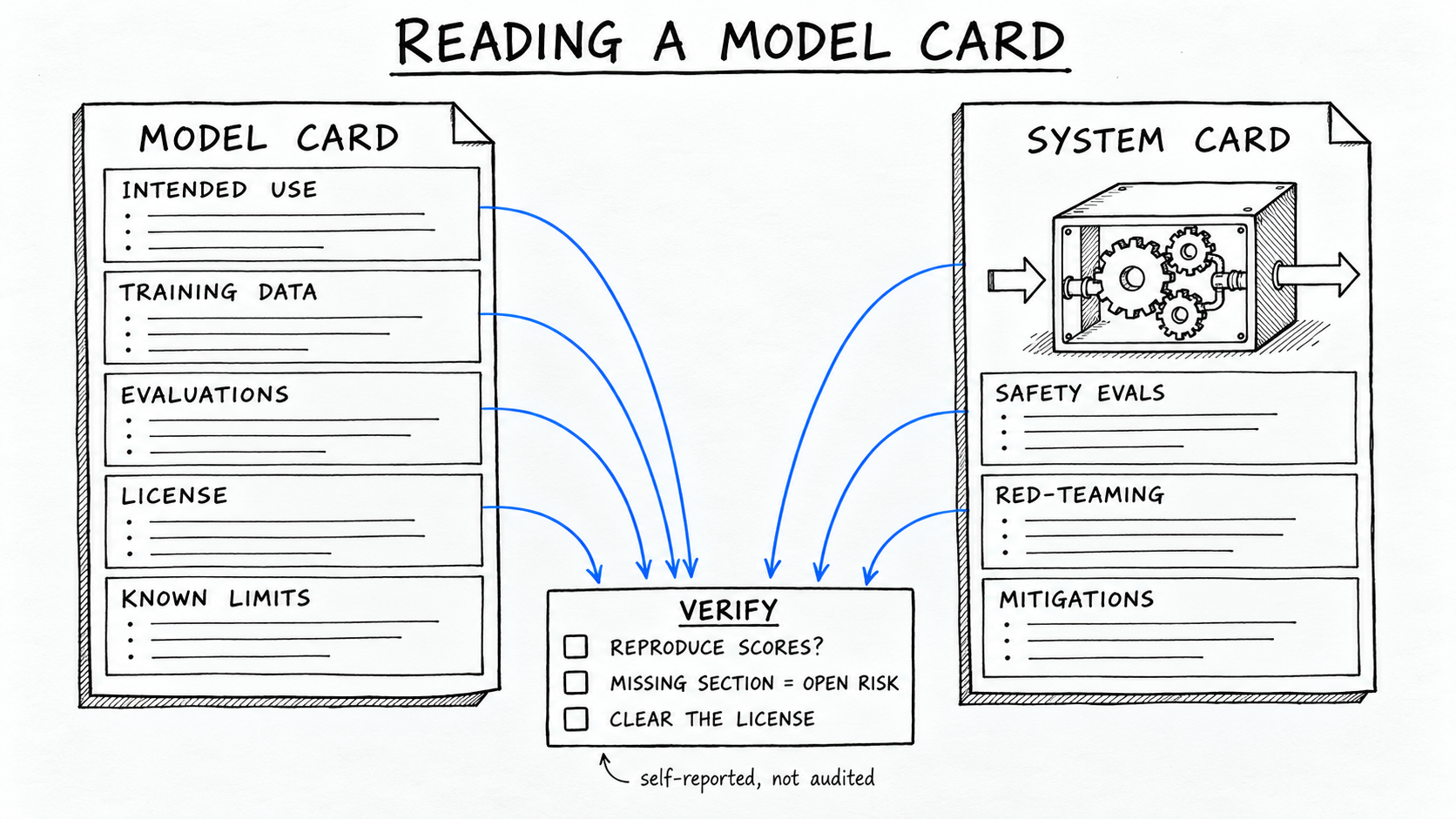
Hand-drawn diagram titled Reading a model card. A model card lists intended use, training data, evaluations, license, and known limits; a system card shows a gear-box product sketch with safety evals, red-teaming, and mitigations. Cobalt arrows converge on a verify checklist - reproduce scores, missing section = open risk, clear the license - annotated self-reported, not audited.View full-size diagram ↗

What it is

A model card is the disclosure document shipped with a model: intended uses, training-data summary, evaluation results, license, and known limits. A system card covers the deployed product built around a model - safety evaluations, red-teaming findings, and the mitigations wrapped around the whole system rather than the raw weights.

How it works

Read in a fixed order: intended and out-of-scope use (where the model was never validated), evaluations (which benchmarks, run by whom, with what methodology), training-data disclosure (what is omitted is itself information), license terms, then known limitations and mitigations. Everything is self-reported; nothing is independently audited unless the card says a third party was involved.

A concrete example

Before shipping a Hugging Face model, check three fields: the license block (can you serve it commercially), the eval table (author-run or an external harness), and the bias and limitations section (is it empty). OpenAI's deep research system card is the deployment-side version: documented prompt-injection and autonomy risks plus shipped mitigations - the list to re-test in your own integration.

Why it matters

Model launches arrive daily - three in today's issue alone - and cards are usually the only structured disclosure at release time. Reading them well turns marketing claims into checkable statements: results you can reproduce, missing sections you treat as open risks, and license terms you clear before writing code against a model.

What people get wrong: That a card is a guarantee or an audit. It is vendor-authored: benchmark results are not independently verified, and a missing safety section does not mean the risk is absent, only that it is undisclosed. Treat cards as claims to verify, not certificates.

Today's top 5

BizAnthropic's draft IPO prospectus: H1 2026 revenue $16.3B vs $1.1B a year ago, an $80.7B accounting-driven net loss, ~$750B compute plans

15x revenue growth meets a $750B compute bill - the numbers the whole IPO cycle will be priced against.

AgentsDeepSeek open-sources DeepInfer, the inference framework behind its production API, citing 155T tokens/day per cluster; runs on Huawei chips

Open weights were never the expensive part. Sharing the serving stack is what actually cuts the cost of running open models.

AgentsGoogle open-sources TorchTPU, a native PyTorch backend for TPUs, letting AI apps leave Nvidia with a config change instead of a rewrite

The CUDA moat is code, not chips - a config-change escape hatch for PyTorch apps is aimed straight at it.

LabsMistral's Voxtral 3 pairs new speech-to-text and TTS models with a voice-agent SDK for real-time, tool-calling agents in 50+ languages

Voice agents move from demo to SDK: one streaming pipeline for listening, reasoning, tool calls, and speech.

BizSpaceX Q3 AI revenue grew 830% YoY to $7.56B with $431M operating income, overtaking Starlink connectivity as its largest segment

AI is now SpaceX's largest business line - 830% growth in a year says the compute land-grab is not slowing.

See the full wire feed →

Quick check

Was this issue useful?

Get Crabhaus in your inbox

A concise daily briefing on the AI developments worth understanding.